




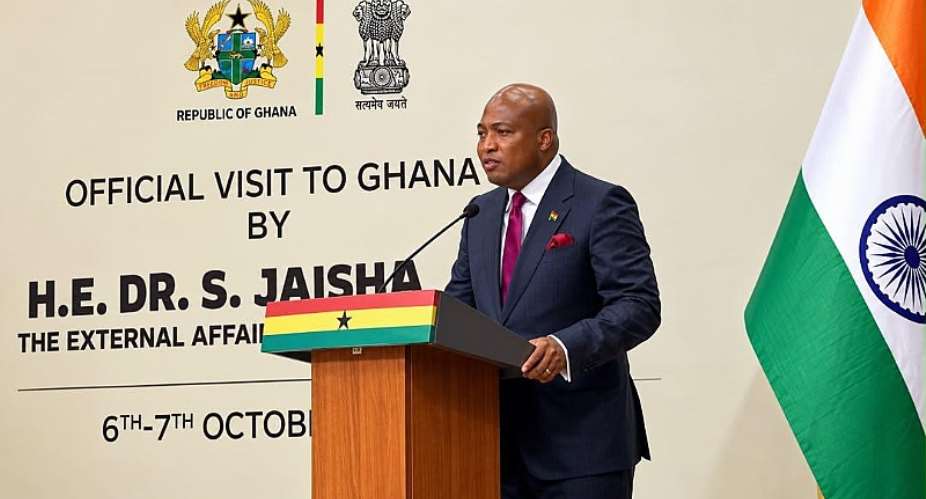
The government has secured Cabinet approval for Ghana to formally apply to join BRICS, a move Foreign Affairs Minister Samuel Okudzeto Ablakwa says will broaden the country’s international partnerships and create additional opportunities for economic development.
Mr Ablakwa announced the decision in Accra on Tuesday, October 6, saying the proposed membership forms part of the Mahama administration’s strategy to move Ghana beyond economic stabilisation towards long-term transformative growth.
“Another major highlight which I am disclosing to the Ghanaian people for the first time is that the Cabinet of President John Dramani Mahama has decided that Ghana should put in a formal application to join BRICS,” he said.
The Minister said the decision was also linked to the government’s broader “new economy” agenda, which is built around seven pillars and seeks to attract investment, create jobs, promote industrialisation and ensure that Ghana derives greater value from its natural resources.
He stressed that joining BRICS would not mean Ghana was abandoning its existing development partners, including the International Monetary Fund (IMF), the World Bank and African multilateral financial institutions.
“You do know that we are members of the IMF, we are members of the World Bank, and we are also founding members of the African multilateral financial institutions.
”But BRICS offers us that opportunity to have options in development, and you want to have options,” he said.
According to Mr Ablakwa, Ghana intends to retain its longstanding relationships while establishing new partnerships with countries that can contribute to its economic transformation.
“We are not going to walk away from our traditional partners who value that relationship, but we must have new friends,” he said.
He identified India, Brazil and China as important partners for Ghana, pointing to the expansion of trade between Ghana and India, which he said had increased from about US$3 billion in 2024 to approximately US$7 billion.
“So this is an important partner,” he said, adding that China also remained a major economic player in Ghana.
Mr Ablakwa said greater engagement with BRICS countries would strengthen Ghana’s cooperation with the Global South and support the government’s objective of building a more productive and self-reliant economy.
He said the government wanted to promote “resource sovereignty” by ensuring that Ghana was able to participate more equally in the exploitation of its natural resources rather than continuing to export raw materials without adding sufficient value.
“We want resource sovereignty where we can be treated as equal partners. We don't want a situation where we continue to export raw materials.
“We want to add value to the natural resources that we have. And we want to work with partners who have the same shared history and shared commitments,” he said.
The Foreign Affairs Minister also argued that having a wider range of international partners could create greater competition and give Ghana more room to determine its own development priorities.
He said the government supported a multipolar international system in which countries had greater freedom to pursue development strategies suited to their circumstances, without being excessively constrained by conditions from a limited number of international institutions.
Mr Ablakwa said preparations were underway for Ghana’s formal application, after which the government would engage existing BRICS members to seek support for the country’s bid.
He noted that Ghana already maintained diplomatic and bilateral relations with the bloc’s founding members — Brazil, Russia, India and China — as well as its newer members.
The Minister also highlighted the longstanding relationship between Ghana and India, particularly the historical ties between Ghana’s first President, Dr Kwame Nkrumah, and India’s first Prime Minister, Jawaharlal Nehru.
He said the two leaders played significant roles in the development of the Non-Aligned Movement and that Ghana and India had maintained cooperation in multilateral affairs since Ghana’s independence.
Mr Ablakwa disclosed that Ghana had formally sought India’s support for its BRICS application and said the government was encouraged by comments from India’s Minister of External Affairs, Dr Subrahmanyam Jaishankar, who was in Accra on an official visit.
Dr Jaishankar said India understood Ghana’s interest in joining the bloc and had consistently supported Ghana’s aspirations and development objectives.
He said Ghana’s interest was understandable given the principles underpinning BRICS, describing the bloc as a grouping of countries from diverse regions that value independence of thought and freedom of choice.
“BRICS itself is a gathering of countries who have a strong independence of thought, who want to have a freedom of choice, who believe that they’re coming together from very diverse geographies strengthens each one of them when they are part of a collective,” he said.
Dr Jaishankar said the bloc’s objectives could appeal to countries across different geographical regions, while making clear that Ghana’s application would ultimately require consideration by all BRICS members.
“Obviously, this is an issue of collective consideration. So we have to see how that goes forward,” he said.
BRICS began as BRIC, comprising Brazil, Russia, India and China, and was formalised at the first meeting of BRIC foreign ministers on the sidelines of the United Nations General Assembly in New York in 2006.
The first BRIC Summit was held in Yekaterinburg, Russia, in 2009, while South Africa joined the grouping in 2011, giving rise to the BRICS acronym.
The bloc subsequently expanded in January 2024 with the admission of Egypt, Ethiopia, Iran, Saudi Arabia and the United Arab Emirates, followed by Indonesia in January 2025.
BRICS currently has 11 full members: Brazil, China, Egypt, Ethiopia, India, Indonesia, Iran, Russia, Saudi Arabia, South Africa and the United Arab Emirates.
In 2025, Belarus, Bolivia, Kazakhstan, Cuba, Malaysia, Nigeria, Thailand, Uganda, Uzbekistan and Vietnam joined the grouping as partner countries.
The bloc serves as a platform for consultation and cooperation among member countries on global and regional political and economic issues, including discussions on reforms to international governance institutions.
 EOCO returns seized £6,700, ¢2,750 cash, phones and laptops to Hanan Abdul Wahab
 Africa launches own credit agency in bid for cheaper borrowing
 'We want new friends who'll treat us as equal partners' — says Foreign Affairs M...
 ‘Let’s not be too hard on civil Society groups who are still critical of us’ — A...
 Trump says he will speak to Putin over reported plague death in Russia
 'I will not share NPP strategies with my twin brother Alhassan Abanga in NDC' — ...
 Afenyo-Markin insists National Cathedral should be completed
 ‘GoldBod’s structure encouraging galamsey, buys whatever aggregators bring’ – Af...
 Mahama holds discussions with India's External Affairs Minister
 Afenyo-Markin cautions NPP members against acts that undermine the party


