




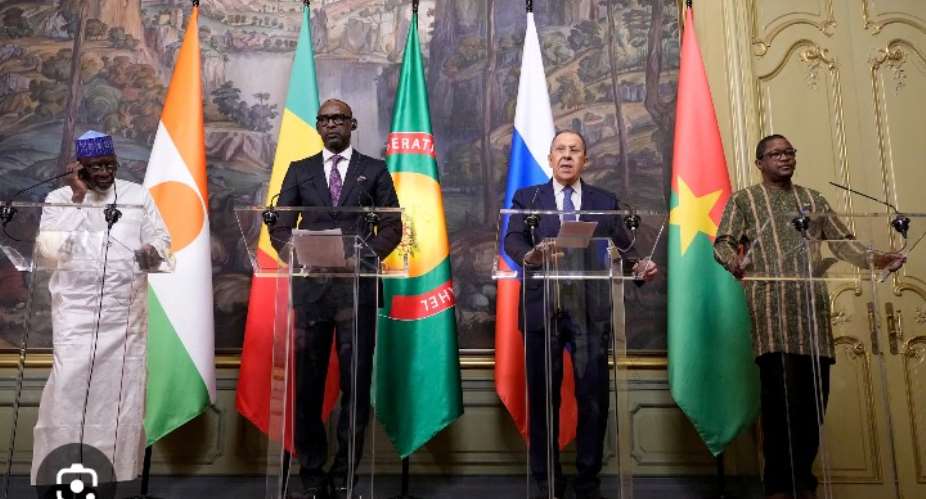
Two announcements in early October showed where Moscow's Sahel policy is heading. On 29 September, Uranium One Group, a subsidiary of Russia's state nuclear corporation Rosatom, told TASS it plans to build a lithium mine and processing plant at Bougoula in southern Mali.
A feasibility study is due in 2027 and construction in 2028. Days later, Russia's energy minister, Sergei Tsivilev, was reported to have met General Abdourahamane Tiani in Niamey, at the first session of a new Russia–Niger intergovernmental commission, with a large delegation of officials and businessmen.Read together, the two stories suggest the Sahel is being offered a new patron with a familiar appetite.
A promising number, not yet a mine
Rosatom says its geologists have surveyed more than 200 square kilometres over two years and raised the Bougoula resource by half, to the equivalent of 458,000 tonnes of lithium carbonate. That figure is in the "inferred" category, the least certain tier under the JORC reporting standard. It is a lead, not a proven reserve.
Timelines have also slipped. In September 2024, Mali's finance minister said the project could yield its first lithium within 24 months.That window has now closed, and the project is still at the planning stage. Rosatom says it hopes to attract investors from "friendly countries".
The design matters as much as the schedule. The plant is meant to produce spodumene concentrate, a raw material shipped abroad to be turned into battery-grade lithium. The higher-value steps in the chain, including chemicals, cells and vehicles, would happen elsewhere. A Malian mine feeding a foreign processor would repeat the old pattern of extraction without industrialization.
Gold, and who holds the keys
Supporters of the partnership can point to gold. According to the analysis I reviewed, Mali broke ground in June 2025 on a 200-tonne refinery near Bamako with Russia's Yadran Group, with the Malian state holding 62 per cent and Yadran 38 per cent.
Local refining is the kind of value addition African governments have long demanded, and on paper it is a better deal than most the region has been offered.
The details deserve scrutiny, however. The plant's stated capacity is far larger than Mali's own output, and Yadran's president has said it should serve neighbouring countries too.
A minority partner that helps the plant win international certification, something Malian refineries have never obtained, holds influence out of proportion to its stake.
These points come from a single briefing and I could not independently verify them, so they should be checked against primary sources.
Niger: mapping before mining
In Niger, Moscow's approach looks quieter but potentially more consequential. The same briefing reports that Tsivilev called for systematic geological exploration and mapping of Niger's resources, and that Niger's new state uranium company signed a memorandum with Uranium One in December 2025 covering permits and exploration.
This follows the junta's break with Western operators, including the revocation of French company Orano's permit at Imouraren and the nationalisation of the Somaïr mine.
Sovereignty over the ground is one thing. Control of the geological data is another.
Whoever maps the deposits learns first where the value lies and is best placed to bid for it.
The security half of the bargain is wobbling
Russia's mining push was sold alongside a security guarantee. That guarantee has been tested. On 25 April, an al-Qaeda affiliate, JNIM, and Tuareg separatists launched a coordinated offensive in Mali. Defence Minister Sadio Camara, a central architect of the Bamako–Moscow rapprochement, was killed in an attack on his residence in Kati.
Tuareg rebels said they had agreed terms allowing Russia's Africa Corps to withdraw from Kidal, a city it helped Mali recapture in 2023. Mali's army said fighting continued, and Russian state media gave a different account of the battle.
When the security side of a deal falters while the extractive side advances, Malians and Nigeriens are entitled to ask who benefits most.
A fair counterpoint
Moscow did not invent the Sahel's extractive economy. Niger's uranium left the country through French-linked operators for decades. In Mali, the largest lithium mine, Goulamina, is 65 per cent owned by China's Ganfeng and 35 per cent by the state.
Russia is one bidder among several. What distinguishes it is the pairing of mining deals with regime-protection, an arrangement that looks much like the one the juntas said they were leaving behind.
What Africa should demand
Russian officials say they want to go beyond extraction and help build processing capacity. That promise can be tested. Mali and Niger can ask for the following:
Publication of the Bougoula, refinery and uranium contracts.
Open tenders in which Russian, Chinese, Turkish, Indian and African firms compete.
Local-refining targets written into licences, with penalties for missing them.
Geological data shared with national surveys and universities, not held only by ministers and foreign partners.
The Russia–Africa Summit opens in Moscow on 28 October, according to the briefing. African delegations will be handed memoranda there.
Governments that broke with old patrons in the name of dignity should make sure the new partnership does not simply ask fewer questions. They should read the fine print twice.
Mustapha Bature Sallama
Medical/ Science Communicator,
Private Investigator, Criminal Investigation and Intelligence Analysis,
International Conflict Management and Peacebuilding. (USIP)
[email protected]
+233555275880
References
TASS, "Rosatom to build lithium mine in Mali," 29 September 2026: https://tass.com/economy/2194593
Uranium One Group release on Bougoula resource increase (inferred category, JORC), reported by 1ru.ru, 29 September 2026: https://www1.ru/en/news/2026/09/29/439079-v-mali-nasli-potencial-dlia-promyslennogo-proizvodstva-litievogo-syria-rosatom-gotovit-proekt-goka.amp.html
Reuters, "Russia, Mali discuss joint lithium and solar projects," 26 September 2024: https://www.mining.com/web/russia-mali-discuss-joint-lithium-and-solar-projects/
Reuters via BusinessDay, "Mali's defence minister reported killed as jihadists storm major centres," 26 April 2026: https://www.businessday.co.za/world/2026-04-26-malis-defence-minister-reported-killed-as-jihadists-storm-major-centres/
AllAfrica/AFP, "Mali: Le ministre de la Défense Sadio Camara tué après une attaque jihadiste," 26 April 2026: https://fr.allafrica.com/stories/202604260056.html
Observador, "Ministro da Defesa do Mali morre em ataque de rebeldes," 26 April 2026: https://observador.pt/2026/04/26/ministro-da-defesa-do-mali-morre-em-ataque-de-rebeldes-tres-outros-familiares-tambem-morreram/
CapMad, "In Mali, government renews lithium permits as Russia and new investors move in behind Ganfeng": https://www.capmad.com/post/in-mali-government-renews-lithium-permits-as-russia-and-new-investors-move-in-behind-ganfeng

 EOCO returns seized £6,700, ¢2,750 cash, phones and laptops to Hanan Abdul Wahab
 Africa launches own credit agency in bid for cheaper borrowing
 'We want new friends who'll treat us as equal partners' — says Foreign Affairs M...
 ‘Let’s not be too hard on civil Society groups who are still critical of us’ — A...
 Trump says he will speak to Putin over reported plague death in Russia
 'I will not share NPP strategies with my twin brother Alhassan Abanga in NDC' — ...
 Afenyo-Markin insists National Cathedral should be completed
 ‘GoldBod’s structure encouraging galamsey, buys whatever aggregators bring’ – Af...
 Mahama holds discussions with India's External Affairs Minister
 Afenyo-Markin cautions NPP members against acts that undermine the party


