




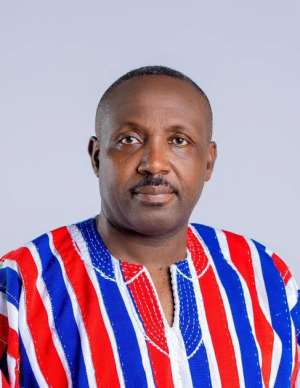
The democratic architecture of the New Patriotic Party (NPP) has always prided itself on providing overwhelming consensus when choosing its supreme commanders. From the early eras of the party to recent history, delegates have traditionally handed winning National Chairmen unmistakable majorities to steer the elephant ship.
However, the outcome of the 2026 National Delegates Conference held at the Baba Yara Sports Stadium in Kumasi, the Ashanti regional capital, has rewritten that script. By electing Mr. John Boadu as National Chairman with just 47.19% of the valid votes cast, the delegates have thrown the party into uncharted administrative waters.
For the first time in the NPP's modern history, an elected National Chairman has taken office knowing that a statistical majority, nearly 53% of his own electorate, actively cast their ballots for other options.
This razor-thin plurality stamps John Boadu with an uncomfortable historical label: he is officially the least favoured elected National Chairman in the democratic history of the NPP.
How the Past Chairmen Super-Majorities Stack Up
To understand why Boadu's 47.19% victory is raising alarms within executive circles, one only needs to look at the statistical mandates secured by his predecessors.
Historically, breaking past the 50% absolute majority mark was a baseline expectation for any prospective NPP Chairman.
| National Chairman | Election Year | Total Valid Votes | Winning Votes | Winning Percentage |
| Stephen Ayesu Ntim | 2022 | ~5,550 | 4,014 | ~72.3% |
| Freddie Blay | 2018 | ~5,400 | 3,021 | ~55.9% |
| Paul Awentami Afoko | 2014 | 4,738 | 2,034 | 42.93% |
| Jake Obetsebi-Lamptey | 2010 | 3,934 | 2,030 | 51.60% |
| Peter Mac Manu | 2005 | 1,346 | 711 | 52.82% |
| John Boadu | 2026 | 6,120 | 2,888 | 47.19% |
Note: While Paul Afoko won a four-man race with 42.93% in 2014, his mandate was viewed as a rejection of the incumbent establishment (Jake Obetsebi-Lamptey gathered just 66 votes), whereas Boadu’s 47.19% comes in an era with a significantly expanded, institutionalized delegate pool of over 7,000 electors.
The Historical Weight of the Mandate
When Stephen Ntim finally secured the chairmanship in 2022 after multiple attempts, he did so with a thumping 72.3% landslide, giving him an unquestionable moral mandate to run the party.
Going further back, Peter Mac Manu (52.82%) and Jake Obetsebi-Lamptey (51.60%) both safely cleared the 50% absolute threshold in intensely contested, multi-candidate fields. Even Freddie Blay, amidst fierce internal party factions in 2018, captured nearly 56% of the delegates' trust.
Boadu’s sub-50% finish signals a highly polarized grassroots. His closest challenger, former Energy Minister Boakye Agyarko, commanded a fierce 2,048 votes (39.35%), while Paul Afoko’s comeback attempt pulled 490 votes. This means that for every 10 delegates Boadu encounters in party meetings, more than 5 of them walked to the ballot box hoping someone else would lead the party.
The Challenge of Governing with a Fragmented Mandate
Can a leader with a fractional mandate effectively steer a major political party like the NPP? The challenge for Boadu is not constitutional; the NPP constitution gives the National Chairman absolute authority to chair the National Council and executive committees regardless of victory margins. The challenge is moral and operational.
When a national chairman moves to execute heavy-handed disciplinary measures or introduces structural reforms ahead of the crucial 2028 general elections, a base that voted 53% against him can easily shift from cooperative to resistant. Boadu cannot manage the party with the top-down decisiveness that Stephen Ntim’s 72% mandate allowed.
To overcome the label of being the "least favoured" chairman, Boadu has already signaled a shift toward collaborative leadership. Recognizing that he needs every faction to survive, his post-election addresses have focused entirely on healing and bringing the likes of Mr. Agyarko and Mr. Afoko's camps into the mainstream administrative fold.
John Boadu's institutional knowledge as a former General Secretary is undisputed. But as he takes the high seat, he must realize that leading a party where the majority desired a different path requires fewer decrees and far more diplomacy.
To successfully break the barrier and lead the NPP to a 2028 victory, Boadu will have to work twice as hard to win the hearts of the 53% who left him off their ballots.


 I’ll sue NPP if the constitutional amendment at delegates conference goes throug...
 NPP executives are like lions being led by a goat – Odike
 Two final-year students killed by speeding tipper truck in Ekumfi
 Afenyo-Markin cautions NPP members against working secretly to undermine party
 The Abanga twins: Two brothers, two parties, one political family
 Fair Wages and Salaries Commission engages striking teachers over conditions of ...
 Tema Central MP details disputes with Ebi Bright amid assault allegation
 PAC raises alarm over GH¢5.2bn financial irregularities in MDAs
 Teachers to remain on strike as talks with FWSC end in stalemate
 La Pleasure Beach demolition: Committee to determine compensation for affected b...


