




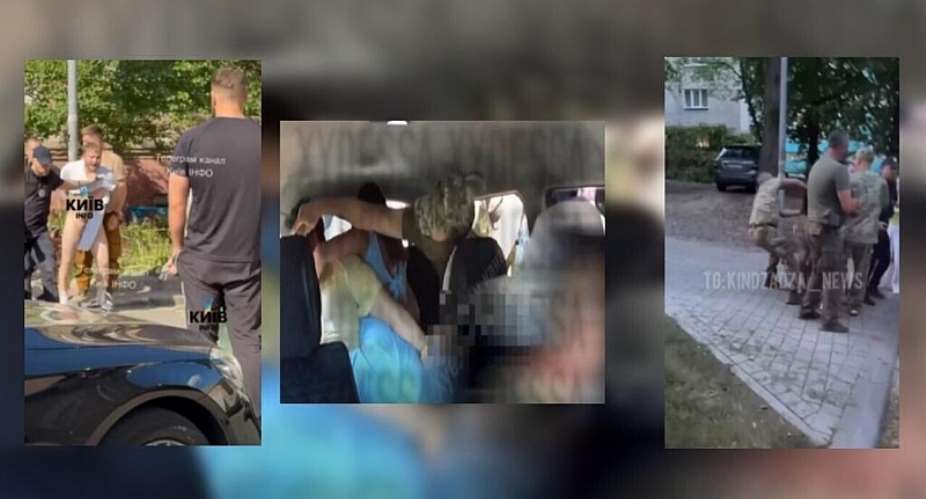
In a video posted on September 4, a man was forcibly taken into a police vehicle on Mykhaila Boichuka Street, in Kyiv's Pecherskyi district. His clothes were torn as he struggled to resist being put into the car. Several people filmed the incident. Police officers in black uniforms were present, alongside unidentified individuals who appeared to use physical force against the man.
"They tackled him like a dog"
We contacted several witnesses present at the scene. An employee of a pharmacy located at the nearby intersection told us:
“They blocked the street with their cars here. They tackled him like a dog. They tore his clothes.”
A woman living in a building on Mykhaila Boichuka Street said :
“My neighbours told me that they beat him up and took him away. He lived right here, near me.”
According to a lawyer specialising in military law that we consulted, the way in which the detention was carried out may have exceeded the police's legal authority. He noted that the presence of unidentified individuals using force alongside police officers is particularly worrying; and that the grey civilian vehicle against which the man was pressed appears to be a type commonly used by recruitment personnel during mobilisation activities.
We also contacted the Pecherskyi District Territorial Recruitment and Social Support Centre (TCK) in Kyiv to ask for information about the reasons for the intervention and what happened to the man afterwards. TCKs are government institutions responsible for military registration and conscription. They did not respond to our requests for comment.
The footage of this incident has circulated widely on Ukrainian social media and Telegram channels, alongside many other videos depicting alleged “busification” – a neologism that emerged during the war to describe the alleged practice of forcibly taking men into minibuses or vans for mobilisation.
While some footage has been identified as AI-generated or manipulated – including by Russian-linked accounts – lawyers and witnesses told us they had encountered numerous cases involving what they described as irregular or coercive mobilisation practices.
After more than four years of war with Russia, the Ukrainian armed forces face significant manpower shortages. In the first months following Russia's full-scale invasion, hundreds of thousands of Ukrainians volunteered to serve. As the war continued however, recruiting sufficient personnel became increasingly difficult. In April 2024, Ukraine lowered the minimum age for mobilisation from 27 to 25 and increased administrative penalties for violations of military-registration and mobilisation rules.
Mobilisation is regulated primarily by the Law of Ukraine No. 3543-XII – adopted in 1993 and subsequently amended, most recently on 31 July 2026 – as well as by Cabinet of Ministers of Ukraine Resolution No. 560, of 16 May 2024.
Ukrainian law provides exemptions and deferrals from mobilisation for several categories of people, including persons with disabilities, certain parents, caregivers, students, educators and workers, subject to specific statutory eligibility requirements.
TCK officers are authorised to verify military-registration documents and issue summonses. They are not authorised to carry out administrative detention; this power lies with the National Police. During document checks, officers must identify themselves.
“By the end of 2025, we had received 6 127 complaints”
The Ukrainian Parliament Commissioner for Human Rights (ombudsman) Dmytro Lubinets, had warned several times about the increasing number of complaints addressed to his office concerning the conduct of certain representatives of TCK.
He stated in February 2026 :
“While we received just 18 complaints at the start of the full-scale invasion in 2022, by the end of 2025 the figure had risen to 6,127.”
His office informed us that the ombudsman processed 5024 requests between 1 January 2026 and 3 September 2026.
“Monitoring visits by employees of the ombudsman's office to the TCKs in Kyiv, Kharkiv, Bila Tserkva and other cities recorded critical violations: illegal restrictions of freedom [Editor's note: detention of individuals who had valid deferments or in circumstances where the legally prescribed procedure had not been followed], physical beatings and other forms of coercion.”
“I could accept forced mobilisation if it were carried out properly”
Andrii Dombrovskyi, a 26-year-old young man, says he had been injured during his forced mobilisation, on July 26, 2026. Although he was in the age of mobilisation, he was not subject to an arrest warrant or otherwise sought by the authorities. According to his lawyer, the recruitment officers could only have issued him with a summons and had no legal grounds to take him away from the street.
“I was riding my bike in one of the alleys in Zhytomyr. From the corner came the car. It seemed like a regular civil car. It was a Renault Duster, but I knew from some Telegram chats that they are often used by the workers of mobilisation units. They stopped right near me. Some men came out, started saying something to me. I kept riding past them but they hit my bike and I dropped to the ground. My leg started hurting. No one introduced themselves or said anything. They just took me and put me in the car.”
After being taken for a mobilisation-related medical examination and then to a military unit, he was hospitalised with a broken leg. He is currently on medical leave at home and has initiated legal proceedings challenging the lawfulness of his mobilisation. Andrii Dombrovskyi shows his broken leg while staying at Municipal Enterprise “Hospital No. 1” of the Zhytomyr City Council on August 5, 2026.
He explains why he does not want to serve:
“I don't really want to kill people or die. I can understand that we are at war, we need people. I could accept forced mobilisation if it were carried out properly and in accordance with the law. But what is happening now is something I cannot tolerate in any way.”
Before being detained, he was avoiding the TCK officers with the help of local Telegram channels, in which users share the position of recruitment officers. Administrators of such channels take serious risks. In April 2023, in Lutsk, in the Volyn region, one of them was sentenced to five years in prison for obstructing the lawful activities of the Armed Forces of Ukraine.
“We have cases of men being forcibly mobilised, despite a formal deferral”
Serhiy Kosiichuk is Andrii's lawyer. He is a managing partner of the Ukrainian law firm Primus Partners, which specialises in military mobilisation and military law. At the moment, his team has approximately 30 active court proceedings across Ukraine concerning challenges to mobilisation carried out in violation of the law. He also regularly posts content about mobilisation on his social media accounts, including his TikTok page.
“We have cases of men being forcibly mobilised, despite a formal deferral. While travelling in Ukraine, they are stopped at a checkpoint for a document check and told that their records need to be clarified. On this pretext, they are taken to the local TCK. Their information in the electronic military registration system is altered: their deferral disappears from the system and they are registered for military service in the district where they were stopped, despite not residing there, which is unlawful.”
Applications for the granting or renewal of a mobilisation deferral are reviewed by commissions established at TCKs and the existing deferral generally remains valid while the application is being considered. @primus_partners
#ЗатриманняЛюдини #ВихованняДитиниЗІнвалідністю #ПравоНаВідстрочку #ВійськовийТЦК #ЗаконнаДія #розголос #резонанс #голосієво #голосіївськийтцк @Національна поліція України @Міністерство оборони України ♬ оригінальний звук - Адвокати ⚖️ Житомир 📍
“Even during wartime, mobilisation must take place within a clear legal framework”
For his work, Serhiy Kosiichuk received threats and was also detained:
“Two years ago, because of my active public position on these issues, and after receiving anonymous threats allegedly linked to law enforcement officials, there was an attempt to mobilise me. I was detained without proper grounds.”
Criminal investigations were opened in connection with the incident, but at the moment they are effectively stalled.
“I fully understand that Ukraine is fighting a war and that mobilisation is necessary for the survival of the country. My position has never been against mobilisation itself. My position is that even during wartime, mobilisation must take place within a clear legal framework and with respect for fundamental rights. That is why I try not only to speak publicly about these problems, but also to participate in creating legislative solutions.”
Serhiy Kosiichuk participated in the elaboration of Draft Law No. 15076-1, submitted to the Ukrainian Parliament on March 30, 2026. The bill seeks to clarify the respective powers of TCKs and the police during mobilisation, with the aim to prevent arbitrary detention.
“He was not allowed to see either a lawyer or anyone else”
Polina Marchenko, managing partner of the Polina Marchenko Law Office, also deals with the protection of the rights of military-liable citizens of Ukraine.
She mentions the case of one of his clients :
“He was not considered liable for military service because of his health. He had all the relevant documents with him. Nonetheless, last February he was stopped in Bila Tserkvahim and taken to a TCK. They kept him there for seven days and he was not allowed to see either a lawyer or anyone else.
He has been mobilised and is serving in one of the military units right now. We are legally challenging the mobilisation decision.”
During his time in the TCK, her client was able to record a video on his phone. In the video, which was later published on social media, he claimed that many other people in detention were ill and were not medically fit to serve in the military.
As Serhiy Kosiichuk, Polina Marchenko, runs a legal blog where she talks about what people should do in case of unlawful mobilisations. She says that she has received intimidations from a state agency that she does not want to mention.
In a written response, Ukraine's Ground Forces Command said it could neither confirm nor deny an increase in complaints against TCKs. It said allegations of misconduct by TCK personnel are investigated and may lead to disciplinary action, but that it has no consolidated data on the number of sanctions imposed. Regarding the cases cited in this article, the Command said that reports of possible violations of the law, abuse of official powers or improper actions by TCK military personnel – once officially received, are subject to verification in accordance with the established procedure.
Mobilisation irregularities, amplified through social media, are deepening tensions around Ukraine's mobilisation system and contributing to growing hostility towards TCKs, including confrontations and reported attacks on recruitment personnel.
Russia is fuelling resentment against mobilisation personnel by disseminating contents about forced mobilisations involving TCK agents.
Moreover, Russian accounts disseminate contents created by AI about Ukrainian soldiers being handcuffed to go to the frontline or crying after their mobilisation.
At the same time, Russia faces its own manpower shortages and is also implementing forced mobilisation against its own population, while using coercive and exploitative practices to recruit foreign nationals into its military forces.
After more than four years of full-scale war, both countries are struggling to meet their manpower needs, making mobilisation an increasingly prominent issue in the information war.
Article written in collaboration with the editorial team of RFI Ukraine.


 I’ll sue NPP if the constitutional amendment at delegates conference goes throug...
 NPP executives are like lions being led by a goat – Odike
 Two final-year students killed by speeding tipper truck in Ekumfi
 Afenyo-Markin cautions NPP members against working secretly to undermine party
 The Abanga twins: Two brothers, two parties, one political family
 Fair Wages and Salaries Commission engages striking teachers over conditions of ...
 Tema Central MP details disputes with Ebi Bright amid assault allegation
 PAC raises alarm over GH¢5.2bn financial irregularities in MDAs
 Teachers to remain on strike as talks with FWSC end in stalemate
 La Pleasure Beach demolition: Committee to determine compensation for affected b...


