




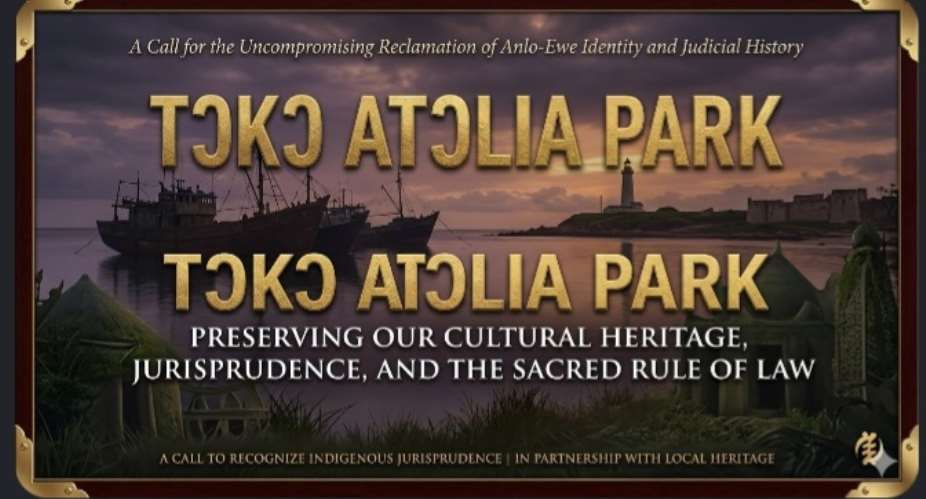
In contemporary discourse surrounding post-colonial identity, the architectural and toponymic structures of public spaces serve as vital physical archives of a nation's history. For Ghana, a country actively seeking to leverage its historical assets for domestic and international growth, naming public landmarks is an act of deep socio-political consequence. Recent public debate regarding landmark renaming in the Volta Region highlights a foundational opportunity: the formal designation of Tɔkɔ Atɔlia Park. Far from a nostalgic exercise in sentimentality, renaming this space represents an intentional structural alignment with the principles of critical cultural preservation. To institutionalize the name of the historic "Fifth Landing Stage" is to activate a dormant asset capable of driving experiential heritage tourism, advancing decolonial education, and honoring the profound customary jurisprudence that governed the Anlo-Ewe people long before colonial intervention.
The Jurisprudential Context of Tɔkɔ Atɔlia
To evaluate the historical weight of this designation, one must analyze the complex legal and ethical framework of the pre-colonial Anlo state. Tɔkɔ Atɔlia, translating to the "Fifth Landing Stage" in Anloga, was not merely a geographic point along the Keta Lagoon; it functioned as the institutional center of communal accountability:
- An Indigenous Supreme Court: The site served as the ultimate punitive venue for individuals found guilty of severe, destabilizing infractions against the state, such as treason, murder, and persistent recidivism.
- A Philosophy of Communal Preservation: While the traditional sentence—ritualistic live burial up to the neck—appears severe by contemporary standards, historical analysis reveals a system designed around spiritual deterrence and the preservation of societal equilibrium, rather than arbitrary violence.
- A Living Monument of Restorative Law: Today, the site stands as a peaceful, defunct execution ground that represents a physical thesis on how pre-colonial African societies maintained civic order and ethical discipline without external systems.
The Dual Imperatives: Tourism and Pedagogy
Transforming a communal space into Tɔkɔ Atɔlia Park creates a dynamic environment where two vital developmental pillars intersect: experiential domestic tourism and rigorous historical education.
The Educational Value
- Decolonizing the Historical Narrative: Standardized educational curricula often over-index on Eurocentric colonial history. A formalized heritage park provides a tangible, empirical resource for students to study indigenous West African governance and social control.
- Institutionalizing Active Pedagogy: By integrating field studies at the park into basic and secondary social studies curricula, local schools can move historical education out of abstract textbooks and into living, open-air classrooms.
- Preserving Oral Traditions: The physical presence of a dedicated park serves as an anchor for local historians and elders to pass down precise, unadulterated oral accounts to younger generations, stemming the tide of cultural amnesia.
The Tourism Aspect & Regional Synergy
- Expanding the Volta Tourism Circuit: While the Volta Region is globally recognized for ecological tourism, there remains an under-monetized demand for deep heritage tourism. Tɔkɔ Atɔlia Park provides a distinct historical asset that complements existing regional destinations.
- Capitalizing on Adjacent Historical Landmarks: A developed park would not exist in a vacuum; it directly anchors a high-potential historical corridor. Tourists visiting the nearby Fort Prinzenstein in Keta—a stark monument to the trans-Atlantic slave trade—and the iconic Cape St. Paul Lighthouse in Woe (the oldest lighthouse in Ghana) would gain access to a multifaceted regional itinerary that spans colonial, maritime, and indigenous Ewe histories.
- Integrating the Atorkor Slave Market Corridor: Just 28 kilometers from Keta lies the coastal community of Atorkor. The Atorkor Slave Market serves as a poignant, dark tourism node where European slavers actively bought captives shipped from the interior. Crucially linked to local oral history, it recalls the infamous 1856 abduction where an entire local drumming troupe was deceived and stolen into slavery. Elevating Tɔkɔ Atɔlia bridges the narrative from indigenous pre-colonial sovereignty directly to the devastating external impacts of the trans-Atlantic trade path.
- Fostering Experiential Domestic Travel: In alignment with national drives to boost local travel, a curated park taps into the growing segment of Ghanaian travelers seeking historically significant domestic destinations.
- Synergy with the Hogbetsotso Festival: Annually, thousands of international and diasporic tourists descend upon Anloga. By establishing a fully realized heritage park, the local assembly can capture high-value cultural tourism revenue by offering guided, academic tours that connect festival rituals directly to physical landmarks.
Proposed Memorial Architecture & Monumental Structures
To match the gravitas of this heritage corridor, the infrastructure must feature evocative, structural markers that facilitate healing, education, and remembrance. We recommend the integration of three vital architectural installations:
- The Frieze of Remembrance: The internal park walls should feature an expanded narrative relief frieze modeled after the Atorkor Slave Trade Memorial. This sculptural installation will depict the pre-colonial judicial evolution, local folklore, and the stark realities of the coastal transit routes to deter historical amnesia.
- The Pillar of Dual Justice: A central monumental abstract statue composed of modern stainless steel juxtaposed with ancient stone columns—echoing contemporary global memorial designs—symbolizing the intersection of indigenous customary jurisprudence and the enduring human quest for liberty.
- An Eco-Acoustic Amphitheater: A dedicated pavilion looking over the Keta Lagoon, designed to host living history narratives, spoken word, and traditional drumming ceremonies. This structure serves as a living tribute to the stolen creative artists of our past, converting a site of historical grief into an active center of cultural renaissance.
The realization of this cultural project cannot rely solely on grassroots advocacy; it requires systemic, institutional intervention from state leadership.
Therefore, we direct an urgent call to action to the Minister for Tourism, Culture, and Creative Arts, and the Ministry of Tourism, Arts and Culture (MoTCCA). The Ministry, using its executive mandate and working through its frontline agencies like the Ghana Tourism Authority (GTA), must take immediate steps to partner with the Anlo Traditional Council and the Anloga District Assembly to execute the following:
- Executive Recognition and Funding: Formally adopt the Tɔkɔ Atɔlia Park initiative under the ministry’s flagship national heritage development projects, allocating technical resources and capital to build the site's physical infrastructure.
- Curation and Infrastructure Development: Commission the installation of bilingual educational plaques (in Ewe and English), accurate monuments, and a visitor information center staffed by trained local guides to transform the space into a highly professionalized, international tourist destination.
- Digital Integration: Incorporate Tɔkɔ Atɔlia Park into the state's digital tourism platforms and national marketing campaigns, satisfying the Ministry’s current policy push toward the digital transformation of Ghana’s tourism assets.
A nation that neglects its historical architecture loses the ability to define its own identity. Naming a public park after Tɔkɔ Atɔlia is not merely an act of regional pride; it is a critical, scholarly reclamation of the Anlo landscape. It asserts that our indigenous systems of justice, community preservation, and historical memory possess enduring value that deserves preservation in modern infrastructure. By answering this call, our tourism and local government authorities can transform a solemn historical site into a vibrant center of education and sustainable economic development. Let us elevate Tɔkɔ Atɔlia from the pages of forgotten history and establish it firmly as a lasting pillar of Ghanaian heritage.
✍️ Submitted by:
Retired Senior Citizen
For and on behalf of all Senior Citizens of the Republic of Ghana 🇬🇭
Teshie-Nungua
[email protected]


 Fire destroys property building in Koforidua
 Mahama pardons 863 convicted persons
 National Cathedral site reverts to government as Attorney-General reviews audit
 NDC confirms Dzifa Gunu’s disqualification from La Dadekotopon constituency secr...
 Household waste fees could fall to GH¢50 every two weeks under new system — Ayar...
 Tamale: Three missing children found dead inside parked vehicle at Koblimahagu Z...
 Kojo Bamba’s election projects mindset of violence, it’s backward politics – Mus...
 'You can expose corruption without insulting people's humanity' — Agyinasare on ...
 Prof Mike Ocquaye backs Kojo Bamba’s Vice Chair election, cites need to protect ...
 NPP is not putting ‘old wine in new bottles’ – Ibrahim Adjei on new executives


