




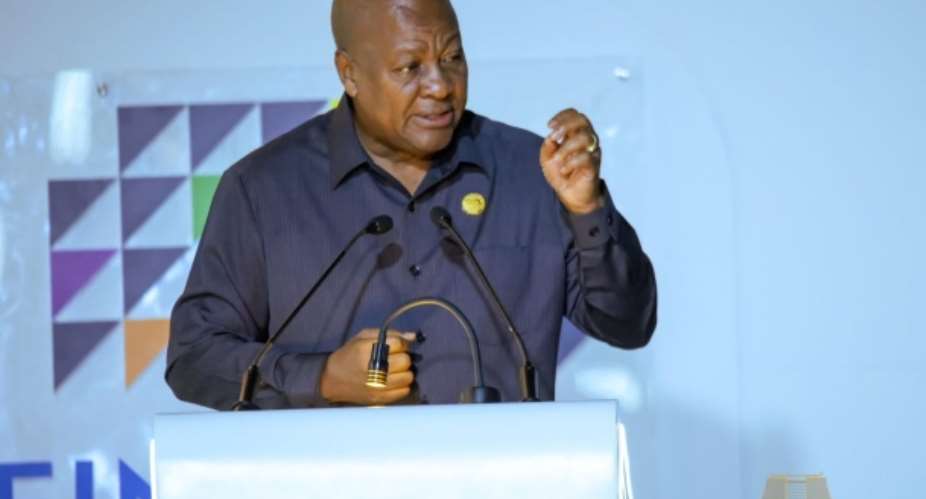
President John Dramani Mahama has urged African leaders to prioritise health sovereignty as part of a broader continental strategy to secure Africa’s long‑term health and economic future.
He said it is time for Africa to stop treating health as a charitable expense and instead position it as an investable, high‑growth economic sector.
Speaking at the Alamein Africa Forum on Saturday, October 3, 2026, in El Alamein, Egypt, President Mahama said Africa’s goal must be the health sovereignty and economic and fiscal security of its 1.4 billion people.
“Our goal is health sovereignty, and economic and fiscal security of 1.4 billion African people. For decades, African finance ministers and global investors have made a fundamental error. They have treated health as a line‑item cost and a social expenditure in their budgets to be funded only when there is money left over. Today, at the Alamein Africa Forum, we are moving beyond that outdated perspective. Health is not a charitable cost. It is an investable, high‑growth economic sector,” he said.
Health Investment
President Mahama underscored the economic value of investing in health, citing global evidence that health spending drives human capital development, manufacturing, job creation and macroeconomic stability.
“The arithmetic is indisputable. The Copenhagen Consensus showed that a targeted package of basic emergency maternal and newborn care can yield $87 in economic and social returns for every dollar invested. The Lancet Commission established that falling mortality rates accounted for nearly a quarter of total income growth in developing economies in the early 2000s,” he said.
He warned that Africa’s heavy dependency on external health supplies remains dangerous, noting that the continent imports over 70% of its pharmaceuticals and nearly 99% of its vaccines, draining tens of billions of dollars annually.
President Mahama added that traditional donor assistance is declining, with OECD projections showing health aid could fall by 29% to 46% compared to 2024 levels.
He stressed that governments cannot fund the transition alone and called for private capital, industrial developers, commercial banks and sovereign funds to participate—highlighting initiatives such as Business United for Mothers, Babies, and Youth, championed by Tanzania’s President Samia Suluhu Hassan.
He urged African leaders to stop treating health as a budgetary expense and instead build factories, integrate supply chains, fund innovators and secure the future of their citizens.
AfCFTA and Local Manufacturing
President Mahama said the case for a vibrant local pharmaceutical industry rests on four pillars:
- A captive market projected to reach 2.5 billion people by 2050,
- Significant foreign exchange savings through import substitution,
- The unified continental market under the African Continental Free Trade Area (AfCFTA),
- And the ability to scale production for 1.4 billion consumers.
“The African Continental Free Trade Area and African manufacturing plants do not serve a single country of 10 or 30 million. They serve a single unified market of 1.4 billion consumers,” he said.
He cited the Africa CDC’s first pooled tender for maternal and child health products, which achieved over 30% price reductions and ensured African manufacturers secured 50% of product lines.
Mahama also highlighted Africa’s structural paradox: nearly one million trained healthcare professionals and science graduates remain unemployed, despite a shortage of six million health workers, according to the WHO.
Continental Initiatives
President Mahama pointed to Egypt’s successful elimination of hepatitis C—reducing prevalence from 10% to under 0.5% through technology transfer, domestic production and local treatment of four million citizens. Egypt is now the first country recognised by WHO as being on the path to eliminating hepatitis C.
He also cited Nigeria’s African Medical Centre of Excellence in Abuja, pioneered by Afreximbank and King’s College Hospital, which aims to curb the country’s $6 billion annual loss to outbound medical tourism.
Ghana’s Progress
President Mahama said Ghana is implementing the Accra Reset, which includes:
- Expanding the National Health Insurance Scheme,
- Introducing free primary healthcare,
- Establishing the Ghana Medical Trust Fund (MahamaCares),
- Empowering the Food and Drugs Authority and the National Vaccine Institute to transition Ghana from a consumer to a producer of health products.
Launch of HINGE
To scale up continental progress, he announced a new enabler:
“Today, we present the Health Investment and National Gateway (HINGE) Enabler. Developed with the African Medicines Agency, Institut Pasteur and AfroChampions, HINGE will become a digital platform that streamlines regulations, clinical validation and commercialisation into a unified process for innovators and investors.”
He added that through the Accra Reset Presidential Council, dedicated task forces and reformed inter‑ministerial observatories will track capital flows, enforce policy commitments and dismantle non‑tariff barriers across regional value chains.
— Graphic Online

 Ghana gaining notoriety for cocaine — Bawumia
 Bawumia exposes NDC's ‘scam’ promises to Ghanaians
 NPP chairmanship: Sammy Crabbe backs John Boadu in last-minute show
 EOCO detention won't stop me from representing Salomey – Baffour Awuah
 NPP’s focus is to reclaim power in 2028 — Osahen Afenyo-Markin
 NPP must put aside differences, unite to rebuild party – Odeneho Kwaku Appiah
 NPP delegates approve 14 constitutional amendment motions
 NDC's 24-hour economy has turned into ‘24-hour demolition’ — Bawumia
 NPP adopts amendment to make flagbearer party leader
 NDC delegation exit NPP conference over delays, poor communication


