




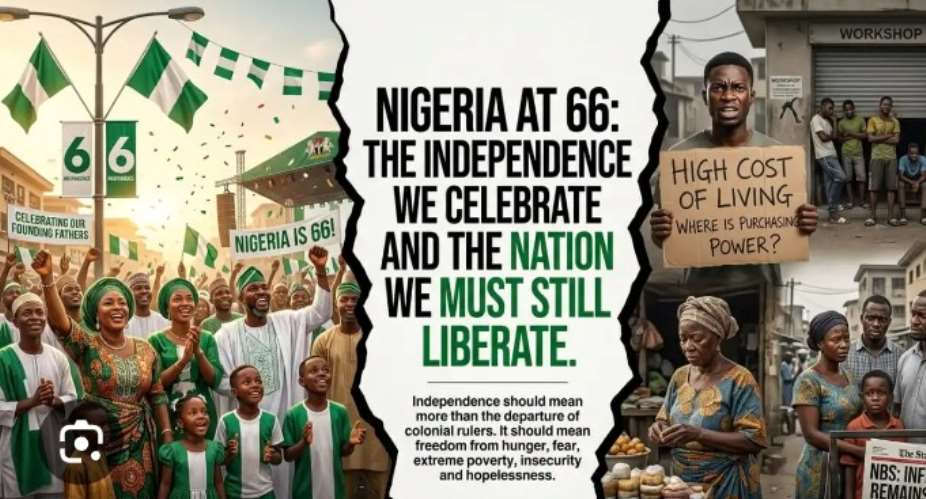
Nigeria turns 66 today with a question every citizen understands: will the rules that govern our votes finally serve the voter?The history explains why it matters.
Independence in 1960 gave way within six years to the first coup, then to civil war. For roughly three decades of our independent life, soldiers ruled, and the annulment of the June 12, 1993 election remains the clearest case of power overriding the ballot.
The 1999 handover opened the longest civilian run in our history, and in 2015 an incumbent lost and conceded to the opposition for the first time. These are real gains, but a democracy is judged by whether its rules protect ordinary voters.
A new law, a new test
This year's legal change is significant. President Tinubu signed the Electoral Act 2026 into law on 18 February, repealing and re-enacting the earlier statute.
Analysts point to several provisions that favour citizens. The Act creates a dedicated fund for INEC, abolishes indirect primaries that limited voting to selected delegates, and makes technology mandatory.
One legal analysis adds that election tribunals in 2027 must receive IReV data as admissible evidence and engage with it. If that holds, results uploaded at polling units can no longer be waved away in court.
The calendar changed as well. INEC moved the presidential and National Assembly polls to 16 January 2027, the first January presidential election since 1999,with governorship and state assembly elections on 6 February.
INEC said the shift followed the repeal of the 2022 Act and the new statutory timelines in the 2026 law. One analyst cautioned that altering a settled calendar could disrupt the political class and the electorate alike.
Where the law still falls short
Reform on paper is not reform in practice. The same legal analysis finds the Act provides no verification mechanism for IReV data and removes qualification as a ground for election petitions.
Another assessment stresses that laws alone do not guarantee credible elections, and that the Act permits a manual form for sending results where technology fails. Technology with a manual fallback is where public trust will be won or lost.
The prospective view
Three tests will define the coming months:
Technology on the day. If results upload promptly and match what voters saw at their polling units, confidence will rise. If the manual fallback becomes routine, it will fall.
Primaries that mean something. Direct primaries should give members, not godfathers, a say. Who emerges as candidates will show whether the reform has teeth.
Campaign conduct. The Senate Leader urged parties to campaign within the Electoral Act and the Constitution, warning against statements that could provoke ethno-religious violence. He said no ambition is worth setting the nation ablaze.
Senate leaders used the anniversary to call for unity and peaceful politics ahead of 2027. Those words matter in the north and the Middle Belt, where such rhetoric has fuelled violence before.
What citizens should demand
Nigerians at 66 are not the voters of 1960 or the subjects of 1984. They carry phones, photograph result sheets and know their rights. The law now gives that vigilance evidential weight. The task for civil society, the media and observers across Africa is to insist the rules are applied as written.
Military rule showed what happens when power answers to no one. The ballot box is how it answers to us. January 2027 will show how far that principle has travelled.
Mustapha Bature Sallama
Medical/ Science Communicator,
Private Investigator, Criminal Investigation and Intelligence Analysis,
International Conflict Management and Peacebuilding. (USIP)
[email protected]
+233555275880
References
Voice of Nigeria, "Independence: Senate Leaders Call For Unity, Peace, Democratic Values," October 1, 2026. https://von.gov.ng/independence-senate-leaders-call-for-unity-peace-democratic-values/
The Guardian Nigeria, "2027: Bamidele warns politicians against hate speech." https://guardian.ng/news/2027-bamidele-warns-politicians-against-hate-speech/
Wikipedia, "2027 Nigerian general election." https://en.wikipedia.org/wiki/2027_Nigerian_general_election
Legal500, "The Electoral Act 2026: Progress, Gaps, And The Legal Landscape For 2027." https://www.legal500.com/intelligence/nigeria/litigation-mediation-arbitration/the-electoral-act-2026-progress-gaps-and-the-legal-landscape-for-2027
The Conversation, "Nigeria's new election law leaves gaps: 5 reforms for free, fair and credible polls." https://theconversation.com/nigerias-new-election-law-leaves-gaps-5-reforms-for-free-fair-and-credible-polls-276990
SBM Intelligence, "INEC moves goalposts," March 6, 2026. https://sbmintelligence.substack.com/p/inec-moves-goalposts
AllAfrica, "Nigeria: Updated - INEC Reschedules 2027 General Election, Releases New Election Timetable," February 26, 2026. https://allafrica.com/stories/202602270088.html


 Baffour Awuah may spend night in EOCO custody — Lawyer
 Suspend Ghana-Colombia port and visa deals over cocaine seizures — Minority
 Ghana Law Society proposes National Service for fresh lawyers
 'We cannot continue to be a Bar of Accra, by Accra, for Accra' — Ghana Law Socie...
 Stop speculation, premature conclusions; allow investigation to determine Baffou...
 Judge halts Ex-NAFCO CEO's trial until ruling on seized phones
 Manhyia South MP who resisted arrest reports to EOCO a day after arrest warrant ...
 "Show us evidence" —Upper West teacher unions demand proof of payment before end...
 Adenta: Bolt driver jailed 25 years for cutlass attack and robbery of beautician...
 EOCO drags Manhyia South MP to former law firm, residence for search


