




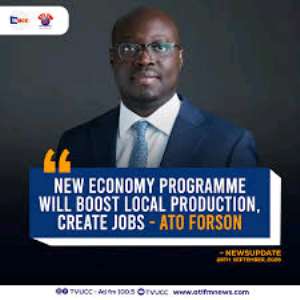
Finance Minister Dr Cassiel Ato Forson has unveiled an ambitious economic blueprint aimed at reducing Ghana’s dependence on imports, expanding domestic production and creating sustainable employment opportunities.
Speaking at a strategic meeting with the leadership of the Association of Ghana Industries and leading members of the business community on September 27, 2026, Dr Forson said the government’s New Economy programme would mark a decisive transition from economic stabilisation to production-led growth, job creation and wealth generation.
According to the Finance Minister, Ghana cannot achieve lasting economic prosperity while continuing to import a significant proportion of the goods it consumes. The next stage of the country’s recovery must therefore focus on strengthening local industries, increasing productive capacity and creating opportunities for Ghanaian businesses and workers.
“Our mission is to produce more of what we consume and create more jobs here at home,” Dr Forson declared. “Every import is an opportunity to ask: why can’t we make it in Ghana?”
He explained that the New Economy programme represents a fundamental shift from an economic model that borrows primarily to finance consumption to one that deliberately invests in productive sectors capable of generating jobs, exports and sustainable national wealth.
“That is the promise of the New Economy: Ghana producing, Ghanaians working and prosperity growing,” he stated.
The programme, expected to be a major feature of the 2027 Budget, will mobilise approximately US$1.6 billion, representing about one per cent of Ghana’s gross domestic product, for investment in carefully selected productive sectors.
Dr Forson said the proposed funding would be used to attract additional private-sector investment and channel resources into industries where Ghana possesses clear competitive advantages and the potential to generate significant economic returns.
Commercial agriculture will be among the programme’s major priorities. The government intends to support large-scale farming, agro-processing and value addition to reduce the country’s dependence on imported food and agricultural products. This intervention is also expected to improve food security, create rural employment and provide reliable raw materials for local industries.
The government will also prioritise value addition in the mining sector by encouraging the domestic processing and refining of Ghana’s mineral resources. Rather than continuing to export minerals mainly in their raw form, the programme seeks to retain a greater share of their economic value within the country.
Energy security will constitute another critical pillar of the New Economy agenda. Planned investments in gas-to-power and gas-to-fertiliser projects are expected to provide more reliable energy for industry while reducing Ghana’s dependence on imported fertiliser. Affordable and dependable energy remains essential to improving the competitiveness of Ghanaian manufacturers and supporting industrial expansion.
Strategic transport infrastructure will also receive attention, with projects such as the Western Railway Line expected to connect mining communities, agricultural zones and industrial centres to major markets and ports. Improved transport links could lower production costs, facilitate the movement of goods and strengthen Ghana’s export capacity.
Dr Forson stressed that the government would concentrate its resources on sectors capable of stimulating economic activity on a significant scale. The objective is to create an environment in which businesses can expand production, enter new markets, increase exports and employ more Ghanaians.
Although the complete blueprint is still being finalised, the Finance Minister assured industry leaders that its full details, implementation framework and financing arrangements would be announced when the programme is formally launched as part of the 2027 Budget.
The New Economy agenda reinforces Dr Forson’s consistent argument since taking office in January 2025 that Ghana must produce more of what it consumes if it wants to build a resilient, prosperous and self-reliant economy.
For decades, Ghana’s dependence on imported food, manufactured goods, industrial inputs and consumer products has placed persistent pressure on the cedi, weakened local industries and exported employment opportunities to other countries. The proposed shift towards domestic production could therefore become an important turning point, provided it is supported by predictable policies, affordable financing, reliable energy, efficient infrastructure and disciplined implementation.
The success of the programme will ultimately depend not only on the size of the proposed investment but also on whether the government can create the conditions necessary for Ghanaian enterprises to compete, expand and thrive. If effectively implemented, the New Economy programme could help transform Ghana from an import-dependent consumer economy into a productive nation capable of creating jobs, generating wealth and competing confidently in regional and international markets.


 Baffour Awuah may spend night in EOCO custody — Lawyer
 Suspend Ghana-Colombia port and visa deals over cocaine seizures — Minority
 Ghana Law Society proposes National Service for fresh lawyers
 'We cannot continue to be a Bar of Accra, by Accra, for Accra' — Ghana Law Socie...
 Stop speculation, premature conclusions; allow investigation to determine Baffou...
 Judge halts Ex-NAFCO CEO's trial until ruling on seized phones
 Manhyia South MP who resisted arrest reports to EOCO a day after arrest warrant ...
 "Show us evidence" —Upper West teacher unions demand proof of payment before end...
 Adenta: Bolt driver jailed 25 years for cutlass attack and robbery of beautician...
 EOCO drags Manhyia South MP to former law firm, residence for search


