




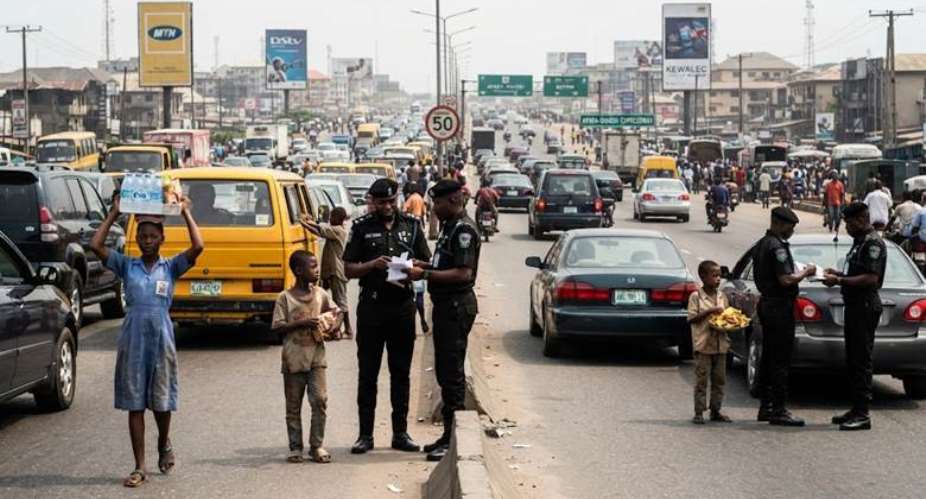
There is something profoundly disturbing about seeing a child standing in the middle of a busy Nigerian road, a tray balanced on the head, a plastic bag of oranges in one hand, sachet water in another, while vehicles and motorcycles race past with frightening indifference. There is something even more painful about knowing that, at the very hour that child should be sitting in a classroom learning to read, write and dream, he or she is out there trying to earn money for a family that may be struggling to survive. Nigerians have become so accustomed to the sight that it barely shocks them anymore.
Children hawking at traffic lights. Children weaving between cars. Children knocking on vehicle windows. Children selling food, drinks, fruits, newspapers and household items. Children working in markets and workshops. Children carrying loads that appear too heavy for their small bodies. Children returning home from selling or from the farm exhausted when their classmates are doing homework. We see them. We drive past them. We buy from them. We sometimes complain about the traffic they create. And then we move on.
But Nigeria should not move on. Because behind every child hawking on the street is a national failure that goes far beyond poverty. It is a failure of protection. A failure of social policy. A failure of education. A failure of enforcement. And, ultimately, a failure of imagination about what a nation owes its children.
Nigeria's data on their own tell a devastating story. The International Labour Organization and Nigeria's National Bureau of Statistics reported from the 2022 National Child Labour Survey that about 24.7 million Nigerian children were engaged in child labour, with more than 14 million involved in hazardous work. Among children aged 5–14, 35.3 per cent were simultaneously in school and working, while another 11.2 per cent were working without being in school.
UNICEF's education data are equally sobering: about 10.5 million Nigerian children aged 5–14 are out of school, despite primary education officially being free and compulsory. UNICEF says one in every five of the world's out-of-school children is a Nigerian. But these are not just numbers. Every percentage point represents thousands of children whose childhood is being traded for survival.
Every child standing beside a highway represents a question that ought to haunt the conscience of government: why is this child not in school? And there is another question we must ask: who is protecting that child while he or she is out there? A classroom has teachers. A school has, at least in principle, adults responsible for children's safety. A school has rules, routines and some degree of accountability.
A roadside has none of these guarantees. A child hawker is exposed to speeding vehicles, motorcycles, exhaust fumes, extreme heat, rain, physical exhaustion and dangerous roads. A child can be struck by a vehicle in seconds. A child can disappear in seconds. A child can be lured into a vehicle in seconds. The danger does not end with road accidents.
The street is also an environment in which children can become vulnerable to sexual exploitation, trafficking, grooming, violence and other forms of abuse. Nigeria's own Federal Ministry of Labour and Employment acknowledges that child labour can create a reservoir of children vulnerable to recruitment into prostitution, violent crime and other forms of exploitation.
The U.S. Department of Labor has likewise documented children in Nigeria being subjected to some of the worst forms of child labour, including commercial sexual exploitation and trafficking, while street vending itself is identified among hazardous or exploitative forms of child work. The United States Department of State has also reported that traffickers exploit Nigerian children in sex trafficking and forced labour, including street vending, domestic work, begging, mining and agriculture.
This is why the argument that "the child is only selling something for a few hours" is dangerously simplistic. There is no harmless street when a child is supposed to be in school. There is no completely safe roadside for a child whose supervision has been surrendered to traffic, strangers and circumstance. And there is no responsible society that should regard the economic exploitation of children as an ordinary feature of urban life.
The most painful part is that many of these children are not hawking because they have chosen the street over education. They are there because their families are trapped. A hungry household needs money. A parent without decent employment needs help. School expenses, transportation, uniforms, books and food can become overwhelming. Inflation and economic hardship can turn a child's labour into a family's survival strategy.
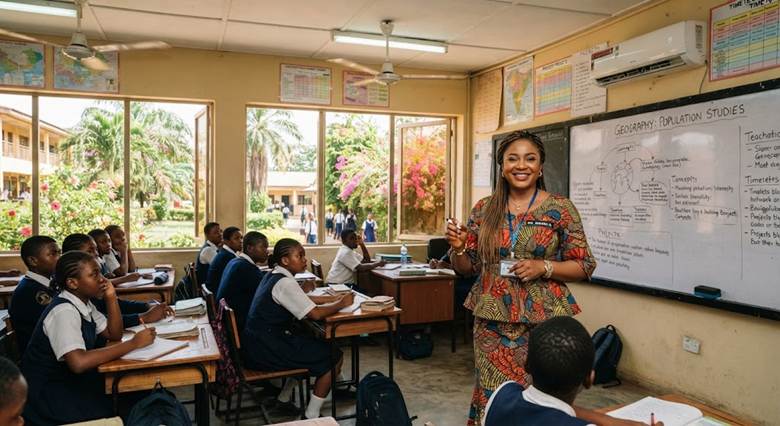
That reality deserves compassion. But compassion must not become an excuse for government inaction. The answer to a poor family's dependence on a child's earnings cannot simply be to arrest the child or confiscate the goods. The answer must be to attack the poverty that pushed the child onto the street in the first place. This is where government becomes indispensable.
Government has instruments that individual citizens do not have. It can build schools. It can fund teachers. It can provide social protection. It can enforce child-labour laws. It can support vulnerable families. It can regulate workplaces. It can prosecute traffickers and abusers. It can provide meals and other incentives that keep children in school. It can coordinate education, labour, health, justice and social-welfare agencies. Government can change the environment in which parents make impossible choices. So, what exactly is government doing? To be fair, the answer is not "nothing". Nigeria has policies and institutions that address child labour. In June 2026, the National Steering Committee on the Elimination of Child Labour validated the National Child Labour Policy and National Action Plan 2026–2030. The framework is intended to reduce hazardous child labour, strengthen institutions and help children remain in or return to school. In August 2026, Nigeria also validated the 2024 National Child Labour Survey and moved toward integrating child-labour data into the regular Nigeria Labour Force Survey.
The World Bank approved $500 million in additional financing in 2025 for HOPE-EDU, an education programme intended to support foundational literacy and numeracy, create learning opportunities where overcrowding restricts participation, and strengthen school management and education systems. The programme is expected to reach millions of children in public primary schools.
There are therefore programmes, policies, laws and partnerships. But the street keeps filling with children. That is the uncomfortable contradiction Nigeria must confront. A government cannot measure success merely by the number of policies it produces. A child does not eat a policy document. A child does not learn inside a press release. A child standing beside a highway does not become safe because another committee has been inaugurated.
The real test is whether the child eventually leaves the street. Whether he returns to school. Whether his parents can survive without his income. Whether his school has a teacher. Whether there is a desk. Whether there are toilets. Whether there is food. Whether the child can remain in school long enough to acquire an education that changes the trajectory of his or her life. And whether, when that child is abused, trafficked or assaulted, the perpetrator faces consequences.
Nigeria has been talking about education for decades. Yet UNICEF reports that millions of children remain outside the formal education system, while child labour remains widespread. The 2023 UNICEF analysis found that 31 per cent of Nigerian children aged 5–17 were in child labour. Among primary-school-age children, the proportion was 46 per cent. Children engaged in child labour also showed substantially lower foundational reading and numeracy skills than children not engaged in child labour. This should terrify us. Because education is not merely about passing examinations. Education is a protective shield.
A child in school is not automatically safe—schools themselves must be safe—but regular schooling creates structure, adult supervision, social connection and a pathway toward economic independence. When children disappear from school and appear on the streets, Nigeria loses much more than classroom attendance. It loses human capital. It loses potential doctors, teachers, engineers, entrepreneurs, scientists, artists, farmers, public servants and community leaders. It loses years of childhood that can never be recovered.
A child cannot postpone childhood and retrieve it later. This is why government must stop treating education as merely another sector competing for money in the annual budget. Education is the foundation upon which almost every other national ambition rests. How can a country seriously fight unemployment while millions of children are growing up without adequate education?
How can it fight crime while children are left vulnerable to criminal recruitment? How can it fight trafficking while children are allowed to spend their formative years in unregulated environments? How can it speak of economic transformation while millions of children are being trained by poverty instead of schools? How can it talk about a demographic dividend when so many young Nigerians are denied the human capital needed to make that dividend possible?
Other countries facing child-labour challenges have demonstrated that the response cannot be confined to one ministry. Ghana, for example, has developed a national action plan against child labour and, more recently, has been pursuing coordinated child-centred policies involving education, child protection, social protection and employment. In 2026, Ghana also launched a partnership involving government, Japan and UNICEF to strengthen child protection and support more than 13,000 vulnerable children and caregivers in areas affected by child labour.
Ghana still has a serious child-labour problem. It is not a utopia. UNICEF estimates that about 21 per cent of Ghanaian children aged 5–17 are involved in child labour. But the comparison is instructive because it shows the importance of treating the problem as a coordinated national policy challenge rather than as something society merely sees on the roadside.
The lesson for Nigeria is not that another country has magically solved child labour. The lesson is that government must build systems capable of reaching the child before the child reaches the street. That means social protection for families living on the edge. It means effective school feeding where appropriate. It means accessible and genuinely affordable schooling. It means identifying children at risk of dropping out. It means local officials knowing which children have disappeared from classrooms.
It means labour inspectors who can actually reach workplaces and streets. It means child-protection officers who can respond. It means police and prosecutors who understand that exploitation of children is not a minor offence. It means courts that can deliver justice. It means communities being educated about grooming and trafficking. It means parents being supported rather than simply blamed. And it means consequences for adults who deliberately exploit children.
Nigeria already has a legal foundation. The Child Rights Act was enacted federally in 2003, although domestication across states has taken years and implementation remains uneven. UNICEF has repeatedly highlighted the problem of fragmented child-protection legislation and weak accountability. The question, therefore, is no longer simply whether Nigeria has laws. The question is whether Nigeria has the will to make those laws work.
Because a law that exists only on paper cannot protect the child running between vehicles. A policy that is made sitting in Abuja cannot protect the girl being groomed on a street corner unless somebody translates that policy into action. A budget allocation cannot educate a child unless the money actually becomes a functioning classroom, a teacher, learning materials, a meal, transport assistance or whatever barrier is keeping that child away from school.
This is where political leadership must become painfully practical. Government should know where children are dropping out. It should know why they are dropping out. It should know which families are sending children to work. It should know which streets and markets have concentrations of child hawkers. It should know which employers are using children. It should know which children are vulnerable to trafficking. It should know which schools are overcrowded. It should know where teachers are absent. It should know which communities have no safe access to school.
And then it should act. Not tomorrow. Not after another summit. Not after another speech. Now. Because while officials deliberate, childhood is expiring. A ten year-old who spends five years hawking does not get those five years back when government finally becomes serious. The sixteen year-old who has spent adolescence working instead of learning cannot simply rewind time. The girl who is sexually abused cannot have the experience erased by a later government programme. The child knocked down by a vehicle cannot be brought back by a press statement.
This is why the phrase "Nigeria is bleeding" is not rhetorical excess. The country is bleeding its future in broad daylight. And perhaps the most painful question is whether we have become so accustomed to the bleeding that we no longer feel the wound. We must feel it again.
We must look at the child hawking beside us and see not a nuisance, not a business opportunity, not cheap labour, but a citizen. A child with a constitutional and human right to protection, development and education. The Convention on the Rights of the Child recognises every child's right to education and requires states to protect children from economic exploitation and work that is hazardous or interferes with education or harms their development.
Nigeria cannot ask the world to treat it as a serious nation while permitting millions of children to grow up without the protection that serious nations provide their children. The government should not need another tragedy before it acts. It should not need another child killed by a vehicle. Another girl trafficked. Another boy recruited into criminal activity. Another child raped. Another family destroyed. Another generation lost.
The time has come to make the child the starting point of education policy, poverty policy, labour policy and social policy. If a family is too poor to keep its children in school, help the family. If a school is inaccessible, build the school or provide safe alternatives. If children are being exploited at markets, enforce the law. If employers use children illegally, prosecute them. If traffickers groom children, dismantle the networks and prosecute the traffickers. If schools are failing, fix them. If education funds are insufficient, prioritize them. If institutions are fragmented, coordinate them. If officials responsible for protecting children are failing, hold them accountable. And if government has promised something for children, citizens should demand evidence that the promise became reality.
Nigeria's children are not waiting for another policy anniversary. They are waiting for rescue. They are waiting for classrooms. They are waiting for books. They are waiting for teachers. They are waiting for food. They are waiting for safety. They are waiting for adults to decide that their childhood is more valuable than the few naira they can make selling goods at a traffic junction.
There is no national development plan more urgent than getting a child safely into school. There is no infrastructure project more important than building the human being who will one day build the country. There is no economic statistic more important than whether a child is alive, safe, learning and hopeful. The child standing beside the highway this morning may be carrying a tray. But that tray may also be carrying Nigeria's conscience.
Every passing vehicle is another reminder. Every sale is another reminder. Every school bell ringing somewhere nearby is another reminder. The question is not whether we have seen these children. We have. The question is whether we are prepared to keep seeing them and doing nothing. Nigeria has enough committees.
Enough speeches. Enough policies. Enough promises. What it needs now is urgency. Because a nation that cannot protect its children is not merely failing the children. It is mortgaging its own future. And the future is standing before us every day—in uniforms that should be worn to school, in small feet running through traffic, in tired eyes searching for customers, in little hands stretched toward car windows.
They are children. They should be learning. They should be playing. They should be dreaming. They should be safe. Nigeria must wake up.


 Baffour Awuah may spend night in EOCO custody — Lawyer
 Suspend Ghana-Colombia port and visa deals over cocaine seizures — Minority
 Ghana Law Society proposes National Service for fresh lawyers
 'We cannot continue to be a Bar of Accra, by Accra, for Accra' — Ghana Law Socie...
 Stop speculation, premature conclusions; allow investigation to determine Baffou...
 Judge halts Ex-NAFCO CEO's trial until ruling on seized phones
 Manhyia South MP who resisted arrest reports to EOCO a day after arrest warrant ...
 "Show us evidence" —Upper West teacher unions demand proof of payment before end...
 Adenta: Bolt driver jailed 25 years for cutlass attack and robbery of beautician...
 EOCO drags Manhyia South MP to former law firm, residence for search


