




I. The Deadline On the morning of April 7, the American president typed a sentence that the world then had to sit and look at for the rest of the day. "A whole civilization will die tonight, never to be brought back again. I don't want that to happen, but it probably will," Donald Trump wrote on Truth Social. The deadline was 8 p.m. Eastern, and the demand was that Iran reopen the Strait of Hormuz.
Then, just under ninety minutes before the deadline, he announced a two-week pause, conditional on the strait reopening.
Hold both facts at once: the threat and the retreat. It is how the story ended, and it is why people still argue about it.
II. The Reaction Not everyone read the post as theater. Iran's ambassador to the UN called it deeply irresponsible and profoundly alarming. Amnesty International described "apocalyptic threats." Human rights expert Kenneth Roth said Trump was openly threatening a war crime. Al Jazeera reported that Trump's earlier threats against power plants and bridges were ones many legal experts said would amount to a war crime.
Trump's defenders offered a narrower reading. The American Center for Law and Justice, which supports him, argued that when the president says a civilization will die, he is referring to the regime and the IRGC, and not Iranian citizens. Others noted that he ended the post by blessing the Iranian people.
I am not here to adjudicate his intent. Only he knows it. I am here to talk about the words, because words are what reach the rest of us.
III. The Speech Fast-forward to September, the 81st UN General Assembly. On the 22nd, Trump framed the Iran question as a choice between a deal and destruction. He asked whether a deal would be made, or whether he would "annihilate the Islamic Republic and do it quickly."
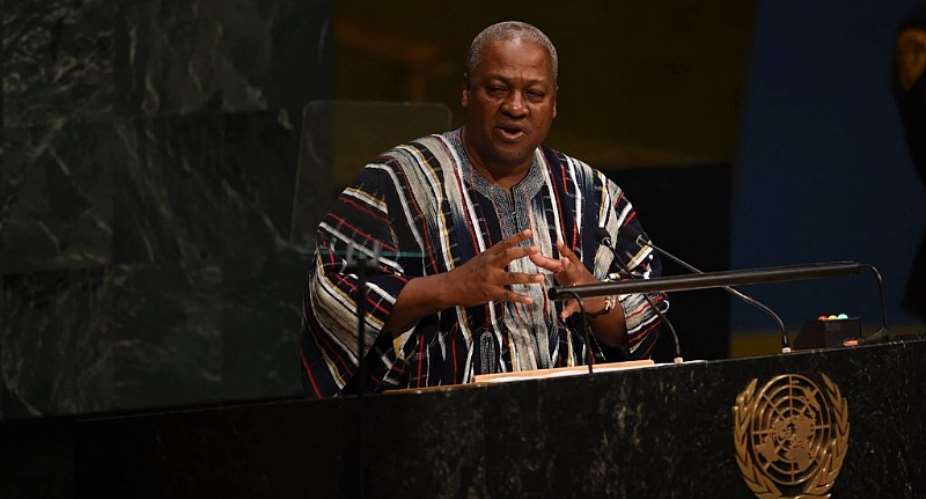
Two days later, Ghana's John Dramani Mahama took the same podium. He called for a return to negotiations and then added a sentence that did not appear to need adding: no human civilisation deserves to be annihilated, certainly not a member state of the United Nations.
He never said the word "Trump," and it would be dishonest to pretend he did. Asked about it at the Council on Foreign Relations, he said he was a student of history, that the idea of annihilating a civilisation is anathema to him, and that he was not referring to anybody. His words, he said, were simple, and that was that.
IV. The Art of Not Naming Names Some commentators have treated that answer as a retreat. I read it as craftsmanship.
A president of a mid-sized African republic cannot afford to pick a fight by name with Washington, and he did not. What he did was harder. He stated a principle so plain that it can only embarrass people who disagree with it. If you are offended by "no civilisation deserves to be annihilated," you have to explain why, out loud.
Consider what he did not do. He did not defend Iran's government. He did not endorse any side's war aims. He did not deny that the region is in crisis. He actually said the Middle East conflict is having a deleterious effect on the world economy, which is a statement about every grocery bill and fuel pump, Ghana's included.
His standard was uniform across every conflict: respect sovereignty, protect civilians, allow humanitarian access, and hold war criminals accountable. A uniform standard is exactly what international politics rarely offers, and it is exactly what a small power can credibly demand.
V. Why Ghana, Why Now The same speech called for permanent African representation on the Security Council, global financial reform, climate finance, and reparatory justice. He also thanked the 123 nations that voted to affirm a resolution recognising the crimes of the transatlantic slave trade.
Read together, these are one argument. A continent that has seen its peoples treated as expendable has earned the right to say that nobody is expendable. Nobody asked Africa's permission when the maps were drawn. Africa is entitled to an opinion when the missiles are drawn.
VI. The Case Against Me An honest column owes you the best counterargument, so here it is.
The skeptic says Mahama's sentence costs nothing. It stopped no war and changed no deadline. He sits at a podium, delivers a line that earns applause, and returns to Accra with the world unchanged. The skeptic adds that Trump's April deadline produced a ceasefire, and that perhaps maximum pressure is the only language certain governments hear. Reasonable people hold this view.
My reply is short. A ceasefire achieved is not an argument for the threat; it is an argument for the exit ramp. And words that normalize the unthinkable do not stay in their lane. Once "a whole civilization" becomes an acceptable object of a sentence, the next speaker finds it easier to say, and the next target finds it easier to hear.
VII. The Verdict Mahama's six words are not diplomacy's finest hour. They are diplomacy's floor, the one thing a body of 193 member states ought to be able to say without a debate. That a debate followed anyway is the story.
So I am for the sentence. Not for any army, any regime, or any press release, but for the sentence. A civilisation is what a people has made across centuries: languages, songs, bridges, bread. It is not a bargaining chip, and it is not a deadline.
Ask yourself one question this week, in whatever country you read this: Which of your civilisation's achievements would you agree to put on someone else's countdown clock?
If the answer is "none," then you already agree with the president of Ghana. Say so, and say it plainly. Plainness was the point.

 Judge halts Ex-NAFCO CEO's trial until ruling on seized phones
 Manhyia South MP who resisted arrest reports to EOCO a day after arrest warrant ...
 "Show us evidence" —Upper West teacher unions demand proof of payment before end...
 Adenta: Bolt driver jailed 25 years for cutlass attack and robbery of beautician...
 EOCO drags Manhyia South MP to former law firm, residence for search
 BNI investigates Yaw Ampofo Ankrah over alleged World Cup visa facilitation sche...
 EOCO arrests three over drone flights at headquarters during arrest, probe of Ma...
 Police arrest three suspected kidnappers over Yendi abduction
 Prof Emmanuel Osei Sarpong appointed Acting NSA Director-General
 NSA Boss Yaw Ampofo Ankrah suspended over US$623,000 World Cup visa allegations


