




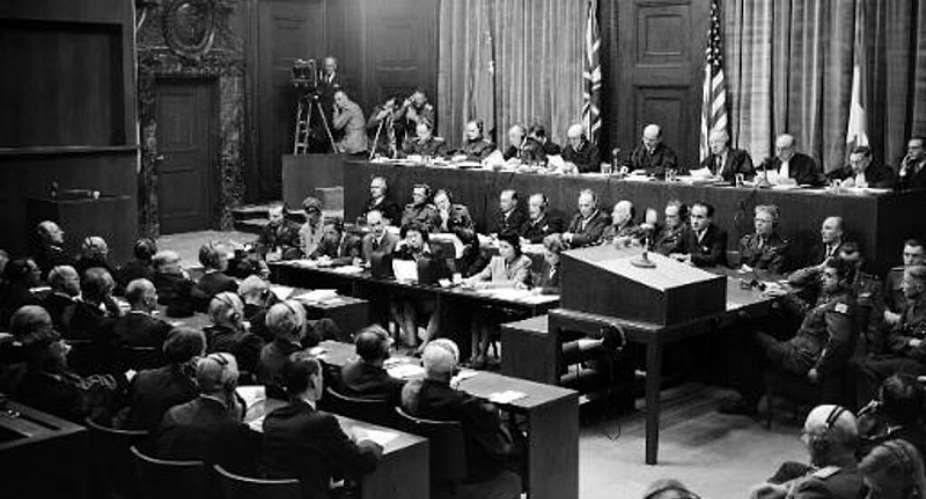
The Nuremberg trials concluded by sentencing 12 Nazi defendants to death and seven to periods of imprisonment ranging from 10 years to life.
Prior to this, international law dealt primarily with states rather than individuals. Nuremberg set the precedent in terms of prosecuting individuals for war crimes, crimes against humanity and crimes against peace.
Following the trials, the United Nations in 1950 codified the Nuremberg Principles – seven guidelines which established principles including individual responsibility, the supremacy of international law, a lack of immunity for heads of state and the fact that following orders did not relieve an individual of responsibility.
These paved the way for the founding in 2002 of the International Criminal Court (ICC), the world's only permanent independent international tribunal, which prosecutes individuals for genocide, war crimes and crimes against humanity.
French judge Bruno Cathala was integral to the creation of the ICC and served as its first registrar from 2003 to 2008. Also the author of Judging Evil: History of International Criminal Justice, he spoke to RFI about why the Nuremberg Trials were a turning point.
How Germany's Nuremberg trial for Nazi crimes transformed international law Prosecutor Ralph Gerhart Albrecht addresses the Nuremberg Trials.
Bruno Cathala: In reality, [Nuremberg] didn't just change the history of international law. It changed the history of the world. Everything changed with Nuremberg.
Before Nuremberg states were sovereign, absolutely sovereign. You couldn't prosecute the leaders of states. States could be held responsible, but not their leaders. In fact, there had been an attempt to prosecute Kaiser Wilhelm II in 1919. He remained in the Netherlands, he was not extradited and so no head of state was ever put on trial.
Then, for the first time in 1945, the idea emerged that it was not only abstract entities, the states, that were responsible, but individuals. That was the great change. There was responsibility and there was an attempt to end impunity. That was the first fundamental change.
The second fundamental change was the idea that states could not simply make whatever laws they wanted, as Nazi Germany had done. In other words, you cannot commit crimes against humanity, genocide or war crimes and claim that you can do whatever you want within your own state. That was also a fundamental change, and it still applies today.
International court convicts CAR rebel commander of crimes against humanity
RFI: So Nuremberg was a trial of many firsts?
BC: The 24 defendants [who were indicted] at Nuremberg were the main surviving Nazi leaders. There was Göring, Hess, Ribbentrop, Rosenberg and other leading Nazi figures.
That was something fundamental. When you see these people in the defendants' box, the world changes. What I mean is that they are finally seen for what they are: criminals sitting in the defendants' box. For the international community, for the victims and for everyone who had suffered, that was an enormous change. Hermann Göring, Rudolf Hess, Joachim von Ribbentrop ad Wilhelm Keitel in the defendants' box.
RFI: Was that the idea of the Nuremberg trials, to send that message to heads of state and leaders?
BC: Absolutely. In reality, the spirit of Nuremberg was not only about sending that message to Nazi Germany, but also about sending it to ourselves – to the Americans, the French and the Russians, the Soviets, who were there.
I will quote what Robert Jackson said, the United States chief prosecutor who was one of the great figures at Nuremberg and one of the great figures in international criminal justice.
Speaking to the judges, he said: “I do not expect that you can make war impossible, but we hope to place the force of international law, its prescriptions and its prohibitions, at the service of peace.”
And that applies regardless of the country.
RFI: After the Nuremberg trials, international justice lay dormant for years, throughout the Cold War. In your book Judging Evil: History of International Criminal Justice, you recall that when you were a student in the late 1970s, one of your professors said: "Prosecuting heads of state? You can't be serious."
BC: That's exactly what has fundamentally changed today. We can no longer say that. There is a concern among different countries and people. Some don't want the International Criminal Court, some want it, some don't want to be tried.
But in the 1970s, nobody was talking about it anymore. As you said, there was a kind of great sleep. On the one hand, there was the Cold War. On the other hand, there were the decolonisation wars. Nobody really wanted to be subject to international justice.
The major change came after the fall of the Berlin Wall. From that point on, states began to agree that things should not only be settled by force, but that wars should finally be dealt with through justice. They used force in the former Yugoslavia and in Rwanda. But they said that those responsible should be tried for the crimes they had committed. On the last day of the Nuremberg trials in August 1946, the 21 accused made their final speeches from the dock.
RFI: Tell us about the beginnings of the ICC...
BC: We started with nothing. The Dutch state had rented us a building that had previously housed the Dutch telecommunications company. It had 13 floors and there was nothing in it. So we had to fill, if you like – this empty shell – with legal texts. We had to build everything.
Bosnian Serb 'Iron Lady' war crimes convict Plavsic dies aged 96
RFI: You've said that creating institutions is a bit like building a house with Lego: what matters is that it holds together. This is an image that is being used again today. US Secretary of State Marco Rubio said recently that he would dismantle the ICC brick by brick. How do you react when you hear such attacks on something you helped create?
BC: I first react by thinking about this history – the history of international criminal justice and the history of the progress of the human spirit. It is a history that is not linear, but it always moves forward. The Americans have done this before. From the beginning, they attacked the ICC, then they came back, then they left again.
There is resistance and opposition from different sides. There is resistance from international public opinion, from NGOs and from states too, because the states that decided to sign up to the International Criminal Court are also putting their sovereignty at stake. So my reaction is that there have always been ups and downs with international criminal justice.
In reality, things evolve in the end. And I think things will gradually change in a positive direction. So, we have to hold on now.
RFI: So you don't think the ICC is in danger of dying today?
BC: As long as we have states that support it, as long as we have high-quality judges, I believe, and as long as we have people who understand that the rule of law is fundamental for them too, I don't think it is in danger of dying.


 Judge halts Ex-NAFCO CEO's trial until ruling on seized phones
 Manhyia South MP who resisted arrest reports to EOCO a day after arrest warrant ...
 "Show us evidence" —Upper West teacher unions demand proof of payment before end...
 Adenta: Bolt driver jailed 25 years for cutlass attack and robbery of beautician...
 EOCO drags Manhyia South MP to former law firm, residence for search
 BNI investigates Yaw Ampofo Ankrah over alleged World Cup visa facilitation sche...
 EOCO arrests three over drone flights at headquarters during arrest, probe of Ma...
 Police arrest three suspected kidnappers over Yendi abduction
 Prof Emmanuel Osei Sarpong appointed Acting NSA Director-General
 NSA Boss Yaw Ampofo Ankrah suspended over US$623,000 World Cup visa allegations


