




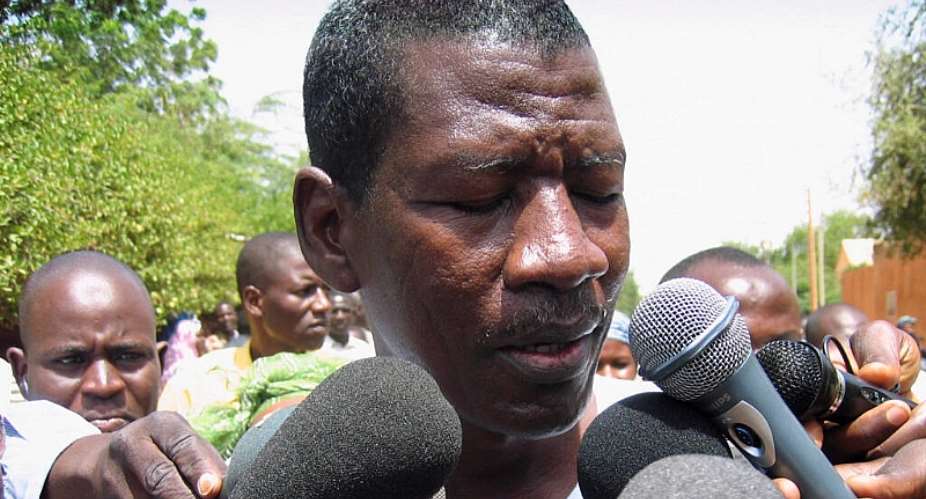
Kaka, a prominent figure in Nigerien journalism and a former RFI correspondent, has spent more than three decades reporting from the country.
He was previously imprisoned in Niamey from September 2007 to October 2008, accused of complicity in threatening state security or authority after interviewing leaders of the Tuareg-led Niger Movement for Justice (MNJ).
Press freedom group Reporters Without Borders (RSF) is calling for an investigation into his disappearance, saying it has strong reason to believe the country's military authorities are involved.
It has now referred the case to the United Nations Committee on Enforced Disappearances, having previously referred it to the African Union's special rapporteur on freedom of expression and access to information.
Tine, founder of the Afrikajom think tank, which focuses on democracy and security in Africa, spoke to RFI about the case. He believes it is part of a wider deterioration of the civic space in Niger since the military, led by General Abdourahamane Tiani, took power in a coup in July 2023.
Former RFI journalist disappears in Niger after attempted coup
RFI: It's now been a month since we last heard from Moussa Kaka. What does that make you think?
Alioune Tine: It is extremely worrying and difficult to understand, particularly in a country where the military is in power. We should be able to protect people's lives and fundamental freedoms. We are very concerned. We strongly want to see clear, concrete signs that Moussa Kaka is alive.
We knew him as a professional journalist who did fantastic work. I knew him personally. I intervened in 2007 and 2008, when he was in prison. I mediated between RFI and president Mamadou Tandja and he was released.
But we knew where to find Kaka. We could speak to the authorities about Moussa Kaka and his freedom. Once there was a connection and people were talking, Moussa was freed.
We're asking the current authorities, and particularly General Tiani, to give us the opportunity to speak with him, to express our concerns and desire to have news of Moussa Kaka, to see him free and continuing to do his work as usual.
RFI: So, for you, is this an enforced disappearance?
It is an enforced disappearance because responsibility lies first and foremost with the Nigerien general, whom we solemnly call on to tell us where Moussa Kaka is, whether he is still alive and, if he is alive, to release him. His family is extremely anxious. Alioune Tine
Niger's junta marks three years amid rising violence and lost freedoms
RFI: Reporters Without Borders believes theNigerien authorities are involved in his disappearance. The G25, which brings together several Nigerien civil society organisations, says that according to its investigation, Kaka is being held by an intelligence service called the DGDSE. Do you find this information credible?
Completely credible, because it's becoming increasingly difficult in Niger to be an independent civil society activist who acts independently and says what they think.
There has been an enormous deterioration in civic space, with human rights violations. All of this means that the people and organisations who believe he is being held hostage by the Nigerien intelligence services have information that is credible today, and that must be taken seriously. We have to ask those responsible – that means the Nigerien authorities – to release Moussa Kaka.
There is absolutely nothing to justify the arrest and enforced disappearance of Moussa Kaka.
RFI: A year ago, several journalists in Niger were arrested. Most of them were subsequently released. Do you see the Nigerien authorities taking a harder line towards the press?
There is a hardening, because it is obvious that serious events have happened recently – the attempted coup [in July 2024]. And when journalists report truths that people do not like, the government takes measures and tries to govern through fear, to terrorise people so that they remain silent.
And that is what's happening. People no longer dare to speak in Niger. It's also happening in [other] African countries where we have military dictatorships.
The African and international communities can't continue to remain completely indifferent to these things – they're dark stains.
RFI: Do you think the African Union and the African Commission on Human and Peoples' Rights (ACHPR) in Banjul could do more?
The ACHPR, which is due to meet in October here in Dakar, is on the front line. The African Union too, ECOWAS and even the Alliance of Sahel States (AES). We have to call on all of them.
African citizens are being arrested. And I think no African, no African institution, should remain indifferent to these phenomena.
What we need today is a real mobilisation of African public opinion in defence of people's fundamental freedoms.
Burkina Faso added to human rights watchlist over crackdown on civil society
RFI: In the three countries of the central Sahel [Mali, Burkina Faso, Niger], the military regimes in power often accuse journalists of not being patriotic enough. Isn't Kaka proof that you can be both an independent journalist and a patriotic citizen who loves his country?
Of course. Most professional journalists are patriotic journalists. That's why they can't be manipulated.
I've been to Mali and worked with independent experts. Journalists are really responsible people, for the most part. They are patriots, for the most part.
So, honestly, I think there's no need to be afraid of the true words of people who present the facts. On the contrary, there needs to be dialogue with journalists to protect the nation and tackle the same challenges – insecurity and attacks by armed terrorist groups.
When it comes to insecurity, there needs to be unity among Nigeriens. Nobody likes to see their country attacked.
In that context, we need to put an end to this never-ending transition. That means the constitutional order must be restored. People must wake up.
RFI: When you were a UN human rights expert, from 2018 to 2024, you met with several West African heads of state. Do you think contact with the Nigerien authorities is possible today?
It's very difficult. I used to find it easy to meet the Nigerien authorities, during [former president Mamadou] Tandja's time. And after Tandja, with [former president Mahamadou] Issoufou and even [former president Mohamed] Bazoum. I see myself as one of the most Nigerien of Senegalese people because I have been with them. When I'm in Niger, I feel at home.
RFI: Do you feel a sense of helplessness in this regard now?
That's it, helplessness. Because there is too much resistance, we're facing such a level of radicalism. It really strips us down.
But we're not despairing. If we have the opportunity to go there, meet the authorities and advocate, we'll do it. We mustn't retreat in the face of the military's resistance.
We see journalists disappearing, we see civil society organisations and leaders disappearing. But that isn't a good image for our continent, for our region.
And it calls on all democrats, all African citizens, all African public opinion, to mobilise to put an end to it. If we mobilise, we can put an end to it.
This interview was adapted from the original version in French by Christophe Boisbouvier.

 Judge halts Ex-NAFCO CEO's trial until ruling on seized phones
 Manhyia South MP who resisted arrest reports to EOCO a day after arrest warrant ...
 "Show us evidence" —Upper West teacher unions demand proof of payment before end...
 Adenta: Bolt driver jailed 25 years for cutlass attack and robbery of beautician...
 EOCO drags Manhyia South MP to former law firm, residence for search
 BNI investigates Yaw Ampofo Ankrah over alleged World Cup visa facilitation sche...
 EOCO arrests three over drone flights at headquarters during arrest, probe of Ma...
 Police arrest three suspected kidnappers over Yendi abduction
 Prof Emmanuel Osei Sarpong appointed Acting NSA Director-General
 NSA Boss Yaw Ampofo Ankrah suspended over US$623,000 World Cup visa allegations


