




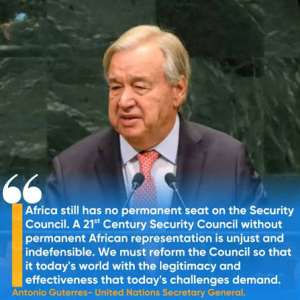
The just-concluded 81st United Nations General Assembly reprovoked a subtle yet very concerning thought in me. Africa is large enough to supply soldiers for peacekeeping, it's large enough to host wars, large enough to bury civilians, large enough to absorb sanctions, refugees, coups, famine and the debris of other people’s foreign policies, yet it's somehow too small to occupy a permanent chair in the room opening where international security is decided. At the ongoing General Assembly in New York, that old absurdity was dragged into the sunlight again. António Guterres, in his final General Assembly address as Secretary-General, called the absence of permanent African representation on the Security Council “unjust and indefensible”. The President of the General Assembly, Annalena Baerbock, put it more poetically, saying Africa “needs to be at the table, not on the menu”. President William Ruto of Kenya went further, asking why Africa should remain permanently discussed but permanently excluded. I almost wanted somebody to hand him a Nigerian microphone and say, “Oga, tell them again.”
But let us remove the diplomatic perfume from this concerning issue. The Security Council was born in 1945, when the world was still counting the deaths of the Second World War and Africa was largely living under colonial rule. The five permanent seats went to the United States, Britain, France, China and the Soviet Union, with Moscow’s seat later passing to Russia. The architecture was therefore not designed by some celestial committee of universal fairness; it was designed around the power realities of a particular historical moment. But then, that moment has gone. Empires have fallen, colonies have become states, the Soviet Union has disappeared, China has transformed, India has risen, Germany and Japan have become economic giants, and Africa has produced 54 United Nations member states. Yet the furniture in the most powerful room has scarcely moved. What sort of institution claims to represent the twenty-first century while retaining the political seating arrangement of the mid-twentieth? Is this reform, or merely history refusing to vacate the premises?
The arithmetic is even more embarrassing. Africa is home to about 1.4 billion people and constitutes 54 of the UN’s 193 member states, and this makes it the largest regional bloc in the organisation, yet no African state possesses permanent representation on the Council. That is not a decorative omission. The Security Council has primary responsibility for international peace and security, and its decisions can carry sanctions, authorisations of force and other consequences that reach far beyond the horseshoe table in New York. Howbeit, Africa has repeatedly been treated as a theatre of international security rather than one of its authors. Somalia, Sudan, the Sahel, Libya and the Great Lakes have all reminded the world that African crises do not remain politely inside African borders. Yet when the prescriptions are written, the patient is frequently outside the consulting room.
There is, however, another chapter in this story, and Africa must be careful not to become so intoxicated by the language of historical injustice that it forgets the mathematics of contemporary power. The African Union’s Ezulwini Consensus and Sirte Declaration have demanded at least two permanent African seats, with the same privileges, including the veto if the veto itself survives reform, alongside five non-permanent seats. The position is not merely emotional, it is an attempt to correct a peculiar contradiction in the international order: Africa is expected to contribute troops, diplomats, money, mediation and political legitimacy to peace operations, but when the architecture of peace itself is being constructed, the continent is expected to wait outside with its credentials in an envelope. Quite funny and infuriating at the same time. The African Model submitted during the current reform negotiations has reaffirmed that position and proposes an enlarged Council with at least two permanent African seats.
History should make the powerful uncomfortable here. The struggle against colonialism was not won because the empire suddenly developed a conscience; it was won because Africans and their allies made the contradiction between colonial domination and the language of universal freedom increasingly impossible to defend. Kwame Nkrumah understood the problem before many of today's diplomats had learned the vocabulary of multilateralism. Patrice Lumumba discovered, at enormous personal cost, what happens when a newly independent African state enters an international system whose ideals and power structures do not always shake hands. Nelson Mandela later demonstrated that African diplomacy could move from the prison cell to the centre of international moral argument. The point is not to romanticise these men. They were human beings, with their errors and contradictions. The point is that history repeatedly shows institutions changing when the excluded refuse to behave as though exclusion were natural. Africa should therefore not approach Security Council reform as a supplicant asking for a favour. As Mahmoud Ali Youssouf, Chairperson of the African Union Commission, has put it, Africa is demanding correction of what he calls a historical injustice.
And yet, here comes the uncomfortable question that Africans themselves must answer. If Africa receives permanent seats, who speaks for Africa? Nigeria? South Africa? Egypt? Algeria? Kenya? Ethiopia? Or will the continent reproduce its familiar habit of entering the same room as 54 flags and leaving with 54 opinions? The greatest danger is not that the world will refuse Africa a chair; it is that Africa will finally receive one and begin fighting over whose backside should occupy it. The African Union has therefore insisted that the continent itself should determine which states represent it, rather than allowing the competition to become another continental beauty contest sponsored by rival foreign powers. This is where diplomacy must become more than ceremonial handshakes and photographs. A permanent African voice must be accountable to an African position, particularly on wars, sanctions, peacekeeping and intervention. Otherwise the chair will belong to Africa only in name while the microphone belongs to somebody else.
I think there is even a deeper irony. The Security Council was created to prevent the catastrophe of another world war, yet its own structure increasingly resembles a museum exhibit from the age that created the catastrophe. The Council has 15 members, five permanent and ten elected for two-year terms, while the permanent five possess the veto that can block substantive decisions. In June 2025, for example, a Gaza ceasefire resolution received 14 votes in favour but failed after the United States cast the sole opposing vote. Whatever one's position on that particular conflict, the episode illustrated the peculiar geometry of the veto: fourteen raised hands can still be defeated by one permanent hand. George Orwell wrote in Animal Farm, “All animals are equal, but some animals are more equal than others.” He was writing fiction, but international politics has occasionally behaved as though it were taking notes.
Guterres has now said, plainly, that “this is 2026, not 1946”, and the sentence deserves to be placed above the entrance of the Security Council chamber. Africa does not need pity from Europe, America, Asia or anybody else. It needs the international system to reconcile its principles with its practices. The continent has been present at the UN since independence, present in peacekeeping, present in mediation, present whenever the world gathers to mourn another African tragedy, and present whenever the Security Council requires an African crisis to be discussed. It is time for Africa to be present where the consequences are decided. Let the diplomats argue about which countries should occupy the seats, what the veto should become and how the Council should be enlarged. Those are legitimate questions. But the larger question should no longer be negotiable: can an organisation proclaim universal security while permanently excluding an entire continent from its highest security table? Africa has sat in the waiting room long enough. The door should now be opened, not because Africa is asking to be treated specially, but because a world that calls itself universal cannot remain comfortable with an architecture built around Africa's absence.
Hashim Yussuf Amao is an award-winning young Nigerian author and a geopolitical analyst.

 Judge halts Ex-NAFCO CEO's trial until ruling on seized phones
 Manhyia South MP who resisted arrest reports to EOCO a day after arrest warrant ...
 "Show us evidence" —Upper West teacher unions demand proof of payment before end...
 Adenta: Bolt driver jailed 25 years for cutlass attack and robbery of beautician...
 EOCO drags Manhyia South MP to former law firm, residence for search
 BNI investigates Yaw Ampofo Ankrah over alleged World Cup visa facilitation sche...
 EOCO arrests three over drone flights at headquarters during arrest, probe of Ma...
 Police arrest three suspected kidnappers over Yendi abduction
 Prof Emmanuel Osei Sarpong appointed Acting NSA Director-General
 NSA Boss Yaw Ampofo Ankrah suspended over US$623,000 World Cup visa allegations


