




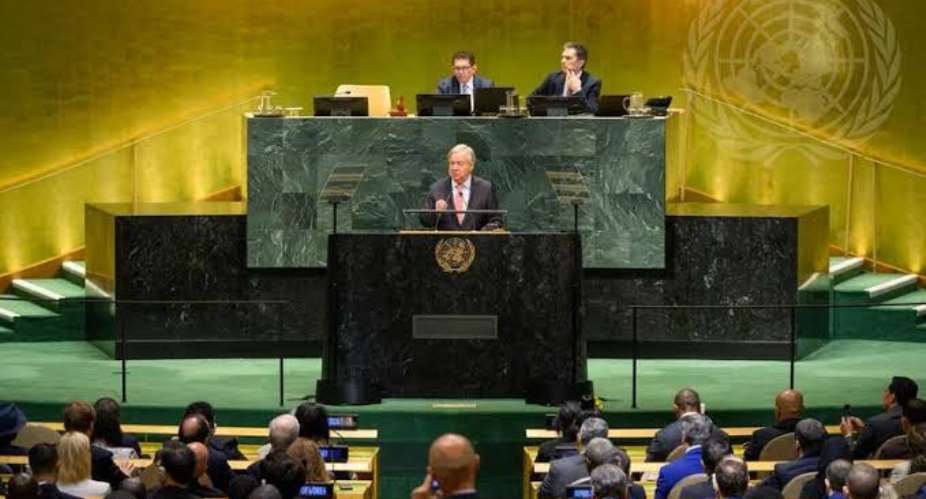
Every September, the same theatrical ceremony unfolds in New York like clockwork.
A procession of the plantation supervisors we call presidents in Africa climbs the rostrum of the United Nations General Assembly, receives a few minutes of applause, and tells the world what they have been repeating since the dawn of time: that Africa deserves a seat at the table.
This year, Africa’s leading Askari, Kenya’s William Ruto, returned to the familiar indictment: “The equality proclaimed in this assembly ends at the doors of the Security Council.”
Ruto was right, but being right is not the same as being powerful. We have heard the same meaningless mantra over a million times.
The UNGA is a theatre of nations, an absurdistic theatre if we have to be frank. Its speeches, crafted by well-remunerated presidential script-writers, can expose hypocrisy; its resolutions can register a conscience.
But when war, sanctions, and the machinery of international order are decided, the Security Council holds the decisive instruments. It’s where the Big Guys meet to decide the fate of the world, and the voice of 1.4 billion Africans is absent.
Five states possess permanent seats and vetoes at the UNSC. Africa, with 54 countries and more than a quarter of the Assembly’s membership, has none.
Two fading European empires, France and Britain, wield them.
The Ezulwini Consensus (the AU stance adopted in 2005) demanded two permanent UNSC seats with veto power and two additional elected seats. Even though the demand has been repeated for years, the locked door has not budged.
Since 2005!
So why do African misleaders keep knocking as though the refusal were a misunderstanding?
My Yoruba people say, Iri ti a ba rọja la nna: goods are priced according to how they are displayed.
Africa presents herself as a petitioner and is priced accordingly.
A leader of a sovereign nation who returns year after year to ask for a chair tells the room's owners that the chair is theirs to give.
What African plantation supervisors fail to understand is that sovereignty is not a gift from those who profit from its absence.
If an institution advertises your inferior status, take the advertisement seriously. Withdraw your deference, build leverage, or build another table.
The leader of the Askari regime in Nairobi, Ruto, himself, without any hint of irony, offered a sharper phrase this year: “Africa does not come to plead. We come with a proposal.”
C’mon, Mr. Ruto, let the proposal be more than another eloquent speech.
The question is not whether African leaders can describe injustice; their scriptwriters can surely wake up decent presidential scripts. The question is whether they will make the cost of ignoring Africa greater than the cost of accommodating it.
And that question begins at home. Too many African rulers who denounce exclusion abroad depend on the same arrangements that keep their citizens out of power.
The colonial administrator once appointed local overseers to manage the estate. Independence changed the flag and the titles; it did not always change the job description. Almost all the so-called African leaders are little more than gatekeepers for Western imperialism.
Nigeria’s Tinubu is a prime example. He has turned Nigeria into a pathetic French poodle in West Africa.
African leaders have learned the master’s language, mastered the rituals of diplomacy, and become experts at keeping the peace on behalf of those who still command the money, the military partnerships and the markets.
Their real audience is too often not the people who elected them, but the chancelleries whose approval keeps them respectable.
Kenya makes the contradiction plain. Ruto speaks of Africa’s sovereignty at the UN while British troops continue to train at BATUK, based near Nanyuki.
Kenya’s own Parliament spent two years investigating allegations of abuse, killings, environmental damage and failures of accountability connected to the unit. The report described the unresolved murder of Agnes Wanjiru, whose body was found in a septic tank in 2012.
These are grave allegations and contested matters; they demand investigation, justice and answers, not diplomatic amnesia.
Rather than resolving this case that borders on Kenya’s sovereignty, Mr. Ruto is in New York fulminating against the injustice of the international order.
Agnes Wanjiru's tragic episode reveals something important Mr. Ruto didn’t understand: sovereignty is not a line in a speech. It is a power exercised or surrendered.
Despite his well-applauded lofty speeches, even Ghana, the president of Kwame Nkrumah’s homeland, still confronts the humiliating arithmetic of dependence. Eminent Economist Kwame Pianim called his country a neocolony.
The question arises: why do African leaders speak of solidarity at international fora while national governments hesitate to act together, even within sub-regional bodies like ECOWAS or the EAC?
These leaders must know that when they stay silent or are absent from rooms where power is being exercised, silence is no longer neutrality.
It is a policy choice, and the powerful countries are adept at reading it.
Nkrumah taught us that freedom begins in the mind. Fanon explained the psychology of how colonial rule trains the colonized to mistake imitation for advancement. Marley later gave the same warning in a melody: emancipate yourselves from mental slavery. Ubuntu tells us that a person becomes a person through other persons.
Applied to statecraft, that is not a greeting-card sentiment; it is a strategy. Fifty-four African countries acting separately are easy to flatter, divide and ignore.
Divide and rule is a time-tested tool of imperialism.
A bloc that coordinates its votes, markets, minerals, ports and diplomatic positions can negotiate with some leverage. A bloc that merely applauds its own speeches cannot.
This is the simple geopolitical arithmetic the gaggle of Uncle Toms misleading Africa failed to grasp.
Geopolitics enchew sentimentality. Africans should be clear-eyed about what a UNSC seat would - and would not - do.
Let’s not deceive ourselves: an African permanent member of the UNSC would not automatically speak for African citizens; it could well become just another platform for elite vanity, grandstanding, backroom bargains, and protecting incumbents in power for like forever and a half. Nor would a veto feed a child, keep a school open, or stop a mine from leaving a poisoned river.
We need to realize that, for us in Africa, representation matters because decisions made without those most affected are unjust, and because representation can create leverage.
But we should know that a chair is an instrument, not emancipation. The test is not simply who sits there. It is whose interests that person serves, and what organized power stands behind them that should be of primary interest to us.
African unity cannot be conjured up for one annual speech in New York. It must be practiced when interests diverge, and the pressure to defect is real.
A common African position cannot mean pretending that every country wants the same thing; it means negotiating differences before foreign powers exploit them. It means asking, in advance, what the bloc will defend together, and what price it will exact if its red lines are crossed.
Without that discipline, “Africa speaks with one voice” but remains a fine phrase repeated by fifty-four governments speaking separately.
The work before Africa is practical. We should agree on common priorities before arriving in New York with our unwieldy entourage (Nigeria sent 128 delegates!) We should use the African Union to bargain as a unit, not as a ceremonial chorus. That's what Europe does with the EU. We should tie access to resources and markets to transparent terms. Defend regional institutions from leaders who weaken them for short-term advantage. Demand that foreign military agreements answer to domestic law.
And when a global institution like the UN refuses reform, we should stop pretending that another speech is itself a strategy. We must learn how to build leverage before we can spend it. We should boycott it until the big powers come to their senses.
No one should mistake this for a call to abandon diplomacy. Diplomacy does indeed matter, but diplomacy without power is petitioning in an expensive Savile Row suit.
The Security Council will not open its doors because African leaders have made a moving case for fairness. It will change when a united Africa has something the Council cannot afford to ignore, and the discipline to withhold it until the terms change.
Until then, the ritual will continue: applause for the speech, no chair for the speaker, and a continent asked to accept performance in place of power.
The question is no longer whether Africa has made her case. She has. The question is whether her leaders will stop asking to be admitted to a house whose owners have repeatedly shown them the door, and finally build a house of their own.
Ọ̀dọ̀fin Fẹ́mi Akọ́mọláfẹ́ (1st Dan, Ọ̀dọ̀fin I of Kasoa)

 Judge halts Ex-NAFCO CEO's trial until ruling on seized phones
 Manhyia South MP who resisted arrest reports to EOCO a day after arrest warrant ...
 "Show us evidence" —Upper West teacher unions demand proof of payment before end...
 Adenta: Bolt driver jailed 25 years for cutlass attack and robbery of beautician...
 EOCO drags Manhyia South MP to former law firm, residence for search
 BNI investigates Yaw Ampofo Ankrah over alleged World Cup visa facilitation sche...
 EOCO arrests three over drone flights at headquarters during arrest, probe of Ma...
 Police arrest three suspected kidnappers over Yendi abduction
 Prof Emmanuel Osei Sarpong appointed Acting NSA Director-General
 NSA Boss Yaw Ampofo Ankrah suspended over US$623,000 World Cup visa allegations


