





1.0 Introduction
Illegal wildlife trade is a global conservation challenge valued at billions of dollars and involving large numbers of wildlife specimens each year (Shepherd et al., 2017). One of the major drivers of species decline and local extinction is overexploitation (Ingram et al., 2018). Over the years, researchers have documented wildlife hunting and markets at local and international scales, with numerous reports drawing attention to both legal and illegal trade in pangolins (Nijman et al., 2016).
Pangolins are remarkable and evolutionarily distinct mammals. They are the world's only truly scaly mammals, with unique morphological and ecological adaptations that have developed over millions of years (Pietersen & Challender, 2019). Yet these distinctive animals face severe conservation pressure. Pangolins are widely recognised as among the most heavily trafficked wild mammals globally, and all eight species are threatened with extinction (Choo et al., 2020; IUCN SSC Pangolin Specialist Group, 2025). The demand for pangolins is linked largely to their meat and scales, including their use as food and in traditional medicine. These perceived economic and medicinal values have contributed to extensive hunting and poaching, placing serious pressure on wild populations (Hua et al., 2015). The conservation concern is therefore not simply about protecting an unusual animal; it is about preventing further population decline and possible extinction.
Conservation broadly involves the responsible management of biodiversity and natural resources so that they can provide benefits to present generations without undermining their availability to future generations. In the case of pangolins, this principle has prompted governments, conservation organisations, researchers and communities to strengthen efforts aimed at reducing illegal trade and protecting remaining populations. Against this background, this article highlights selected examples of pangolin conservation efforts across different countries. These examples show that conservation requires a combination of law enforcement, research, public participation, local knowledge, rescue and rehabilitation, and long-term management. Such coordinated action is essential for protecting pangolins, one of the world's most heavily trafficked wild mammals (Challender et al., 2014).
2.0 Examples of Pangolin Conservation Efforts Around the World
2.1 Zimbabwe: Stronger monitoring and enforcement
Zimbabwe provides an important example of how law enforcement and systematic monitoring can contribute to pangolin conservation. Although pangolin-related wildlife crime has been a concern, strict regulations and close monitoring have supported conservation efforts. Shepherd et al. (2017) reported that pangolin-related crime was relatively low in Zimbabwe between 2000 and 2012, while also documenting the country's firm approach to illegal possession and trade. The Zimbabwean experience demonstrates the value of treating wildlife crime seriously and maintaining consistent enforcement.
2.2 Vietnam: Using local knowledge to support conservation
In Vietnam, conservation study has demonstrated the importance of involving people who possess detailed knowledge of local wildlife. Newton et al. (2008) showed that information from local hunters can help researchers understand the distribution, status and threats facing elusive species such as pangolins. Although hunting itself is a major conservation concern, carefully gathered local ecological knowledge can provide valuable information where conventional wildlife surveys are difficult.
2.3 Singapore: Public participation and wildlife management
Singapore has also used institutional and public cooperation in pangolin conservation. Conservation initiatives involving government agencies and the public have encouraged the reporting and safe return of displaced or rescued pangolins to appropriate habitats and reserves. Such approaches demonstrate that the public can become an important partner in wildlife management when people know how to respond to encounters with threatened species (Pantel & Chin, 2009).
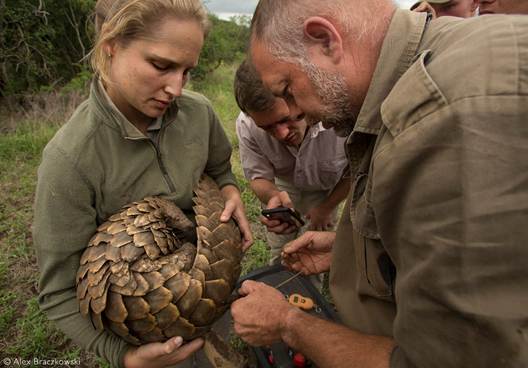
Rescued pangolin given a rare second chance in conservation first (www. africageographic.com). Accessed on 26/10/2026
2.4 China: Awareness and demand reduction
China has long been an important focus in discussions about pangolin trade because demand for pangolin products has contributed to pressure on wild populations. Alongside regulation and enforcement, public education and demand-reduction campaigns have become important conservation tools. Environmental organisations have used public service announcements and prominent advocates to raise awareness about pangolin trafficking and the ecological importance of wildlife conservation. Such campaigns are most effective when they complement, rather than replace, strong laws, enforcement and changes in consumer behaviour.
2.5 India: Conservation breeding and scientific management
In India, Nandankanan Zoological Park has contributed to the conservation of the Indian pangolin by improving knowledge of the species' behaviour, nutrition, reproduction and health care. Mohapatra and Panda (2014) highlighted the role of husbandry and conservation breeding in building knowledge that may support the management of this difficult-to-study species. Captive management alone cannot solve the threats facing wild pangolins, but carefully managed programmes can contribute to research, veterinary knowledge and conservation planning.
3.0 Why Global Cooperation Still Matters
The experiences of Zimbabwe, Vietnam, Singapore, China and India illustrate that no single intervention is sufficient. Pangolin trafficking crosses local and national boundaries, while habitat loss and hunting pressures vary across regions. Effective conservation therefore requires cooperation among range states, law-enforcement agencies, scientists, local communities, conservation organisations and the public. International protection has also strengthened over time. All eight living pangolin species are listed in Appendix I of the Convention on International Trade in Endangered Species of Wild Fauna and Flora (CITES), which provides the highest level of protection from international commercial trade under the Convention. However, legal protection must be matched by effective implementation, monitoring and enforcement if it is to translate into recovery of wild populations.
The comprehensive list of the eight pangolin species, grouped according to their geographic regions (Africa and Asia), is provided below (www.worldwildlife.org; www.rekoforest.org; www.savepangolins.org):
African Species:
- Black-bellied pangolin (Phataginus tetradactyla);
- White-bellied pangolin (Phataginus tricuspis);
- Giant Ground pangolin (Smutsia gigantea);
- Temminck's Ground pangolin (Smutsia temminckii);
Asian Species:
- Indian pangolin (Manis crassicaudata);
- Chinese pangolin (Manis pentadactyla);
- Sunda pangolin (Manis javanica); and
- Philippine pangolin (Manis culionensis)
4.0 Conclusion
All eight pangolin species remain threatened with extinction. Current assessments range from Vulnerable to Critically Endangered, reflecting continuing pressures from overexploitation, illegal trade and habitat loss (IUCN SSC Pangolin Specialist Group, 2025). This makes pangolin conservation a continuing global responsibility rather than a problem that has already been solved.
Countries and conservation organisations have adopted different approaches, including stronger law enforcement, research, conservation breeding, public education, rescue programmes and the use of local ecological knowledge. These efforts provide important lessons, but their long-term success will depend on sustained enforcement, habitat protection, reduction in illegal demand and meaningful community participation. Protecting pangolins ultimately requires moving beyond concern to coordinated and measurable conservation action.
By Emmanuel Bonney
References
- Challender, D. W. S., Waterman, C., & Baillie, J. E. M. (2014). Scaling up pangolin conservation: IUCN SSC Pangolin Specialist Group conservation action plan. Zoological Society of London.
- Choo, S. W., Zhou, J., Tian, X., Zhang, S., Qiang, S., O'Brien, S. J., Tan, K. Y., Platto, S., Koepfli, K. P., Antunes, A., & Sitam, F. T. (2020). Are pangolins scapegoats of the COVID-19 outbreak-CoV transmission and pathology evidence? Conservation Letters, 13(6), 1-12. https://doi.org/10.1111/conl.12754
- Heinrich, S., Wittmann, T. A., Prowse, T. A. A., Ross, J. V., Delean, S., Shepherd, C. R., & Cassey, P. (2016). Where did all the pangolins go? International CITES trade in pangolin species. Global Ecology and Conservation, 8, 241-253. https://doi.org/10.1016/j.gecco.2016.09.007
- Hua, L., Gong, S., Wang, F., Li, W., Ge, Y., Li, X., & Hou, F. (2015). Captive breeding of pangolins: Current status, problems and future prospects. ZooKeys, 507, 99-114. https://doi.org/10.3897/zookeys.507.6970
- Ingram, D. J., Coad, L., Abernethy, K. A., Maisels, F., Stokes, E. J., Bobo, K. S., et al. (2018). Assessing Africa-wide pangolin exploitation by scaling local data. Conservation Letters, 11(2), 1-9. https://doi.org/10.1111/conl.12389
- IUCN SSC Pangolin Specialist Group. (2025). Pangolins still at risk: New Pangolin Specialist Group report calls for stronger global action.
- Mohapatra, R. K., & Panda, S. (2014). Husbandry, behaviour and conservation breeding of Indian pangolin. 63(2), 73-80.
- Nash, H. C., Wong, M. H. G., & Turvey, S. T. (2016). Using local ecological knowledge to determine status and threats of the Critically Endangered Chinese pangolin (Manis pentadactyla) in Hainan, China. Biological Conservation, 196, 189-195. https://doi.org/10.1016/j.biocon.2016.02.025
- Newton, P., Van Thai, N., Roberton, S., & Bell, D. (2008). Pangolins in peril: Using local hunters' knowledge to conserve elusive species in Vietnam. Endangered Species Research, 6(1), 41-53. https://doi.org/10.3354/esr00127
- Nijman, V., Zhang, M. X., & Shepherd, C. R. (2016). Pangolin trade in the Mong La wildlife market and the role of Myanmar in the smuggling of pangolins into China. Global Ecology and Conservation, 5, 118-126. https://doi.org/10.1016/j.gecco.2015.12.003
- Pantel, S., & Chin, S. Y. (2009). Proceedings of the workshop on trade and conservation of pangolins native to South and Southeast Asia, 30 June-2 July 2008, Singapore Zoo, Singapore. TRAFFIC Southeast Asia.
- Pietersen, D. W., & Challender, D. W. S. (2019). Research needs for pangolins. In Pangolins: Science, Society and Conservation. https://doi.org/10.1016/B978-0-12-815507-3.00034-4
- Shepherd, C. R., Connelly, E., Hywood, L., & Cassey, P. (2017). Taking a stand against illegal wildlife trade: The Zimbabwean approach to pangolin conservation. Oryx, 51(2), 280-285. https://doi.org/10.1017/S0030605316000119
Profile of the Author


 Ghana gaining notoriety for cocaine — Bawumia
 Bawumia exposes NDC's ‘scam’ promises to Ghanaians
 NPP chairmanship: Sammy Crabbe backs John Boadu in last-minute show
 EOCO detention won't stop me from representing Salomey – Baffour Awuah
 NPP’s focus is to reclaim power in 2028 — Osahen Afenyo-Markin
 NPP must put aside differences, unite to rebuild party – Odeneho Kwaku Appiah
 NPP delegates approve 14 constitutional amendment motions
 NDC's 24-hour economy has turned into ‘24-hour demolition’ — Bawumia
 NPP adopts amendment to make flagbearer party leader
 NDC delegation exit NPP conference over delays, poor communication


