




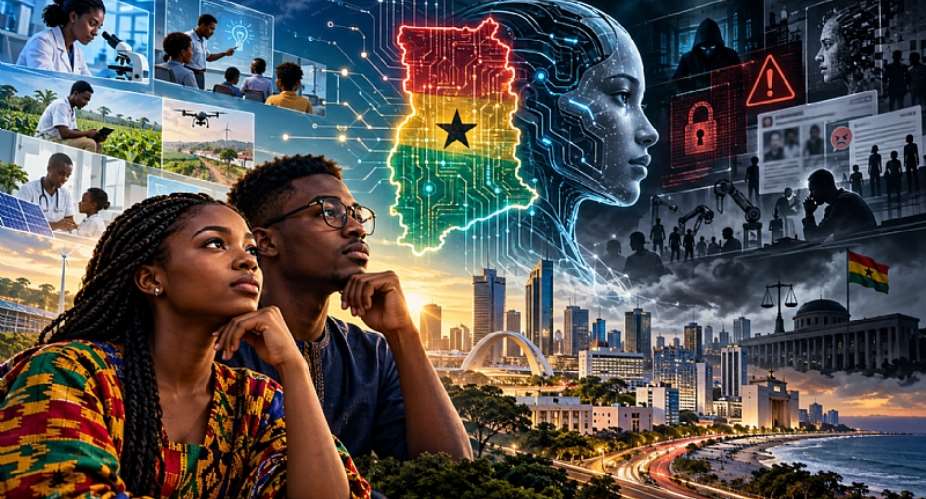
Artificial Intelligence is moving faster than many governments, schools, businesses, and societies are prepared for. What sounded like science fiction only a few years ago is now becoming ordinary life. Machines can write reports, generate realistic images, imitate human voices, analyse medical information, create computer code, support financial decisions, translate languages, and communicate with people in ways that increasingly resemble human interaction.
The question is no longer whether artificial intelligence will transform society. It already is.
The more difficult question is whether humanity is prepared for what comes next.
Some people speak about artificial intelligence as though it will inevitably destroy humanity. Others dismiss such fears as exaggerated. The truth is likely to be more complicated. Nobody can state with certainty that AI will wipe out humanity within the next decade. But it would be equally dangerous to assume that because the most dramatic predictions are uncertain, there is nothing to worry about.
For Ghana, the real danger may arrive long before any science fiction scenario involving machines taking control of the world.
It may arrive through unemployment, misinformation, cybercrime, digital dependency, inequality, privacy violations, and weak national preparedness.
The first threat may be to our jobs Ghana already has a serious employment challenge. Thousands of young people graduate from universities and other tertiary institutions every year with expectations of entering professional careers. Yet many struggle to find stable employment.
Artificial intelligence could make this problem more complicated.
Today, AI systems can already perform parts of the work done by customer service officers, journalists, accountants, programmers, researchers, administrative assistants, marketers, translators, designers, and financial analysts.
This does not mean that all these professions will disappear. Human beings will continue to play important roles in many occupations. But the nature of work is changing rapidly.
The real question is whether Ghana's educational system is changing at the same speed.
If universities continue training students mainly to perform routine tasks that intelligent machines can increasingly complete within seconds, we may be preparing young people for jobs that are gradually disappearing.
Our educational institutions must begin producing graduates who can think critically, solve complex problems, innovate, conduct research, create businesses, and work intelligently with advanced technologies.
AI literacy should eventually become as important as computer literacy.
Ghana could face a misinformation crisis One of the most frightening aspects of modern artificial intelligence is its ability to create convincing false information.
A realistic photograph can be generated without a camera.
A person's voice can be imitated.
A video can be manipulated to make somebody appear to say something they never said.
An entire news story can be created within seconds.
For a country where social media has become one of the main sources of information for millions of citizens, this should concern us.
Imagine a fake video of a political leader spreading across social media during an election.
Imagine an artificial voice recording claiming that a major bank is collapsing.
Imagine a fabricated video appearing to show violence between communities.
The content could be false, but the consequences could be very real.
Artificial intelligence has dramatically reduced the cost of creating convincing misinformation. Ghana therefore needs stronger systems for media literacy, digital verification, fact checking, public communication, and responsible use of synthetic media.
Citizens must increasingly learn that seeing and hearing something online is no longer enough to prove that it happened.
Cybercriminals will also have AI We often discuss artificial intelligence as a tool for businesses, students, and researchers. But criminals have access to many of the same technologies.
Artificial intelligence can help criminals write convincing fraudulent messages, imitate trusted individuals, automate scams, search for weaknesses in digital systems, and manipulate people more effectively.
This should matter greatly to Ghana.
Our financial system is becoming increasingly digital. Mobile money has become part of everyday life. Banking services are moving online. Government services are becoming digital. Universities, hospitals, telecommunications companies, and businesses store enormous amounts of information electronically.
Digitalisation brings convenience, but it also creates vulnerabilities.
The more Ghana depends on digital infrastructure, the more seriously the country must take cybersecurity.
In the age of artificial intelligence, cybersecurity cannot be treated simply as an information technology department's responsibility.
It is becoming a national security responsibility.
We must avoid becoming permanent consumers Perhaps Ghana's biggest long term risk is technological dependence.
Most of the world's most powerful artificial intelligence systems are being developed outside Africa. Ghana, like many African countries, is currently far more likely to consume AI technologies than to create them.
That should concern us.
If artificial intelligence becomes fundamental to education, healthcare, finance, defence, communication, agriculture, government, and business, then countries that control the technology will possess enormous influence.
Ghana cannot spend the next decade merely opening accounts on foreign AI platforms and calling that digital transformation.
We need to build.
We need stronger computing infrastructure, better research laboratories, local data centres, advanced technical training, stronger universities, and greater investment in artificial intelligence research.
Young Ghanaian researchers and engineers should not only learn how to use existing AI systems. They should understand how these systems are built, trained, evaluated, secured, and improved.
The countries that build the next generation of technologies will shape the rules of the future.
Ghana should not be absent from that table.
Our languages and culture must not disappear digitally There is also a quieter danger.
Artificial intelligence learns from data.
Languages, cultures, histories, and communities that are poorly represented in digital data may also be poorly represented in future intelligent systems.
English dominates much of the internet and many major technology platforms. Ghanaian languages remain significantly less represented.
What happens when increasingly powerful AI systems become major sources of education, information, communication, and knowledge, but understand our languages and cultural contexts poorly?
Twi, Ewe, Ga, Fante, Dagbani and other Ghanaian languages should not become digital afterthoughts.
Universities, technology companies, government institutions, and researchers must begin investing seriously in local language datasets, speech technologies, translation systems, and culturally relevant artificial intelligence.
Our participation in the AI revolution should include our identity.
Ghana needs rules before serious harm occurs Technology usually moves faster than regulation.
That is already happening with artificial intelligence.
Ghana needs a serious national framework for responsible AI development and use.
The country must confront questions involving privacy, discrimination, data protection, cybersecurity, intellectual property, automated decision making, deepfakes, accountability, and transparency.
Who is responsible when an artificial intelligence system makes a harmful decision?
Should banks be allowed to use AI to determine who receives loans without explaining the decision?
Should hospitals use AI systems that have not been properly tested on African populations?
Should students be allowed to submit completely AI generated academic work?
Should government institutions use facial recognition technologies without strong safeguards?
These are no longer theoretical questions.
They are governance questions.
And Ghana should answer them before problems become crises.
Education may determine whether AI becomes a threat or an opportunity One of the worst responses Ghana could make is to simply ban artificial intelligence in schools and universities.
Students are already using it.
Workers are already using it.
Businesses are already using it.
The better solution is education.
Students should learn how to verify AI generated information, identify errors, recognise bias, protect confidential information, cite sources properly, and use technology as a tool rather than a substitute for thinking.
Teachers and lecturers also need training.
So do journalists, lawyers, health professionals, public servants, business executives, security agencies, and policymakers.
Artificial intelligence cannot remain a conversation for computer scientists alone.
Its consequences will affect almost every profession.
The greatest danger may still be human irresponsibility Perhaps artificial intelligence will never become the uncontrollable superintelligence imagined in science fiction.
But humanity does not need machines to become evil for AI to become dangerous.
We only need powerful technology combined with irresponsible people, weak institutions, poor regulation, economic desperation, political manipulation, or criminal intent.
That possibility is already real.
Artificial intelligence could become one of the greatest tools humanity has ever created. It could help doctors detect disease, help farmers improve production, support students, accelerate scientific discoveries, improve government services, strengthen businesses, and create new industries.
Ghana could benefit enormously.
But benefits are never automatic.
A country that fails to prepare could experience the darker side of the same revolution through job losses, misinformation, digital inequality, cybercrime, foreign technological dependence, and social disruption.
The next decade will therefore be critical.
Ghana must invest in AI education.
We must strengthen cybersecurity.
We must support local research and innovation.
We must protect our languages and data.
We must develop appropriate regulation.
We must prepare workers for changing industries.
Above all, we must stop treating artificial intelligence as something happening somewhere else.
The technology is already here.
The question is whether Ghana will shape its future or simply experience whatever future others create for us.
Artificial intelligence may or may not become humanity's greatest threat.
But failing to prepare for it could become one of Ghana's greatest mistakes.

 “Disband Black Stars, sack FA and let FIFA ban us for two years” – Sam George af...
 Young man blows GH₵280,000 bet wins on five iPhone 17 Pro Max, other items
 NPP executive elections: Justin Kodua dismisses claims of blocking constituency ...
 South Africa summons US ambassador for 'record' third time
 Israel-bound flight diverted to Saudi Arabia after brawl between pilots
 Dangote to launch $16bn refinery in Kenya
 GNFS rescues driver trapped in overturned tipper truck at Bolgatanga
 Ghana, Luxembourg to explore visa waiver agreement
 Tullow loses $393m tax arbitration case against Ghana – Finance Minister
 Bawumia outlines policy proposals to grow Ghana’s insurance industry


