




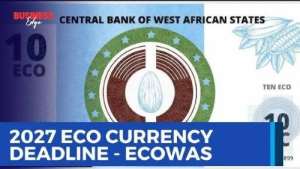
The Economic Community of West African States (ECOWAS) has confirmed a July, 2027 launch date of its regional currency. But ECOWAS has not resolved several fundamental concerns with regard to the exchange-rate framework, monetary policy governance, the role of countries currently using the CFA franc (how would a new ECOWAS monetary authority interact with the existing monetary institutions and arrangements of the CFA franc countries), and the institutional structure of the proposed regional central bank. The successful launch of the ECO depends largely on the resolution of some economic and financial matters that remain central to the effectiveness of the common currency in the future.
The Convergence Council resolved that the launch of the ECO will be done in phases. Phase 1 will comprise Ghana, Nigeria, Sierra Leone, Liberia, Guinea and the Gambia. These core countries in the phase 1 will launch the common currency in July, 2027 if unforeseen circumstances do not urge for a push back of the launch date. But Guinea has indicated it won’t be part of the ECO in the meantime, and it has given compelling reasons for it.
Given ECOWAS’ stated objective of launching the ECO in 2027, the legal and institutional framework for the proposed Regional Central Bank should have been sufficiently advanced before the currency is introduced. The Regional Central Bank is very critical in the effective implementation of the common currency. The Central Bank cannot effectively assume responsibility for a common monetary policy without a clearly established legal mandate, governance structure, operational powers and clearly instituted relationship with the national central banks of the various countries of the union.
The legal framework would need to establish, among other things:
The legal personality and independence of the Central Bank; its mandate and objectives; who appoints the Governor of the Regional Central Bank and its governing board; the structure and voting rules of the Monetary Policy Committee (the MPC); the bank’s authority to issue ECO as a currency; rules for monetary-policy decisions; management of international reserves of the various countries of the monetary union; lender of last resort powers of the Regional Central Bank; banking and financial system responsibilities; capital contributions by member states; rules for seigniorage; accounting and auditing; dispute resolution mechanisms and the legal relationship between the Regional Central Bank and the national governments.
The Regional Central Bank is so essential that ECOWAS cannot underestimate its relevance by scheduling a date for the launch of the ECO before putting in place the core structures of the Regional Central Bank. The structures of the Regional Central Bank must precede the launch by a wide margin.
In a monetary union, the Central Bank is the single institution that sets monetary policy for all members (member countries of the union). Member states give up their own central banks’ control over money, so the Regional Central Bank of the union has to do that job for the whole area. A single central bank without some fiscal coordination and banking oversight to back it up will prove fragile. The Eurozone learnt that the hard way.
The core functions of a Regional Central Bank include:
Common monetary policy: It sets policy rates, manages liquidity and targets inflation for the union as a whole. Individual members can no longer adjust rates or devalue to respond to a local shock.
Currency issuance and payments: It issues the currency, oversees the payment and settlement systems, and manages the pooled foreign reserves and exchange-rate regime.
Lender of last resort: It provides emergency liquidity to solvent banks in trouble. The ECB's role in the eurozone debt crisis (the "whatever it takes" moment) showed how much market confidence depends on this.
Financial stability and supervision: It oversees banks, or coordinates with national supervisors, so that a failure in one country doesn't spread across the union.
It is harder in a monetary union because a single policy rate can be too loose for one member and too tight for another. This is the standard optimum currency area problem, and it is sharp in ECOWAS, where inflation runs from single digits in the CFA zone to much higher in Nigeria, Ghana and Sierra Leone.
If members can borrow freely and expect the central bank to bail them out, monetary policy gets pulled toward financing deficits. That is why unions insist on convergence criteria and rules against monetary financing of governments. Fiscal discipline is therefore essential to the success of the implementation of the common currency.
Credibility depends on legal independence, clear voting rules, and a mandate (usually price stability) that no one member can override. These are the issues ECOWAS still has to settle before the ECO is launched.
Before the ECO becomes a stable and effective regional currency that could strengthen economic integration, reduce transaction costs, simplify cross-border trade, and encourage investment across West Africa, ECOWAS need to design an independent and effective Regional Central Bank.
The fundamental question is not merely whether ECOWAS can launch the ECO in 2027, but rather whether the institutional architecture necessary to make the currency credible, stable and sustainable will be ready by 2027. Therefore, ECOWAS should not allow the announcement of a launch date to substitute for the institutional preparation required to make the ECO credible.
Emmanuel Kwabena Wucharey
Economics Tutor, Policy Advocate and Religion Enthusiast.


 “Disband Black Stars, sack FA and let FIFA ban us for two years” – Sam George af...
 Young man blows GH₵280,000 bet wins on five iPhone 17 Pro Max, other items
 NPP executive elections: Justin Kodua dismisses claims of blocking constituency ...
 South Africa summons US ambassador for 'record' third time
 Israel-bound flight diverted to Saudi Arabia after brawl between pilots
 Dangote to launch $16bn refinery in Kenya
 GNFS rescues driver trapped in overturned tipper truck at Bolgatanga
 Ghana, Luxembourg to explore visa waiver agreement
 Tullow loses $393m tax arbitration case against Ghana – Finance Minister
 Bawumia outlines policy proposals to grow Ghana’s insurance industry


