




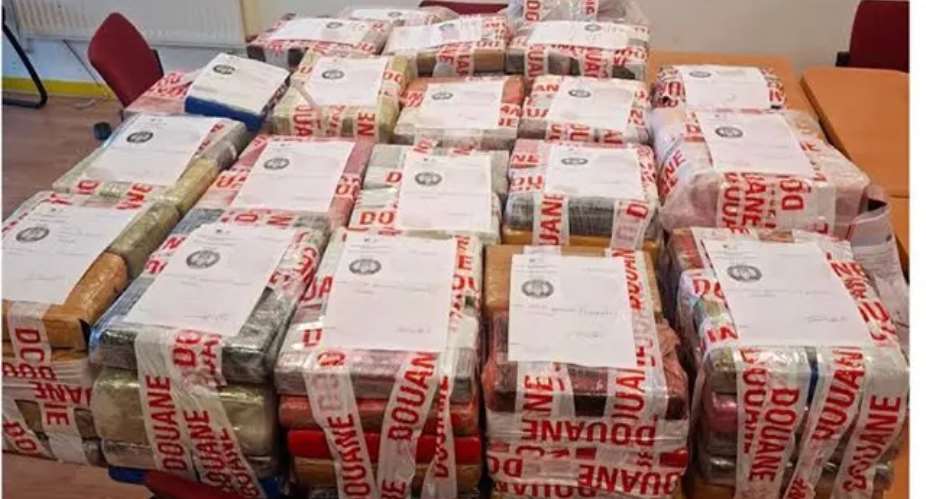
In a fully functioning democracy, a breach of this magnitude, tonnes of cocaine seamlessly funneled from Ghanaian shores to European markets, would trigger immediate political heads rolling and systemic accountability. If the President failed, DCOP Abdul-Osman Razak, Ghana’s National Security Coordinator should have triggered immediate high-level resignations, specifically because the buck stops directly at his desk for failure to detect or prevent this monumental security compromise.
Critically looking at a 33-year timeline of cocaine saga in Ghana, I do not see isolated busts. Instead, I see a textbook case of an entrenched transit economy that has survived four Republics, two political parties, and every reform written on paper. The kingpin is not one man; the kingpin is a system.
An empirical analysis of the data spanning from 1993 to 2026 reveals three distinct structural escalations in the operational dynamics of the network. The initial epoch, I designate as Phase 1 (1993–2004), or "The Courier Phase," represents the foundational stage of this developmental trajectory. Characterized by small seizures, such as 264kg in 1996, 588kg at Tema in 2004, and 580kg at Mpaesem in 2005. During this period, Ghana served primarily as a courier route, with traffickers relying on human mules and cargo supervisors at Kotoka International Airport (KIA).
Phase 2 (2006–2014), designated as "The Bulk Maritime Phase," marked a structural transition toward high-capacity maritime logistics, characterized by a significant escalation in both the scale and organizational sophistication of transit operations. The critical inflection point occurred with the MV Benjamin in April 2006, which yielded 77 parcels (approximately 2.31 tonnes). This was followed by the MV St. Efrem (154kg) in 2009, the MV Attiyah (400kg+) in 2013, and the Nayele Ametefeh 12.5kg Heathrow case in 2014. The primary trafficking method shifted decisively from air to sea, with cocaine from Latin America moving in containerized bulk and via fishing vessel transfers in the Gulf of Guinea.
Phase 3 (2020–2026), termed "The Industrial Phase," reflects the ultimate maturation of this operational evolution into an institutionalized, high-volume apparatus, characterized by systemic infiltration, advanced infrastructural leverage, and large-scale industrial distribution channels. Seizures scaled dramatically: 158kg in 2020, 117kg in 2022, 166kg at KIA in 2024, 3.3 tonnes in Cape Coast in March 2025, 866 parcels at Tema on August 5, 2026, and 3.9 tonnes in Dunkirk in September 2026 from a Ghana-linked container. We have officially moved from kilograms to multi-tonnes.
Technically, narcotics enforcement experts argue that, when seizures grow larger over time, it does not mean law enforcement is getting better; it means overall volume is expanding. Typically, a seizure accounts for only 10-15% of the actual flow. Domestic institutional vulnerabilities were fundamentally anchored in severe evidence custody failures. This was the original sin of the cocaine issues bedeviling Ghana. Systemic compromises, substitutions, or disappearance of seized illicit materials consistently undermined judicial prosecution and institutional accountability from the outset.
The single most damaging entry on Ghana’s cocaine saga was in 2006, when approximately, “5kg cocaine disappeared from police evidence custody" (Source: US INCSR 2008). This was compounded by senior police officers, including ACP Kofi Boakye (now Director of Operations at the Presidency), being investigated per the Georgina Wood Committee.
Once narcotics evidence vanishes from state custody, deterrence is completely lost. In narcotics control, the chain of custody is everything. When police fail to secure exhibits, informants will not testify, prosecutors cannot build strong cases, and judges cannot convict. The 96 pending cases in 2006 (INCSR 2007) were a direct consequence of this breach.
Compounding these internal failures are pervasive institutional conflicts of interest, wherein systemic overlaps between state regulatory bodies, political leadership, and security apparatuses generate profound misalignments that undermine impartial oversight and shield key actors from legal accountability.
Institutional efficiency is further compromised by the fact that state agencies have been structured around competing key performance indicators (KPIs), creating divergent mandates and cross-agency friction that systematically impede cohesive enforcement, obscure organizational accountability, and hinder unified counter-narcotics strategies.
Customs Division (GRA): Its mandate is revenue generation. Under Act 891, every minute a container is held for an intrusive search translates to lost revenue, heavily incentivizing fast-tracking.
GPHA: Its mandate focuses on throughput and efficiency, viewing security primarily as a cost center.
NACOC: Mandated with interdiction, yet under Act 1019, it depends entirely on intelligence from the NIB and physical access granted by GPHA and Customs. While it holds powers equivalent to the police, it possesses zero control over port gates.
No single agency owns the container journey from stuffing to loading. That institutional gap is precisely where 2 to 3 tonnes disappear.
This institutional fragmentation is further exacerbated by the politicization of prosecution, wherein discretionary legal authority is selectively deployed to protect politically exposed persons or target opposition figures, thereby compromising prosecutorial independence and eroding public trust in judicial integrity.
Under both NDC and NPP administrations, the pattern remains identical: major busts and the arrest of low-level handlers occur, but financial investigations consistently die out. Act 1019 (Sections 80-86) explicitly allows for the freezing and forfeiture of assets, and Section 102 permits lifting the corporate veil to prosecute the directors of logistics firms.
How many times has Section 102 been invoked after the MV Benjamin, MV Attiyah, the 3.3-tonne Cape Coast bust, or the 3.9-tonne Dunkirk container? There is zero public record of its use. We arrest the crew while leaving the company intact. That is not narcotics enforcement; that is political theater.
The Eric Amoateng case in 2005 and the Nayele Ametefeh case in 2014 proved that political and social proximity serve as primary enablers. Traffickers require absolute guarantees that if a load is lost, the legal and financial fallout will be managed.
Internationally, Ghana's domestic vulnerabilities are further compounded by critical systemic deficiencies in Maritime Domain Awareness (MDA) across the Gulf of Guinea, where persistent technological, informational, and operational gaps hinder effective cross-border surveillance and allow transnational trafficking networks to navigate regional waters with relative impunity.
There is no mandatory 100% scanning regime for high-risk exports—such as minerals, scrap metal, and cashew nuts—which are ideal for cocaine concealment due to high density.
The country lacks an integrated satellite Automatic Identification System (AIS) paired with Synthetic Aperture Radar (SAR) tracking to flag "dark vessels" loitering off Takoradi and Cape Coast before they transfer loads to local trawlers.
The Joint Port Control Unit does not operate jointly in real time. Although US INCSR reports from 2005 to 2011 repeatedly flagged Ghana, intelligence sharing remained reactive rather than predictive.
This recent interception of 3.9 tonnes from a Ghana-linked container in Dunkirk serves as an international indictment. France caught what Tema missed, signaling to every international trafficking network that Tema remains a safe loading point.
Central to this criminal enterprise is the identification of its principal orchestrators, the high-level financiers and syndicate kingpins who orchestrate, fund, and protect the movement of multi-tonne shipments. Rather than consisting solely of local actors, these masterminds typically operate within shadowy, transnational networks that leverage Ghanaian transit corridors, effectively insulating themselves behind operational cells, political patronage, and front corporations while delegating physical risk to disposable lower-level couriers.
When asked who the kingpins are, security analysts or veteran investigators know the answer is never Jos Leijdekkers, Musah “Attah” (aka Kromo), or any cartel in south America. In West Africa, the kingpin structure operates across three distinct layers:
Layer 1 (The Logistics Facilitator): Owners of clearing agencies, bonded warehouses, and off-dock stuffing yards. They provide clean paperwork, including bills of lading and shipper's load-and-count documentation, while shielding themselves behind corporate veils.
Layer 2 (The Institutional Broker): Retired or serving officers within Customs, the port authority, and security services who guarantee that specific container numbers are bypassed for secondary scanning, or ensure scanner images are cleared as "organic material - agricultural produce."
Layer 3 (The Financial Launderer): Real estate developers, bureau de change operators, and gold traders who absorb multi-million-dollar proceeds. Notably, the money trail from the 2.31 tonnes seized in 2006 and the 3.3 tonnes in 2025 has never been traced.
Until Layers 1, 2, and 3 are aggressively prosecuted under Act 1019, authorities will continue to arrest minor fishermen and forklift drivers while the core networks smoothly import the next three tonnes.
To address these systemic vulnerabilities, a comprehensive structural overhaul is required. The following framework outlines a solution architecture designed to reform institutional governance, align law enforcement mandates, and fortify national security mechanisms against transnational illicit networks.
Zero-Trust Port Protocol: Implement a system where no human operator knows the shipper or consignee prior to scanning, utilizing dual-blind image analysis powered by AI anomaly detection for density mismatches.
Mandatory Asset Forfeiture: Every major bust exceeding 50kg must automatically trigger a thorough financial investigation by the Financial Intelligence Centre and EOCO targeting the clearing agent and shipping line. No financial investigation means an open, unresolved case.
Smart Seals and Blockchain Custody: Replace manual seals with GPS-telemetric smart seals tracking cargo from the stuffing yard directly to the port. The 866 parcels discovered at Tema on August 5, 2026, did not walk into the container on their own; they were stuffed somewhere specific. Track that origin point.
Depoliticize NACOC: Grant NACOC independent prosecutorial powers and an autonomous budget, ensuring it does not rely entirely on the National Security apparatus.
International Joint Inspection: Establish randomized secondary inspections conducted by a joint task force—including the UNODC and foreign customs officials—at Tema and Takoradi, with inspection targets chosen entirely by algorithms rather than human discretion.
We are well aware that the exorbitant cost of contemporary political campaigns creates an environment where politicians frequently become structural beneficiaries of the cocaine economy. As the financial barrier to entry and retention in public office escalates, political actors increasingly rely on deep-pocketed donors who obscure illicit proceeds behind legitimate commercial or philanthropic fronts. In return for critical campaign funding, politicians provide high-level patronage, regulatory immunity, or deliberate oversight blind spots, effectively aligning state power with the interests of trafficking cartels and embedding narco-capital into the foundational financing of democratic governance.
From Rawlings through to the Mahama administration in 2025, both the NDC and NPP have presided over escalating volumes of narcotics. This is not a partisan failure; it is a profound state failure. The cocaine economy in Ghana did not start yesterday, and as the data proves, it has never truly been interrupted—it has merely been relocated from KIA to Tema, from Tema to Cape Coast, and shifted seamlessly from air to sea.
When 3.9 tonnes successfully clear a modern port facility, it is no longer negligence. It is active facilitation.


 Baffour Awuah may spend night in EOCO custody — Lawyer
 Suspend Ghana-Colombia port and visa deals over cocaine seizures — Minority
 Ghana Law Society proposes National Service for fresh lawyers
 'We cannot continue to be a Bar of Accra, by Accra, for Accra' — Ghana Law Socie...
 Stop speculation, premature conclusions; allow investigation to determine Baffou...
 Judge halts Ex-NAFCO CEO's trial until ruling on seized phones
 Manhyia South MP who resisted arrest reports to EOCO a day after arrest warrant ...
 "Show us evidence" —Upper West teacher unions demand proof of payment before end...
 Adenta: Bolt driver jailed 25 years for cutlass attack and robbery of beautician...
 EOCO drags Manhyia South MP to former law firm, residence for search


