




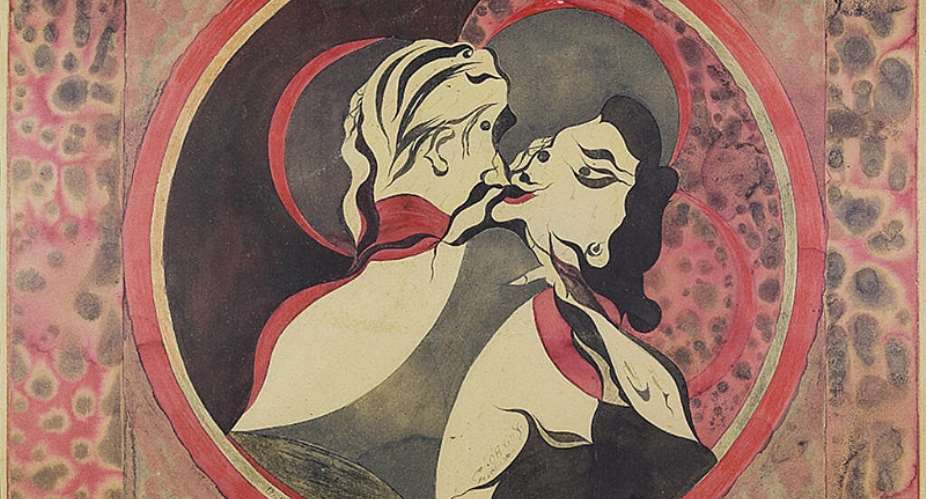
The exhibition at Sainte-Anne brings together 145 drawings and paintings dating from 1858 to 2020, offering a window onto more than a century of changing attitudes towards art and mental illness.
For much of that history, works by psychiatric patients were viewed through the lens of their illness. In 1900, London's Bethlem Royal Hospital – the institution whose name gave rise to the word “bedlam” – held the first major international exhibition bringing together such works.
Its 600 pieces were treated mainly as medical records rather than art. When their artistic qualities later attracted attention, they were sometimes attributed to a supposed lack of inhibition among patients.
Sainte-Anne's collection tells a different story. Works created in a hospital setting came to be valued for their artistic qualities as well as studied by psychiatrists, while the supposed link between mental illness and creativity has increasingly been questioned.
Beyond the diagnosis
Psychological suffering can itself involve powerful inhibitions, despite the idea that patients' creativity reflects a lack of such constraints.
“Perhaps it would be more accurate to say that what matters in certain cases is a particular relationship with reality,” Anne-Marie Dubois, a psychiatrist and scientific director of the Museum of Art and History of Sainte-Anne Hospital (MAHHSA), told RFI.
“The belief in a link between creativity and psychological disorders goes beyond the scientific evidence and persists despite evidence to the contrary.”
Ideas about art and mental illness have also become confused with art brut or “raw art”, a term invented by French artist Jean Dubuffet for spontaneous creation outside the traditions of art history and artistic trends of the time.
But works produced by psychiatric patients do not necessarily belong to that category. Works on display at the Museum of Art and History of Sainte-Anne Hospital in Paris, as part of an exhibition exploring the links between art and psychiatry.
German artist and writer Unica Zürn, who spent time at Sainte-Anne in the early 1960s, is one example. She worked as a draughtswoman, painter and writer, and produced many works during her stay at the hospital.
Zürn was already an artist before she entered Sainte-Anne and remained one afterwards. Rather than simply a product of mental illness, her work was rooted in the artistic movements of her time.
“A patient cannot be reduced to their illness,” Dubois said.
Psychedelic therapy gains ground in Europe, under strict conditions
A shared human experience
The museum's main collection contains around 2,000 works. Some were produced by doctors, while others were donated by artists who took part in other exhibitions at Sainte-Anne in recent years.
A further 50,000 works produced during art workshops at the hospital in the years after World War II are not on public display and have been kept for researchers.
The museum says its approach is part of a continuing effort to fight stigma and recognise that each work is, above all, part of a shared human experience.
Sainte-Anne has a much longer history of what Dubois describes as “asylum and refuge”. People considered mentally ill were already living and working on the site, then a farm, in the mid-17th century.
From 1833, recovering patients from Bicêtre, a prison and asylum just south of Paris, were also sent to Sainte-Anne to work the land.
From ornitherapy to kissing trees, how can nature benefit human health?
Under Napoleon III, plans were drawn up for a new psychiatric institution on the site as Paris was being transformed by civic planner Baron Haussmann. Sainte-Anne opened as a clinical asylum in 1867, providing psychiatric care and helping to train doctors specialising in mental illness.
The complex was designed almost as a small town, with separate buildings, a broad central avenue and gardens.
By the 1930s, another side of hospital life was developing. Sainte-Anne had become a place of culture and artistic creation, where psychiatrists and psychoanalysts came into contact with artists linked to the surrealist movement.
That relationship left its mark inside the hospital.
Artist Frédéric Delanglade led the creation of a large mural in the staff room, with painters Oscar Dominguez and Jacques Hérold among those taking part. It was destroyed during the German occupation of France, and a second collaborative mural was created after the war. An anonymous 1899 drawing, "High-Speed Aerial Vehicle for a Month-Long Migration", is among the works in the Sainte-Anne collection.
France's summer of heatwaves exposes hidden mental health cost
Changing perceptions
Sainte-Anne held its first exhibition of work by patients in 1946. But a much bigger moment came four years later, when the hospital hosted the first World Congress of Psychiatry.
An exhibition organised alongside the congress brought together 2,000 works from 17 countries and around 20 French hospitals. Inspired by the Bethlem exhibition held 50 years earlier, it drew around 40,000 visitors.
This time, the works were not viewed only through a medical lens. Visitors also responded to their artistic qualities, and some of the pieces eventually became part of Sainte-Anne's collection.
The hospital took another step in 1956, when psychiatrist Jean Delay, who headed its mental health clinic, launched its first art workshops for patients. But for years it lacked a proper system for archiving and preserving the works. Pieces were stored in cellars, while many disappeared or were stolen.
That changed in 2016 when, following efforts by Dubois, the museum was granted official status as a national museum, giving the collection legal protection.
A decade later, two rooms at Sainte-Anne are used for temporary exhibitions, ranging from shows devoted to individual artists to broader explorations of art and psychiatry.
► The current exhibition, “Masterpieces: At the Heart of the Sainte-Anne Collection”, runs until 20 December. The museum's wider collection can also be explored online.
This article was adapted from the original version in French by Olivier Favier.


 Allow the law to deal with defilement perpetrators - Director tells families
 Gov’t to develop policy for Ghanaian sign language in education
 Two Ada SHS students plead guilty to assault, slapped with 12-month bond
 Queiroz’s Black Stars hunt Scorpions on Tuesday after being humbled by Elephants
 Enlistment: GAF begins documentation, body selection from September 28
 Violent rainstorm rips off roofs, displaces residents in Krachi Nchumuru
 Ghana risks EU gas market access over methane emissions
 Serbian President Aleksandar Vucic resigns
 Swiss reject plan to toughen neutrality
 Inside the business of gony bags, Madagascar's ubiquitous plastic sacks


