




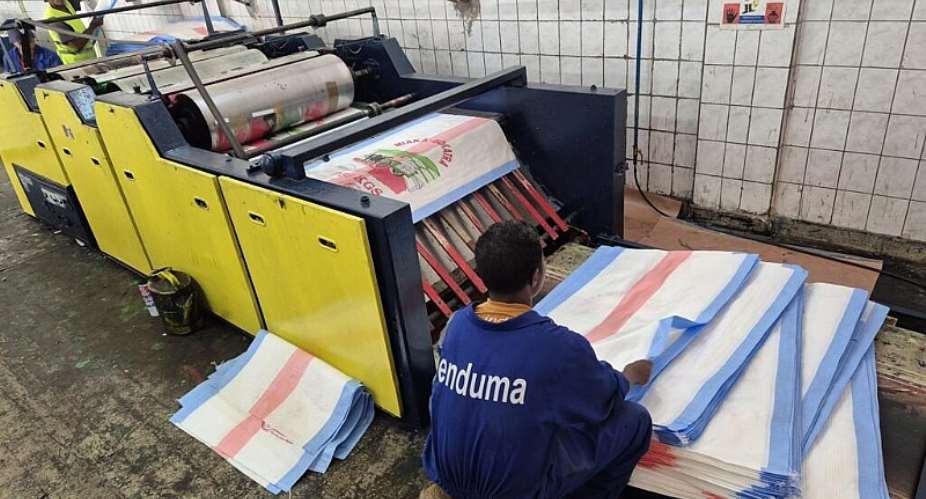
In Enduma's vast warehouse on the outskirts of Antananarivo, the looms are running at full capacity. The company's six-shuttle circular weaving machines operate round the clock, amidst a deafening din.
In just a few minutes, they transform tiny plastic pellets into bags that have become a familiar sight throughout the country.
"Our classic bag is the Miaka-bokatra," explains one employee. "Literally, 'harvest season'. It's the bag you see almost everywhere in Madagascar – it marks the start of the rice harvest season, the paddies, and has come to symbolise Madagascar."
In flood-prone Malawi, bananas become a shield against erosion
Working to the rhythm of harvests
Bearing a picture of a cart drawn by two zebu cattle, these large white gony sacks can carry up to 250 kilos of produce. They were originally designed to replace jute sacks, which are heavier and less waterproof.
They have since become indispensable in industry, but even more so for farmers. Today, Enduma generates 75 percent of its turnover in Madagascar, mainly during the peak agricultural seasons.
"There is industrial demand that keeps us working all year round, for sectors such as the agri-food industry, mining and the lime, flour, cement and salt industries, amongst others," explains Hassanein Hiridjee, the founder's grandson and CEO of the Trimeta Group, the conglomerate that owns Enduma.
"Then there are the agricultural uses. We supply the various farming sectors during their harvest seasons, with the start of the year focused mainly on rice, followed by vanilla, pulses, Cape peas and salt."
The rhythm of the various harvests keeps demand high throughout the year, he says.
The better the harvests, the more bags the company sells. Its success is intimately entwined with the state of Madagascar's crops, the weather and its knock-on effects.
Meet the Kenyans on a roll, manufacturing the electric vehicles of the future
Competition from Asia
Like many of Madagascar's manufacturers, Enduma has to contend with recurring power cuts. Another challenge is imported woven bags made in China or India, which are often of lesser quality, lack traceability and are not certified safe to be in contact with food – and which are, of course, sold at lower prices.
Faced with competition, the company has decided to diversify its activities.
Hiridjee gestures to Enduma's recycling and processing workshop. "This is production waste resulting from power cuts, changes in wefts, spools, and so on. We're able to reprocess this clean waste into granules, which then become the raw materials to make mostly basins, buckets and that sort of thing."
Enduma celebrates its 50th anniversary at the end of the year. Still entirely family-owned, the company aims to scale up its operations. And it is banking on its gony to power its development, hoping to export Malagasy expertise over the Indian Ocean and across the African continent.
This article has been adapted from the original version in French by Sarah Tétaud.


 Serbian President Aleksandar Vucic resigns
 Swiss reject plan to toughen neutrality
 Inside the business of gony bags, Madagascar's ubiquitous plastic sacks
 Caucus Warns: ‘If We Lose Our Teachers, We Lose Our Nation’ as Education Crisis ...
 Boeing Projects 18‑Month Timeline for Ghana’s National Airline Revival Under New...
 Legal Expert Questions EOCO’s Conduct, Says MP Had Right to Resist Unlawful Arre...
 Gunmen kill 27 in two shootings in South Africa
 'We shall hold govt feet to the fire of accountability' — Anyidoho on €225m coca...
 ‘Russian sleeper cell’: Can Germany’s far-right AfD be barred from sensitive int...
 Pope Leo XIV visits Lourdes after giant Paris mass to meet clergy abuse victims


