




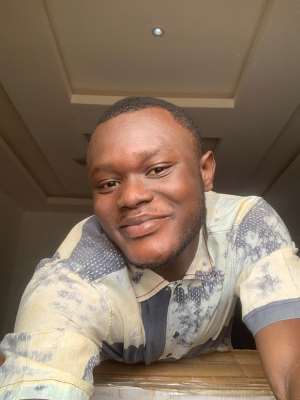
There's a particular kind of creative career that doesn't announce itself with one big break — it accumulates. A short story here, a novella there, a column, a short film, a diploma in something practical while the fiction keeps coming anyway. Look closely and a body of work like that usually has a throughline. In the case of Chief Tutu Baffour Asare Brownsy Williams — the Accra-based author, columnist, and filmmaker behind Brownsy Silva Company — the throughline is a lifelong insistence that African stories deserve the same craft, ambition, and reach as anything coming out of Los Angeles or Mexico City.
**A writer since before he could spell**
The instinct arrived early. By his own account, he knew from around age three that he wanted to write, drafting short stories with his mother's encouragement as she helped build his vocabulary word by word. That early apprenticeship carried him through schools in Berekum, Half Assini, Kumasi, and Tema — where a childhood award for Best Child Actor and Best Artist/Writer in school plays was an early, small signal of where his instincts were pointed. He knew just as early that he wanted to act.
Today that same instinct shows up as a genuine dual practice: acting and storytelling feeding each other, on the page and on screen.
**A one-man content studio with a Pan-African mission**
Brownsy Silva Company is the umbrella under which all of it lives — novels, novellas, short film, opinion journalism, and increasingly, digital platforms of his own making. His stated mission is disarmingly direct: bring African storytelling onto the global map, at Netflix-level craft, without losing what makes it distinctly African.
The fiction output alone is substantial. His novel *The Sons of Brownsy* — a family drama spanning eighteen years, set between Kumasi and Accra — remains a personal touchstone; he considers himself, only half-jokingly, the recognized lead character of his own book. From there the catalogue has grown quickly: the 84-chapter novel *Reborn: The River of Girls*, the two-part saga *The River Remembers*, the novella *Storm Over Paradise*, and a run of Ghanaian-set telenovela-style sagas — *Vengeance in the Blood*, *Blood and Kente*, *Blood on the Gold Coast* — that take the sweeping revenge-and-romance DNA of the Latin American telenovelas he grew up loving and transplant it, fully reimagined, onto Ghanaian soil.
That telenovela influence is no accident. Alongside Charles Dickens, he counts productions like *Triunfo del Amor* among his formative creative influences — proof that a global genre grammar can be rebuilt entirely in a local voice rather than simply imported.
**Behind the camera, and in front of it**
His 2025 short film *Silence* grew out of a more personal concern: mental health, and the silences that surround it in many African communities. It's the kind of project that reveals what sits underneath the storytelling ambition — a filmmaker using the medium not just for spectacle, but for conversations that are often avoided. That same year, he was recognized with Best Emerging Content Creator at the Ghana Emerging Stars Awards.
He has also submitted work to some of the continent's and world's most competitive literary institutions — the Caine Prize, the Afritondo Short Story Prize, the BBC National Short Story competition — the kind of submissions that signal a writer measuring himself against the highest available bar, regardless of outcome.
**The columnist building a second voice**
Since mid-2026, a different register of his work has been building in parallel: long-form opinion journalism for Modern Ghana, under the Chief Tutu persona, tackling everything from AI and geopolitics to healthcare equity and African history — always localized for Ghanaian readers, always insistent on factual precision. It's public-intellectual work in the Obama-and-Oprah tradition he cites as inspiration: using a platform not just to entertain, but to shape how a readership thinks about the world and its place in it.
**An engineer's discipline underneath the artist's instinct**
What rounds out the picture is perhaps the most unexpected thread: he's currently a student at Accra Technical University, studying across software and mechanical engineering. It's an unusual pairing for a working novelist and filmmaker, but it fits a builder's temperament — someone equally comfortable troubleshooting a technical problem as drafting a scene, and increasingly inclined to build his own platforms (a streaming site among them) rather than wait for someone else's.
The throughline
Taken together, it's a portfolio that resists easy categorization — which seems to be the point. Novelist, columnist, filmmaker, engineering student, builder of his own digital infrastructure: the common thread isn't a single medium, but a conviction that African storytellers should own the whole chain, from the first draft to the platform it's published on. In an industry still working out what ownership and cultural authorship look like in the digital age, that's less a career pivot than a quietly deliberate strategy.

 Police interdict seven officers over alleged extortion in Accra
 27-year-old nursing mother shot dead along Tilli–Widnaba road
 Ghana to reopen diplomatic mission in Ireland
 Ghana facilitates return of 180 nationals from Libya
 Parliament to review dollar payment for locally produced crude
 Ghana to build 1,200MW gas-fired power plant, surpassing Akosombo capacity befor...
 “Those responsible should be imprisoned for life with no food” — Friend of murde...
 “I have crocodile skin; insults don’t bother me” — President Mahama
 Police arrest 64 suspects, recover firearms in special operation at Achimota Mil...
 Madina MP receives medical attention after GIMPA collapse


