




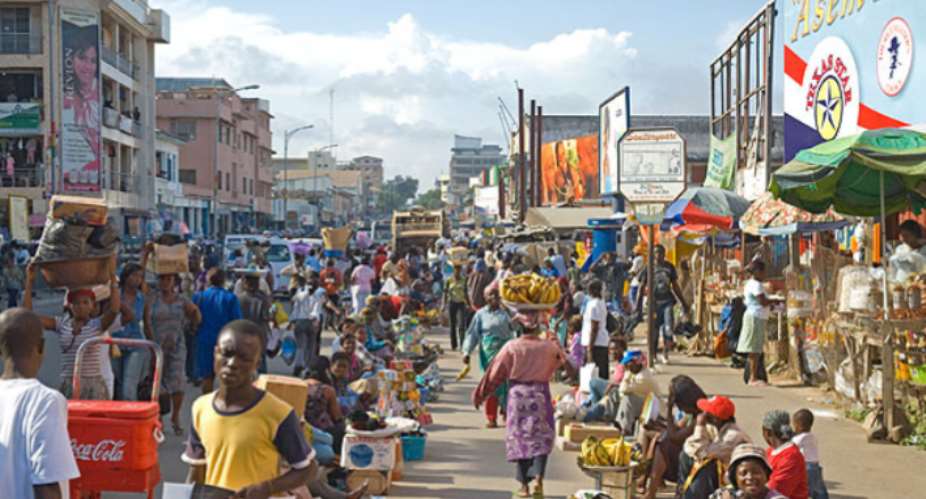
There is a saying among Hausa speakers, heard in the Zongo communities of Accra and Kumasi as much as in Kano or Katsina: gara jiya da yau yesterday was better than today. It is not nostalgia for its own sake.
It is a verdict, delivered daily at the market stall, in the trotro queue, at the fuel pump a quiet accounting of how much further the cedi in your pocket now falls short of what it used to buy.The numbers say recovery.
The kitchen table says otherwise
By the macroeconomic scorecard, Ghana's story in 2026 reads like a turnaround. Inflation, which had climbed to 23.8% in December 2024 on the back of surging food and fuel costs, had fallen to roughly 3.2–3.7% by the first quarter of 2026 the lowest reading since the 2021 rebasing, with the cedi holding stable enough to help contain price growth.
Ghana's economy grew an estimated 6% in 2025, gold export receipts surged, and the country's foreign reserves climbed to nearly $14 billion, giving over five months of import cover.
Yet the same households cheering these headlines on the news are still doing the arithmetic that matters to them: what GHS 300 buys at the till today, and what it bought two years ago.
A widely used survival guide circulating this year for Ghanaian households put it plainly: disinflation is not the same as falling prices. When inflation slows from 25% to 4%, prices are still rising, only more slowly than before. The GHS 10 item that jumped to GHS 14 during the crisis is not returning to GHS 10 it simply grows more gently from here.
Salaries, for the vast majority who are not gold traders, cocoa exporters, or civil servants awarded cost-of-living adjustments, have not kept pace.
The relief may not even hold
More troubling for ordinary Ghanaians is that this fragile calm is not guaranteed to last. Fitch Solutions has projected inflation could climb back toward 9% by the end of 2026 and 13.2% by 2027, driven by renewed cedi pressure, El Niño-linked disruptions to food production, and potential strain on hydropower generation at Akosombo.
The Finance Ministry insists inflation will end the year within its 8% (plus or minus 2 points) target and closer to 5%, but even government technocrats acknowledge the numbers depend on assumptions a stable cedi, favorable weather, calm global markets that are outside any minister's control.
So who saves the ordinary Ghanaian?
This is where the honest answer gets uncomfortable, because no single actor holds the whole solution.
The government controls fiscal discipline, subsidy design, and how much of any macro gain is translated into real wage protection cost-of-living allowances, minimum wage adjustments, and targeted food and transport interventions rather than announcements pitched at headline inflation alone.
Its critics argue recovery has been managed for investors and bondholders before it has been felt by traders and commuters; its defenders point to the genuine, hard-won stabilization of the cedi and reserves after 2022's crisis, achieved without full IMF-imposed austerity chaos repeating itself.
The opposition has a role in holding that translation accountable but only if its own proposals go beyond blaming the government for global shocks (the Ukraine war's food and fuel effects, US Federal Reserve tightening, El Niño) that no Ghanaian administration invented.
External forces gold and cocoa prices, the Fed's interest rate stance, climate-driven crop failures will keep shaping Ghana's fortunes regardless of who occupies Jubilee House.
Insulating ordinary households from that volatility, through local production, diversified exports, and stronger social safety nets, is a generational project, not a budget cycle.
And ordinary Ghanaians themselves traders, market women, artisans, the Zongo communities and Hausa-speaking diaspora who feel this hardship most acutely alongside everyone else are not passive victims awaiting rescue.
Civic pressure, informed voting, and demanding transparency on where gold and cocoa windfalls actually go are the tools available even when no external savior arrives.
The proverb's real warning
Gara jiya da yau is not really about yesterday being perfect it rarely was. It is a warning that trust, once broken by the depreciation and price shocks of recent years, is not restored by a inflation chart alone.
It is restored when a mother in Kumasi's Zongo notices her market basket finally matches her memory of what a cedi used to buy. Until that day, the proverb will keep being repeated not as poetry, but as protest.
Mustapha Bature Sallama
Medical/ Science Communicator,
Private Investigator, Criminal Investigation and Intelligence Analysis,
International Conflict Management and Peacebuilding. (USIP)
[email protected]
+233555275880
Sources
Ghana Statistical Service data via Daba Finance December 2024 inflation figures
Trading Economics Ghana inflation, March 2026
Deloitte "Doing Business in Ghana Guide 2026" GDP, reserves, FX figures
MyJoyOnline Fitch Solutions inflation forecasts, 2026–2027
IC.africa "Ghana Cost of Living Survival Guide" (2026)


 Police interdict seven officers over alleged extortion in Accra
 27-year-old nursing mother shot dead along Tilli–Widnaba road
 Ghana to reopen diplomatic mission in Ireland
 Ghana facilitates return of 180 nationals from Libya
 Parliament to review dollar payment for locally produced crude
 Ghana to build 1,200MW gas-fired power plant, surpassing Akosombo capacity befor...
 “Those responsible should be imprisoned for life with no food” — Friend of murde...
 “I have crocodile skin; insults don’t bother me” — President Mahama
 Police arrest 64 suspects, recover firearms in special operation at Achimota Mil...
 Madina MP receives medical attention after GIMPA collapse


