




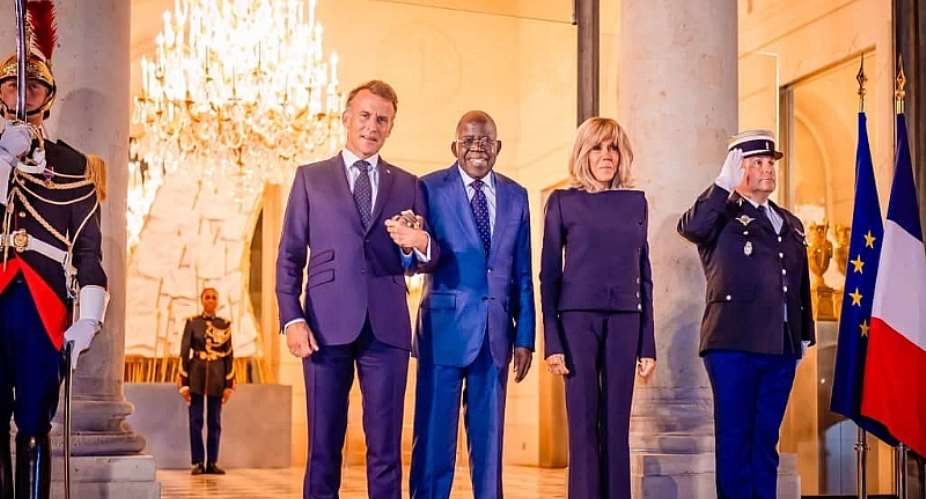
For Nigerians old enough to remember when their country proudly, and with merit, proclaimed itself the Giant of Africa, the current foreign policy fiasco of President Tinubu must be a source of concern, embarrassment, and shame.
While it’s true that some humiliations announce themselves with trumpets and fanfare, Tinubu’s diplomatic fiasco arrives dressed as protocol. At the New Delhi BRICS summit, the world’s most consequential platform for the reordering of global power, Nigeria was present, but President Bola Ahmed Tinubu was not.
Vice-President Kashim Shettima carried the presidential message, mouthing the same nonsensical calls for reform of the United Nations and the international financial system.
The Vice-President’s technical presence exposes a larger political absence: a lack of strategic imagination, independent purpose, and the old Nigerian confidence that once made Africa and, indeed, the world, listen when Abuja spoke.
Just think about this: even though Nigeria is a BRICS partner country, and not a full member, the symbolism of President Tinubu’s absence is devastating.
At a gathering where China, Russia, India, Iran, and other powers debate trade, finance, sovereignty, energy, sanctions, and the architecture of a post-Western world, Nigeria’s head of state stayed away.
No one told Nigerians where their president was or why he missed such an important gathering.
A Nigerian president who finds time to attend summits of that anachronistic British Commonwealth (no one told us Piccaninies what is common and what we have in common with our historical oppressors and exploiters) went AWOL at a BRICS meeting where ultra-serious geopolitical and geoeconomic reforms of the global system, deepening cooperation, creating jobs, and expanding trade were on the table.
But what was the Nigerian proposition? Shettima recited the usual tired propositions urging (yawn) reform of the United Nations and the international financial system. Where was Tinubu’s audacity to say that Africa’s oil, gas, cobalt, lithium, uranium and strategic minerals must no longer be treated as the private orchard of foreign corporations, as the president of Ghana so boldly articulated at the just-concluded UNGA meeting?
A passage supplied from Sputnik Africa, quoting French politician Pedro Guanaes Netto, captured the central question: resource-rich countries must benefit from their wealth instead of merely hosting the mines. That should have been Nigeria’s voice speaking.
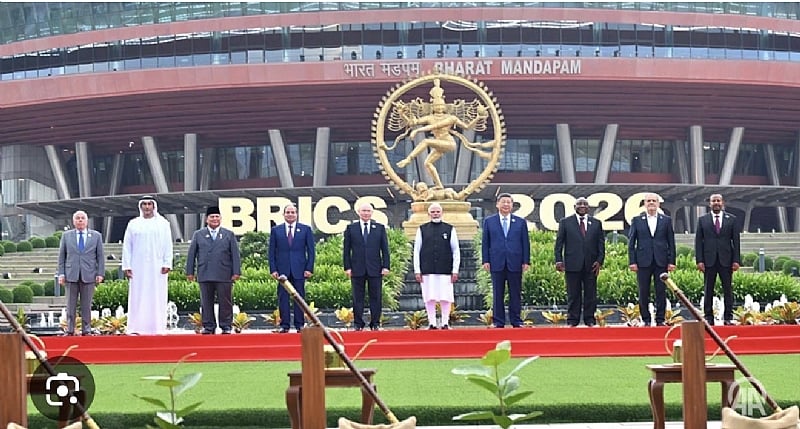
BRICS is not a charity bazaar but an arena where the Global South is attempting, unevenly and contentiously, to reclaim room to maneuver from institutions designed when colonial power still wore a dinner jacket and presented a facade of respectability, with China and Russia showing willingness to help.
Nigeria should have been there at BRICS’ summit rubbing shoulders with the shapers of the New World Order. It should have come with a doctrine and a coherent initiative, not merely as a delegation to deliver rehashed, dated speeches. Shettima should have gone to Delhi with Africa’s strategic interests in his mouth, not with the diplomatic mumbling that reassures Tinubu’s curators in Western capitals.
As we have chronicled in about a dozen articles on this blog, this represents another tragedy of Tinubu’s foreign policy.
A country that once understood the difference between friendship and subordination now mistakes access for influence. Abuja has become too eager to be applauded in Paris, London and Washington, and too timid to ask what those capitals have done with Africa’s resources, security and sovereignty in over five centuries.
Under Tinubu, Nigeria increasingly behaves as if its foreign policy were a visa application: grateful for an appointment, terrified of offending the clerk.
The contrast with Nigeria’s diplomatic history could not be more brutal. At independence, Nigerian foreign policy placed Africa at its center, not as a slogan for speeches but as a fierce material commitment. Nigeria supported liberation movements in Southern Africa, mobilized diplomatic pressure against apartheid and colonial rule, and used its oil wealth to make solidarity tangible.
Against white minority rule, Nigeria did not ask whether Washington approved or wait for a European committee to certify African freedom. It understood that South Africa, Angola, Mozambique, Namibia and Zimbabwe were fronts in the unfinished battle for African emancipation.
Nigeria was present at the birth of the Organization of African Unity in 1963 - the OAU was an institution created to give political form to the proposition that Africa’s fragmented states could not survive as permanent clients of outside powers. The country helped build the diplomatic infrastructure of continental solidarity that later evolved into the African Union, launched in Durban in 2002.
In 1975, Nigeria was central to creating ECOWAS, whose headquarters now sit in Abuja.
Historically, Nigeria did not merely occupy a chair in West Africa. It acted as the region’s indispensable power: financing, mediating, peacekeeping, and, through ECOMOG, taking extraordinary risks when the region’s collapse threatened to become irreversible.
The diplomatic forays of Nigeria of old were imperfect, sometimes overbearing, occasionally self-centered, but they were strategically awake. The country knew that leadership costs money, blood, patience, and political courage. It also knew that sovereignty is not preserved by repeating the language of Africa’s historic oppressors and exploiters.
Now, let’s look at Tinubu’s record. As ECOWAS chair in 2023, he presided over the Niger crisis with the reflexes of a man reaching for a telephone to ask Paris what to do. Under his chairmanship, ECOWAS threatened military intervention against the Nigerien junta, with Tinubu declaring that no option, including force, was off the table.
Tinubu’s approach to diplomacy is the new unknown, as such threats and ultimatums are uncommon in Africa’s culture and conflict-resolution mechanisms. You do not issue ultimatums to your foe so as not to force him to lose face.
Tinubu should have known better; after all, his Yoruba people say: Ikú yá ju ẹ̀sín lọ / Death is preferable to ignominy.
Tinubu’s ill-advised threat was legally as well as morally contestable, strategically inept, and regionally tone-deaf.
It ignored the fury generated by decades of French tutelage and unremitting exploitation, the popular resentment of foreign troops, and the political reality that a military operation in Niger could ignite a wider war in the sub-region.
It also allowed ECOWAS to appear less like an African mediation mechanism and more like a security subcontractor for external, mainly French, interests.
The result was not the restoration of constitutional order.
The result was fracture. Burkina Faso, Mali and Niger formally left ECOWAS on 29 January 2025.
The Alliance of Sahel States had already turned their anti-French anger into a new regional alignment and has so far refused overtures to rejoin ECOWAS.
Whatever one thinks of the three juntas, the diplomatic verdict is merciless: Tinubu’s leadership helped turn a regional community into a wounded and divided shell.
Whatever the verdict on his internal policies, posterity will be harsh on this shameless puppet who transformed a vibrant Pan-African Nigeria into a vassal of France.
History will be most damning: The man who inherited the chairmanship of West Africa’s most important institution presided over its splintering.
Where was the Nigerian diplomatic imagination? Why didn’t Abuja offer an African-led compact, a timetable for civilian transition, security cooperation, economic guarantees and a face-saving route back into regional diplomacy? Why did Tinubu employ the language of punishment before the labor of persuasion?
Nigeria’s conduct appeared calibrated to the anxieties of Paris rather than the historical memory of Niamey, Bamako and Ouagadougou.
Tinubu’s shameless outsourcing of Nigeria’s diplomacy to a fading empire like France is a great embarrassment to his country. A giant of Africa was used as the muscle of a declining empire while denied the dignity of an independent strategy.
The Élysée Palace does not need Nigeria to think; it needs Nigeria to threaten and carry the regional embarrassment when policy collapses.
Tinubu’s BRICS fiasco completes the picture. Nigeria’s attendance through Shettima means the country did not literally lose its voice in New Delhi. But a nation can be physically present and politically missing.
The economic cost of this half-presence becomes sharper when Nigeria is compared with continental competitors like Egypt and Ethiopia. Egypt and Ethiopia entered BRICS as full members from January 2024. Nigeria, by contrast, remains a partner country: invited into consultations and diplomacy, but without the same status in the group’s political decision-making.
That distinction is not ornamental. In a grouping increasingly used to discuss trade facilitation, payment systems, investment, technology and the reform of global finance, the difference between helping shape the agenda and merely being invited to react to it can become the difference between bargaining power and dependency.
Even though it’s under harsh military rule, Egypt understood the value of converting diplomatic association into financial plumbing. It promptly became a member of the New Development Bank, the BRICS-founded institution designed to mobilize infrastructure and sustainable-development finance, in 2023.
This does not mean that every Egyptian economic problem has been solved by its membership in BRICS, or that NDB money is a gift. It means Cairo has gained another channel for financing roads, energy, transport, and other projects, and another institutional relationship through which it can reduce its exclusive dependence on Western-led lenders and the dollar system, along with the accompanying usurious rates and sovereignty-eroding conditionalities. For a country battered by foreign-exchange shortages and debt pressure, even the possibility of financing in other currencies, alongside greater trade with BRICS economies, widens Egypt’s menu of choices.
Ethiopia’s calculation is different but no less revealing. Addis Ababa used its full BRICS membership to place a rapidly growing, strategically located, and populous African economy in the conversation among China, India, Russia, Brazil, and the Gulf powers. The Ethiopians understood that the key gains are not automatic, and that BRICS membership does not manufacture factories, erase debt, or guarantee exports. But they know that it can improve the political signal to investors, open conversations about infrastructure and industrial cooperation, and connect Ethiopia more directly to markets, development finance, and supply chains beyond the old Western gatekeepers. Ethiopia is attempting to turn geopolitical relevance into economic room for maneuver.
Nigeria, with a far larger economy, market, and energy endowment, should have been doing the same, and from a position of greater strength.
It is a serious indictment that Tinubu and his team failed to see this. By failing to press for full membership of BRICS with a coherent Nigerian programme, Abuja risks losing influence over the very mechanisms that could matter to its economic future: cross-border payments that reduce the cost of dollar dependence; investment rules that determine whether African minerals are processed locally or exported raw; infrastructure finance that does not arrive wrapped in the austerity conditions familiar from the old Western institutions; and technology partnerships that can move Nigeria from commodity warehouse to industrial power.
Of course, a BRICS badge does not guarantee any of these benefits. But remaining outside the core of this most important geopolitical club while Egypt and Ethiopia occupy it guarantees that others will help write the rules under which Nigeria later seeks entry.
This comparison is not an invitation to romanticize BRICS; we do our best not to romanticize things on this blog. BRICS as a group is internally divided as its members pursue their own interests (as states should). Membership in even a formidable club like BRICS cannot substitute for competent domestic policy.
That is precisely why Nigeria needed full participation: to negotiate hard, build coalitions, defend African resource sovereignty and prevent the continent from being represented by smaller states whose governments were more strategically alert.
Egypt has secured a place at the table and a foothold in the development bank. Ethiopia has secured a place at the table and a platform for its economic diplomacy. Sadly, Nigeria brought the largest population, one of Africa’s most important markets, and immense oil, gas, and mineral potential, yet arrived with a delegated voice and no visible doctrine.
Nigeria does not need to become anybody’s satellite, not America’s, not Europe’s, not Russia’s, not China’s.
As we have consistently advocated, Pan-Africanism insists that Africans have the strategic agency to bargain with all powers on equal terms.
This is also the principle BRICS, for all its contradictions, brings back into global conversation: the right of nations to decide what happens to their resources and alliances. Unfortunately, Nigeria under Tinubu was missing in action when these ponderous issues were being discussed in Delhi.
Tragically for the country, Tinubu has reduced Nigeria’s once formidable diplomatic inheritance to ceremonial travels for reasons known and unknown (his handlers consider it beneath them to inform citizens where their president is), reactive threats, and Western-facing reassurance. Nigeria entered the world carrying Africa’s cause; today it enters rooms carrying other people’s talking points.
That is why New Delhi's humiliation matters to Nigerians. It’s not because Nigeria was absent, but because their country was present without presence. It was represented but lacked any authority where the core decisions are made.
Our Vice President Shettima came without a coherent initiative, and he sat at the table without bringing Africa’s hunger, anger, and historic claim to the attention of those powers that matter in reshaping the world.
It ought to be clear that a country that forgets its diplomatic history becomes easy to command. Nigeria’s problem is not that the world no longer hears it; it is that Tinubu’s government has forgotten what it ought to say.
©️ Ọ̀dọ̀fin Fẹ́mi Akọ́mọláfẹ́ (1st Dan, Ọ̀dọ̀fin I of Kasoa)

 Police interdict seven officers over alleged extortion in Accra
 27-year-old nursing mother shot dead along Tilli–Widnaba road
 Ghana to reopen diplomatic mission in Ireland
 Ghana facilitates return of 180 nationals from Libya
 Parliament to review dollar payment for locally produced crude
 Ghana to build 1,200MW gas-fired power plant, surpassing Akosombo capacity befor...
 “Those responsible should be imprisoned for life with no food” — Friend of murde...
 “I have crocodile skin; insults don’t bother me” — President Mahama
 Police arrest 64 suspects, recover firearms in special operation at Achimota Mil...
 Madina MP receives medical attention after GIMPA collapse


