




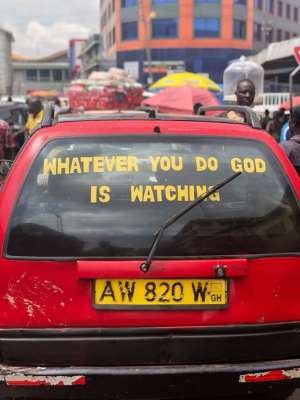
There is an old proverb among the elders of my father's compound: when two elephants fight, it is the grass that suffers. But what happens, I ask you, when it is not two elephants but seven — Washington, Tehran, Moscow, Kyiv, Brussels, Islamabad, and the restless newsroom of American democracy itself — all trampling the same patch of earth at once, while a modest nation on the Gulf of Guinea tries, quietly and stubbornly, to grow its own grass back? That is the question I bring to you this week, dear reader, because the news cycle of the past thirty days has not merely been busy. It has been **cacophonous** — and Ghana, whether we like it or not, is standing in the middle of the field.
The United Nations General Assembly: A Theatre of Anxious Giants
Nearly 130 heads of state converged on New York for the 81st session of the UN General Assembly, opening under the almost wistful theme "Restoring trust, managing transformation: a United Nations that delivers for all." The President of the General Assembly, Dr Khalilur Rahman of Bangladesh, pledged to "work tirelessly to revive trust in this institution, upon which success of our collective action ultimately depends." It is a noble pledge. It is also, one must admit, a **quixotic** one, given what unfolded on the floor.
World leaders gathered this week for an agenda spanning the U.S.-Iran war and Russia's invasion of Ukraine to the fragile ceasefire in Gaza and the risks posed by artificial intelligence. Notably, Chinese leader Xi Jinping skipped the assembly to instead travel to Washington for a summit with President Trump, while leaders from India and Russia also stayed away — a silent but thunderous statement about where the real power now negotiates. President Trump told the assembled world that he faces a "big decision" on Iran: reach a deal after the American midterm elections, or "annihilate" the country. Britain's new Prime Minister, meanwhile, used his maiden UN address to champion artificial intelligence as, in his words, "the key to economic growth," while acknowledging it will also be "a source of disruption to the way we live and work, a multiplier of risk."
This is the paradox of our age rendered in a single week: the same institutions racing to build the tools of tomorrow while quarrelling, in the same breath, over whether to bomb each other today.
The Iran War: Attrition Without End
Let us not soften this with euphemism. The 2026 Iran war has raged since 28 February 2026, drawing in the United States, Israel, Saudi Arabia, the Gulf states, and Iran's Axis of Resistance — a conflict now well past its half-year mark with no armistice in sight. By September, the United States had shifted from an "Economic D-Day" sanctions strategy back to direct airstrikes on Islamic Revolutionary Guard Corps targets, and the U.S. Congressional Research Service now describes the conflict plainly as "a war of attrition," in which Iran faces a perilous economy while Washington and its partners bear mounting military, social, and political costs of their own.
At the UN podium, Iran's president refused to bow. He told the Assembly Iran "will never bow our head," even as the American delegation reportedly walked out mid-speech, and Tehran warned it would not reopen the Strait of Hormuz until Washington met its terms, threatening to expand the war into the Indian Ocean if attacked again.
I say this to my readers plainly: a "big decision" between negotiation and annihilation is not diplomacy. It is **brinkmanship** dressed in a suit. And history — from the trenches of 1914 to the missile crises of 1962 — has taught humanity a costly lesson: leaders who speak of annihilation rarely control where the fire, once lit, finally stops burning.
Ukraine's Skies: A Fragile Triumph of Engineering Over Terror
Amid this darkness, one genuine technical achievement deserves its due. Ukraine's Commander-in-Chief, Oleksandr Syrskyi, reported that even as Russia increased its aerial assault by 1.3 times in September, Ukrainian air defence maintained an effectiveness rate of roughly 74 percent — a statistic that, in the cold arithmetic of war, represents thousands of families who slept through the night unharmed. In one representative attack on 9 September, Russia launched 196 drones and a barrage of ballistic missiles; Ukrainian forces neutralised 165 of them.
This is not victory. It is survival, engineered nightly, at colossal cost. But it is also proof of something Ghanaians understand instinctively from our own history of self-reliance: that **resilience**, unlike luck, can be built, layer by layer, system by system.
Europe Rearms: The Continent That Swore "Never Again" Now Prepares for War
Perhaps the most sobering geopolitical shift of 2026 is the one least discussed on Ghanaian radio call-in shows: Europe is rearming at a pace unseen since the Cold War. The EU's "Readiness 2030" plan aims to mobilise up to €800 billion by 2030, anchored by joint procurement and a €150 billion SAFE loan instrument, while the bloc has set a target that at least 40 percent of member states' defence procurement be conducted jointly by 2027, backed by flagship projects like the European Air Shield and the Eastern Flank Watch surveillance system.
A continent built on the ashes of two world wars, which for eighty years preached soft power and multilateral patience, is now openly preparing hard power for a war it hopes never comes. That is not hypocrisy. It is, I daresay, **prudence** born of hard-won memory — the kind Ghana, too, must someday apply to its own regional security architecture within ECOWAS.
Pakistan: A Democracy Straining at the Seams
Meanwhile, in South Asia, Pakistan's long political convulsion refuses to heal. Unrest in Azad Jammu and Kashmir has broadened well beyond its original grievances over electricity tariffs and wheat subsidies into demands for constitutional reform and greater regional autonomy, with legislative elections in parts of the region postponed due to deteriorating security. Nationwide, a general strike on 28 August shut down private businesses across the country in protest against excessive government electricity and gas charges — a stark reminder that beneath every geopolitical headline lies the same universal grievance: the ordinary citizen's struggle to keep the lights on and food on the table.
America Turns on Its Own Mirror: The White House Media Purge
Back in Washington, a different but related battle rages — not between nations, but between a government and the press meant to hold it accountable. President Trump announced on Truth Social that he was banning CNN, MS NOW, and Politico from covering the White House, accusing the outlets of spreading "fake news" and reporting "fiction and lies," warning that other organisations would face similar action. This follows a similar February 2025 ban on the Associated Press, after it refused to rename the Gulf of Mexico — a dispute still tangled in litigation.
I ask my readers, gently but firmly: what is a republic that cannot bear to be questioned by its own newspapers? The First Amendment was not written for governments that agree with the press. It was written for the days — like these — when they do not.
Ghana's Cedi: From Champion to Cautious Optimist
Now let us bring the lens home, to Ghana, where the story is markedly less **incendiary** but no less consequential. In 2025, the cedi recorded its first annual gain against the dollar in nearly three decades, appreciating by 41 percent — the second-best performance of 144 currencies tracked globally — while national reserves climbed to a record $13.8 billion. The Bank of Ghana has since worked to defend that gain: it expects the cedi to remain relatively stable through the rest of 2026, supported by foreign exchange interventions and remittance inflows, with the Ghana Gold Board targeting $1.4 billion in September receipts alone to bolster reserves.
This is not a fairy tale. Public debt has simultaneously climbed to GH¢684.6 billion, exposing what analysts call a "debt-currency paradox." A stronger cedi built on a heavier debt load is a house with a fresh coat of paint and a shifting foundation. Chief Tutu says: celebrate the paint, but inspect the foundation.
Economic Innovation: The eCedi and the 24-Hour Dream
On the innovation front, Ghana has quietly positioned itself among Africa's fintech pioneers. The Bank of Ghana's eCedi — its central bank digital currency pilot — recently won international recognition for innovation in digital currency design, while the government's 24-Hour Economy Authority has begun signing partnerships with industrial players to establish new production projects across the country. These are the seeds of genuine structural transformation — provided, as our industrialists keep warning, that the policy moves beyond slogans and into steady, financed implementation.
Labour and Infrastructure: The Discontent Beneath the Growth Numbers
Yet macroeconomic headlines mean little to a worker without pay or a driver without a passable road. In September 2026, the Ghana National Petroleum Tanker Drivers Union announced plans to park their vehicles nationwide in protest against the deplorable state of the Valco-Tor-Kpone road, after months of unanswered letters to the Ministers of Roads and Energy. This joins a broader pattern of labour unrest — from civil servants demanding overdue salary structures to health workers protesting institutional dysfunction — that reveals a **recalcitrant** gap between Accra's growth statistics and the lived reality of the citizens producing them.
Domestic Tourism: A Milestone Worth Celebrating
Here, finally, is unambiguous good news. Ghana earned an estimated $4.34 billion in tourism receipts from 1.3 million international arrivals in 2025, while domestic tourism visits climbed from 1.68 million to 1.79 million — a seven percent year-on-year increase — with the top ten tourist sites alone drawing over 1.37 million visitors. More Ghanaians, it seems, are discovering Kakum, Cape Coast, and Aburi not as school-trip obligations but as genuine leisure destinations. This is nation-building of the quietest, most dignified kind.
Sports: Queiroz and the Referee's Whistle Heard Round the Continent
And then, of course, there is football — the one subject guaranteed to unite every Ghanaian household in outrage or ecstasy. After Ghana's 2-0 opening defeat to Côte d'Ivoire in the 2027 AFCON qualifiers, Black Stars coach Carlos Queiroz erupted at a penalty decision, declaring flatly: "That penalty is a joke." He did not stop there. "We do not have VAR to help the referee make the game fairer," Queiroz lamented. "I am tired of these situations, of these referees who do not do a good job."
Queiroz is not wrong to demand consistency. But permit your columnist a moment of **candour**: a coach of his considerable pedigree — having led Portugal, Real Madrid's technical staff, Iran, and now Ghana — knows that officiating controversy is football's oldest, most tediously renewable resource. The Black Stars' path to AFCON 2027 will not be paved by complaints about referees, however justified. It will be paved by goals.
The Steel-Man: What the Other Side Would Say
Fairness, dear reader, demands I now argue against myself. A defender of President Trump's Iran posture would say: six months of failed ceasefires and a collapsed memorandum justify decisive pressure over endless, exploitable diplomacy — and that "annihilate" is rhetorical leverage, not literal policy. A defender of the White House media bans would argue that no constitution obliges a president to grant access passes to outlets he considers adversarial, and that banning access to briefings is not the same as banning speech. A defender of Europe's rearmament would note that deterrence, not aggression, is precisely what prevented a wider war in 1962 and could do so again now. And a sympathiser of Pakistan's government would insist that no state can permit indefinite blockades of its capital, whatever the grievance's legitimacy.
These arguments are not baseless. They deserve a hearing even from a columnist who, as you will have gathered, finds most of them ultimately unpersuasive.
What the Scriptures Say
I turn, as I often do, to the wells of our shared faith traditions — not to score points between them, but because both speak with startling clarity to leaders drunk on power. The Bible warns in **Proverbs 29:2**: *"When the righteous are in authority, the people rejoice: but when the wicked beareth rule, the people mourn."* And in **Isaiah 2:4**, the prophet's ancient hope for our own age of drone warfare and missile shields: *"they shall beat their swords into plowshares, and their spears into pruninghooks: nation shall not lift up sword against nation, neither shall they learn war any more."*
The Quran, likewise, speaks against the arrogance of unchecked power. **Surah Al-Ma'idah 5:32** teaches: *"whoever kills a soul... it is as if he had slain mankind entirely."* And **Surah Ash-Shura 42:38** commends leaders "whose affairs are [conducted] through consultation among themselves" — a rebuke, if ever there was one, to any government that governs by ultimatum rather than dialogue.
Whatever our altar, the message is identical: power without restraint devours the powerful before it devours anyone else.
Bringing It Home: What This Means for Kumasi, Accra, and the Man Selling Waakye by the Roadside
To the ordinary Ghanaian reading this on a trotro from Kejetia, none of these headlines are abstractions. A war in the Strait of Hormuz raises the price of the fuel that powers that trotro. A cedi steadied by GoldBod's gold reserves is the difference between a market woman restocking her shop or closing it. A tanker drivers' strike over a broken road is not news from a distant capital — it is the reason your cooking gas costs more this month. And a Black Stars team distracted by refereeing grievances is a team more likely to disappoint the uncle who has already bought his AFCON jersey on credit.
As my grandmother used to say while pounding fufu at dusk: *"The world's fire may be lit in another man's kitchen, but the smoke still finds its way into your eyes."* Ghana cannot control the UN General Assembly, the Iran war, or a Portuguese coach's temper. But it can control its own discipline, its own institutions, and its own resolve to turn instability elsewhere into opportunity here — through gold, through tourism, through the quiet dignity of a currency finally beginning to hold its ground.
Glossary — Advanced Vocabulary Explained (Oxford Dictionary Style)
- **Cacophonous** *(adj.)* — a harsh, discordant mixture of sounds; here, a chaotic mix of competing global crises.
- **Quixotic** *(adj.)* — exceedingly idealistic; unrealistic and impractical, often in a noble but doomed way.
- **Brinkmanship** *(n.)* — the practice of pursuing a dangerous policy to the very edge of safety before stopping, especially in politics.
- **Resilience** *(n.)* — the capacity to recover quickly from difficulties; toughness sustained through adversity.
- **Prudence** *(n.)* — the quality of acting with care and thought for the future; practical wisdom.
- **Incendiary** *(adj.)* — tending to stir up conflict; inflammatory, provocative.
- **Recalcitrant** *(adj.)* — having an obstinately uncooperative attitude toward authority or discipline.
- **Candour** *(n.)* — the quality of being open and honest in expression; frankness.
- **Attrition** *(n.)* — a gradual, continuous process of wearing down an opponent's strength through sustained pressure.
- **Hegemony** *(n.)* — leadership or dominance, especially by one state or social group over others.
Author's Note
I have written this piece not to please any government, any general, or any football federation, but because I believe the Ghanaian reader deserves to see how the strands of a fraying world — Tehran's defiance, Kyiv's missile-lit skies, Brussels' rearmament, Islamabad's unrest, Washington's war with its own press, and yes, even Queiroz's frustration in Bouaké — are never as distant from Kejetia Market as the headlines suggest. My duty, as I understand it, is not merely to report the fire. It is to hold up a mirror close enough that we, too, check our own house for sparks. Write to me. Disagree with me. That, too, is democracy's oldest and most necessary ritual.
*Chief Tutu*
About the Author
**Chief Tutu Baffour Asare Brownsy Williams** is an author, columnist, filmmaker, and digital content creator based in Accra, Ghana, and the founder of **Brownsy Silva Company**, a multi-disciplinary creative platform spanning novels, films, opinion journalism, and engineering-adjacent content. He is a student at Accra Technical University, pursuing studies spanning software engineering and mechanical engineering, and writes a widely read opinion column for **Modern Ghana**, with a diaspora readership spanning the United Kingdom, the United States, Canada, and Germany. His commentary ranges across geopolitics, economics, sport, and culture, always returning — as it does here — to what the wider world's turbulence means for the ordinary Ghanaian.


 “I have crocodile skin; insults don’t bother me” — President Mahama
 Police arrest 64 suspects, recover firearms in special operation at Achimota Mil...
 Madina MP receives medical attention after GIMPA collapse
 Bolgatanga: Man found dead by roadside in Sumbrungu as police investigate
 Ghana concludes cocoa freight negotiations for 2026/27 season
 Blakk Rasta accuses Gushegu NPP MP Alhassan Tampuli of funding Ghana Jollof atta...
 €225m Cocaine Shipment: Court to rule on bail application of six accused in 3.9-...
 BoG pilots cedi-based payment system for Ghana-China trade
 2026 BECE: Ten schools score zero percent in Adaklu as girls outperformed boys
 'Sceptics, naysayers, alarmists should be aware US ready to work with Ghana on r...


