




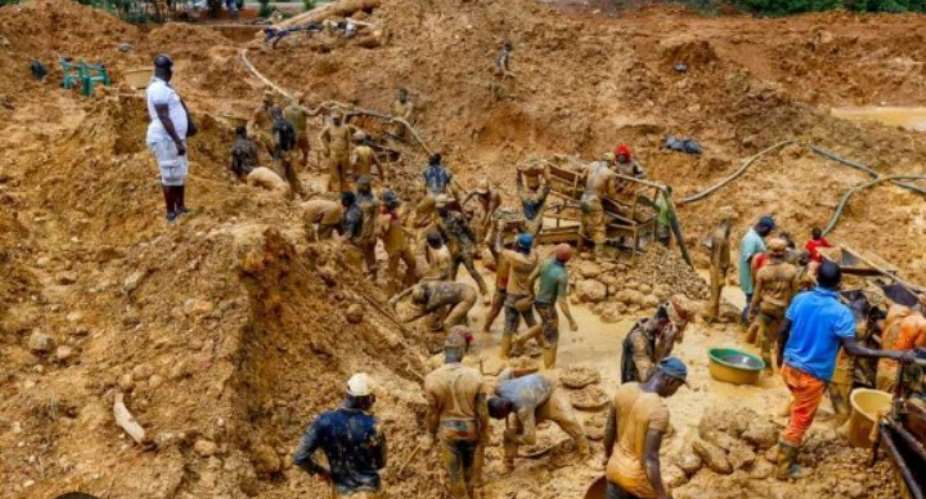
Walk through the mining regions of Ghana, Mali, Burkina Faso, Guinea or Côte d'Ivoire and the complaint sounds remarkably similar in every language: we have the gold, the diamonds, the lithium beneath our feet, yet someone from outside always seems to walk away with the value while communities are left with poisoned rivers, ruined farmland, and armed men fighting over what remains.
It is one of West Africa's oldest grievances, and one of its most current crises. The honest answer to who the "illegal buyer" is turns out to be more complicated, and more regionally interconnected, than any single nationality.
A resource base without equal, a region losing its share
Africa supplies roughly half the world's gold, and West Africa sits at the centre of that supply, with Ghana, Mali and Burkina Faso ranking among the continent's top producers.
Yet Interpol-coordinated operations have estimated that more than 435 metric tonnes of gold, worth over $30 billion, were smuggled out of Africa in a single recent year, with the United Arab Emirates standing out as the primary destination for that illicit flow. That is not a rounding error in a national budget; it is a structural haemorrhage of wealth that dwarfs most of the region's development aid combined.
How the gold actually moves
The mechanics are strikingly consistent from country to country. Gold mined informally in eastern Guinea is often driven three to four hours to Bamako, Mali, where it is easier to sell and convert than through Guinea's own formal channels.
Gold produced in northern Côte d'Ivoire has historically been smuggled into Mali or Burkina Faso by former combatants and demobilised militia commanders who pre-finance local diggers through middlemen, moving roughly 5 kilograms a week out of a single area worth over $200,000 at today's prices.
In Burkina Faso, "comptoirs," private trading companies once closely tied to political elites, have been implicated in fraud and currency schemes designed to launder gold value across borders.
From there, much of the region's illegally mined gold, along with output seized or taxed by armed groups, ultimately reaches Dubai's markets, a hub UN and NGO investigators have repeatedly identified as the preferred destination precisely because its gold trade asks fewer questions about origin.
Who the buyer actually is
There is no single face to this. In Ghana, foreign involvement has been dominated by Chinese migrant capital and equipment entering a sector legally reserved for citizens only, financing the mechanised dredging that has devastated rivers like the Offin and Pra.
In the Sahel proper, Emirati buyers sit at the far end of the chain, absorbing gold that has passed through multiple local and regional middlemen by the time it arrives, its origin effectively laundered out of the paperwork.
In between sit Ghanaian, Malian, Ivorian and Burkinabè traders, financiers and, in some documented cases, former military commanders and political elites who supply the capital or protection that makes illegal extraction and export possible in the first place.
The uncomfortable truth researchers keep arriving at is that this is not simply outsiders invading West Africa's resource base; it depends on local collusion at every link, from the chief who leases land informally to the trader who buys at the pit head knowing exactly where the gold came from.
When the mines start paying for guns
What has changed the stakes dramatically in the past several years is the entry of armed groups into this economy.
JNIM and other jihadist-linked factions operating across Burkina Faso, Mali and Niger now derive direct financing from artisanal gold mines, either by seizing sites outright or by imposing "taxes" on miners who continue working under threat.
A Reuters analysis found that a striking share of terrorist attacks in Burkina Faso occurred within 25 kilometres of artisanal mining areas gold sites are not incidental to the violence; they are often its target and its funding source.
In the Burkina Faso–Ghana–Côte d'Ivoire tri-border area, the same illicit infrastructure used to move gold has become interwoven with fuel and motorbike smuggling and stolen-livestock trafficking that finance the same armed networks, meaning a galamsey pit in coastal West Africa and a jihadist checkpoint in the Sahel can end up connected through the same illicit financial pipeline.
Human cost beneath the trade figures
The exploitation runs deeper than lost tax revenue. The Sahel accounts for roughly a quarter of all child labour in mining globally, with the vast majority of those children under 15 working alongside their families in small-scale sites because formal employment options in some of the world's poorest, least developed areas remain scarce.
Migrant labourers move across borders from Mali, Guinea, Gambia, Ghana, Burkina Faso, Togo and Nigeria to work these sites, often exposed to mercury and cyanide with minimal protection, in an industry where the ILO estimates a substantial share of West Africa's own artisanal gold never appears in any formal export ledger at all.
What governments are attempting
Regional and international response has picked up. A coordinated Interpol operation across Burkina Faso, Gambia, Guinea and Senegal led to roughly 200 arrests and the seizure of chemicals and explosives tied to illegal mining networks.
Ghana's newly established Gold Board now requires large-scale miners to sell a share of output directly to the state and mandates registration for small operators, an explicit attempt to keep more of the value, and the paper trail, inside the country rather than in the hands of whichever buyer shows up with cash.
Researchers studying Burkina Faso and Mali argue formalising artisanal mining more broadly is the only durable way to starve armed groups of mining revenue while protecting the miners themselves from both exploitation and violence.
The regional lesson
The frustration behind "we have the resource, they take the value" is not misplaced, but the fix cannot rest on identifying one foreign nationality as the culprit. Gold, and increasingly lithium and other critical minerals, will keep leaving West Africa through informal channels as long as land can be worked without a license, as long as buyers at the pit head face no serious accountability for where their gold ends up, and as long as neighbouring markets in Bamako, Ouagadougou, Abidjan and ultimately Dubai remain willing to absorb gold whose origin nobody is required to verify.
Formalisation, cross-border enforcement coordination, and honest acknowledgment of local complicity, not simply pointing at the nearest foreigner, are what stand between West Africa's mineral wealth and the communities currently paying for it in poisoned water and armed conflict.
Mustapha Bature Sallama
Medical/ Science Communicator,
Private Investigator, Criminal Investigation and Intelligence Analysis,
International Conflict Management and Peacebuilding. (USIP)
[email protected]
+233555275880
Sources
UNODC, "Gold Trafficking in the Sahel," Transnational Organized Crime Threat Assessment. https://www.unodc.org/documents/data-and-analysis/tocta_sahel/TOCTA_Sahel_Gold_v5.pdf
Global Initiative Against Transnational Organized Crime, "Illicit Hub Mapping in West Africa," 2025. https://page.globalinitiative.net/west-africa-illicit-hub-mapping-media-kit/
Partnership Africa Canada, "El Dorado: The West African Gold Trade" (Côte d'Ivoire, Mali, Burkina Faso mapping). https://impacttransform.org/wp-content/uploads/2017/09/2016-Jan-The-West-African-El-Dorado-Mapping-the-illicit-trade-of-gold-in-Cote-DIvoire-Mali-and-Burkina-Faso.pdf
Africa Defense Forum, "Terrorists Target the Sahel's Gold Mines as a Source of Financing," Oct 2023. https://adf-magazine.com/2023/10/terrorists-target-the-sahels-gold-mines-as-a-source-of-financing/
World Customs Organization, "Burkina Faso: the problem of gold smuggling." https://mag.wcoomd.org/magazine/wco-news-86/burkina-faso-the-problem-of-gold-smuggling/
Verité, "Gold" (Sub-Saharan Africa labour and smuggling data). https://verite.org/initiative/africa/commodities/gold/
ScienceDirect, "Unravelling the nexus of illicit gold trade, protection rackets, and political settlement dynamics: Evidence from Burkina Faso," Jun 2024. https://www.sciencedirect.com/science/article/pii/S0305750X24001529
Africa Security Report, "The Gold Route: How Illegal Mining and Arms Trafficking Undermine West Africa's Borders," 2025. https://africasecurityreport.com/2025/04/07/why-millennials-need-to-save-twice-as-much-as-boomers-did/
Wikipedia, "Galamsey" (regional terminology: orpailleurs in Francophone West Africa). https://en.wikipedia.org/wiki/Galamsey


 “I have crocodile skin; insults don’t bother me” — President Mahama
 Police arrest 64 suspects, recover firearms in special operation at Achimota Mil...
 Madina MP receives medical attention after GIMPA collapse
 Bolgatanga: Man found dead by roadside in Sumbrungu as police investigate
 Ghana concludes cocoa freight negotiations for 2026/27 season
 Blakk Rasta accuses Gushegu NPP MP Alhassan Tampuli of funding Ghana Jollof atta...
 €225m Cocaine Shipment: Court to rule on bail application of six accused in 3.9-...
 BoG pilots cedi-based payment system for Ghana-China trade
 2026 BECE: Ten schools score zero percent in Adaklu as girls outperformed boys
 'Sceptics, naysayers, alarmists should be aware US ready to work with Ghana on r...


