




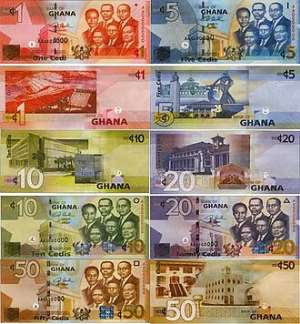
Former New Patriotic Party (NPP) Deputy Secretary for the Biakoye Constituency, Ali Sabiku, has urged political actors and the public to approach the planned introduction of new Ghana cedi banknotes without partisan bias.
He said political affiliation should not determine whether a national policy is supported or criticised, arguing that the focus should instead be on the potential benefits, transparency and value the initiative would bring to Ghana.
Speaking on the Bubune Morning Show hosted by Nana Yaw Asiamah, Mr Sabiku said the planned currency upgrade should be assessed on its merits rather than on which political party is in power.
He recalled the criticism that surrounded similar discussions during the NPP administration and questioned whether those who opposed the exercise at the time would maintain the same position now that the NDC is in government.
"When the NPP was in government and wanted to print money, if we play the tapes and listen to what the NDC people said about it, it will shock you. And so today, what will those people say?" he asked.
Mr Sabiku said political loyalty should not prevent individuals from speaking honestly about government decisions.
"Whatever the truth is, that is what I will say. For me, I belong to a political party, but I won't foolishly say something is good when it isn't," he said.
He therefore called for what he described as "nyaakyom" to be put aside, urging Ghanaians to support initiatives that are beneficial to the country while criticising those they consider harmful.
"We should stop the hypocrisy and put Ghana first. Whatever anyone comes to do, let us see that they are doing it in the interest of Ghana, and let's all support it. What is bad, let's call it bad. What is good, let's call it good," he stated.
On the proposed banknotes, Mr Sabiku said he had no objection to updating Ghana's currency, noting that banknotes naturally deteriorate with prolonged use and may require improvements to their security features.
"If it has faded and we want to upgrade it, let's all support it," he said.
However, he stressed that the institutions responsible for producing the new notes must ensure that the exercise is transparent, cost-effective and delivers value to taxpayers.
Responding to questions about the planned November rollout and whether he suspected any wrongdoing, Mr Sabiku declined to speculate, saying the timing should be determined by the relevant monetary authorities and experts.
"I am not the Bank of Ghana Governor," he said.
He maintained that the authorities should be able to explain why the chosen timing is appropriate and demonstrate how the exercise would serve Ghana's interests.
"If it will not favour Ghana, then he should restrain. But if it will favour Ghana, then he should go on. Ghana first," Mr Sabiku stated.
He also called for strict accountability throughout the production process, particularly concerning the quantity and cost of the new notes.
Mr Sabiku said the absence of the public from the physical production process could create doubts about whether the quantities authorised correspond with those actually produced.
"If Ghana First is in their minds, if it is 10 billion they are printing, they will print it accurately," he said.
He cautioned that the exercise should not become an opportunity for individuals to benefit improperly at the expense of the state.
Public education urged
Mr Sabiku also called for extensive public education ahead of the introduction of the new banknotes to minimise confusion during the transition.
He said traders and other members of the public should be properly educated on how to distinguish the existing notes from the new ones and identify their respective security features.
"Let's look at how we can spread awareness about both the old and the new notes—the difference between them," he said.
He suggested that public education should go beyond television, radio and social media and extend directly into communities.
Drawing on public education methods he recalled from his childhood, Mr Sabiku said authorities could use community-based approaches involving vans, projectors and visual demonstrations to explain the differences between the old and new notes.
He also suggested that the National Commission for Civic Education (NCCE) and the Information Services Department could play a stronger role in educating citizens at the district and regional levels.
According to him, effective public education would help traders and consumers navigate the transition and reduce the risk of counterfeit notes being circulated.
Mr Sabiku ultimately urged the public debate over the new currency to be guided by transparency, accountability and the national interest rather than partisan considerations.
"Let's stop the hypocrisy. Let's put Ghana first," he said.

 27-year-old nursing mother shot dead along Tilli–Widnaba road
 Ghana to reopen diplomatic mission in Ireland
 Ghana facilitates return of 180 nationals from Libya
 Parliament to review dollar payment for locally produced crude
 Ghana to build 1,200MW gas-fired power plant, surpassing Akosombo capacity befor...
 “Those responsible should be imprisoned for life with no food” — Friend of murde...
 “I have crocodile skin; insults don’t bother me” — President Mahama
 Police arrest 64 suspects, recover firearms in special operation at Achimota Mil...
 Madina MP receives medical attention after GIMPA collapse
 Ghana concludes cocoa freight negotiations for 2026/27 season


