




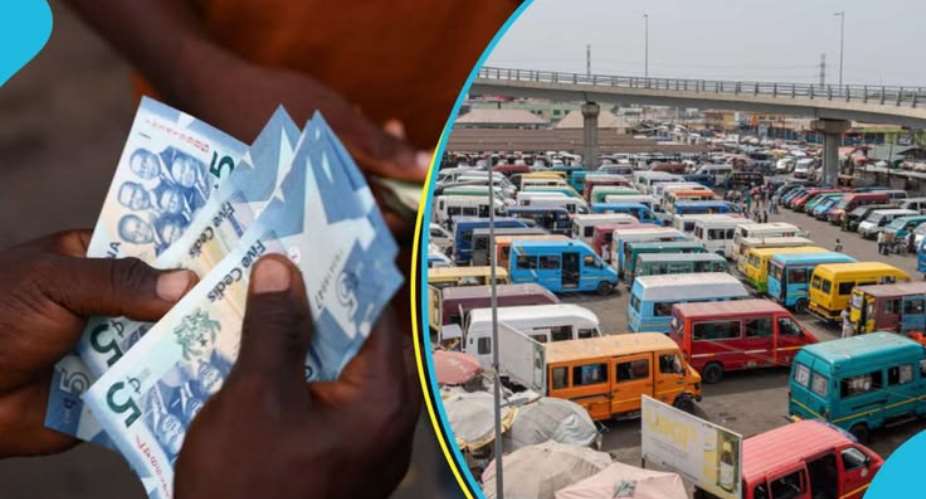
There are weeks when a nation simply lives. And then there are weeks when a nation is asked, all at once, to pay more for the trotro, watch its currency change its face, listen to its President address the whole world, and watch that same world wobble on the edge of several wars. This is one of those weeks. Ghana did not choose all of it. But Ghana, as it always does, will carry all of it — on its back, in its market bags, and in its prayers.
Let us walk through it together, plainly, the way an elder explains the state of the town to a child sitting at his feet.
1. The Trotro Will Cost You More From Tomorrow
Starting Saturday, September 26, 2026, every trotro, shared taxi, and long-distance bus fare in Ghana goes up by 8 percent. This followed weeks of back-and-forth between the Ministry of Transport and the two big transport unions — the Ghana Private Road Transport Union (GPRTU) and the Ghana Road Transport Coordinating Council (GRTCC). The unions had actually asked for a 30 percent increase, citing the cost of fuel, spare parts and vehicle maintenance. Government pushed back, offered a GH¢2-per-litre cushion on diesel, and the two sides settled on 8 percent — a compromise that will still be felt by every market woman, every school-going child, every worker who boards a trotro before sunrise.
The unions have warned their own drivers: charge only the approved fare, post it at the station, or face sanctions. It is a small mercy, but a mercy nonetheless, that this was not the 30 percent originally demanded.
Why it matters to the ordinary Ghanaian: an 8 percent fare hike does not stay in the trotro. It rides along into the price of tomatoes at Kejetia, into the transport component of every good sold in every kiosk in this country. When the vehicle that carries the yam gets more expensive to run, the yam gets more expensive to buy.
2. Cocoa Farmers Wait, As COCOBOD Talks Money In London
While commuters absorb an 8 percent hike, cocoa farmers are watching a different number — the new producer price for the 2026/2027 season. Government has kept farmers steady through a turbulent year: the 2025/26 season opened at GH¢51,660 per tonne, was raised to GH¢58,000 per tonne in October 2025 after stakeholder consultation, then had to be revised down to GH¢41,392 per tonne in February 2026 when world cocoa prices collapsed from around US$7,200 to roughly US$4,100 per tonne. That price was held steady through the 2026 light crop season.
Now, as the new main season approaches, COCOBOD has been in London engaging international trading houses, discussing a new Ghana Cocoa Board Act passed in 2026 that promises an automatic pricing formula tied to world prices and guarantees farmers at least 70 percent of the gross export value of their beans. Industry sources suggest a new price near GH¢2,737 per 64-kilogramme bag — roughly a 5.8 percent rise from GH¢2,587 — though this is not yet officially confirmed.
Why it matters: Ghana is still fighting Côte d'Ivoire for cocoa competitiveness, still fighting swollen shoot disease and ageing farms that could shrink this season's crop by up to 16 percent, and still trying to protect the farmer who wakes before the cockerel to tend the tree that earns this country its foreign exchange. A cocoa farmer's cutlass built the Ghana we inherited. That farmer deserves a price that respects the sweat, not just the ledger.
3. The Cedi Gets A New Face — The "Heritage Series"
In arguably the week's most striking domestic announcement, Bank of Ghana Governor Dr Johnson Pandit Asiama unveiled a new family of banknotes — the Heritage Series — to be launched on November 3, 2026, at Bank Square, Accra. The upgraded GH¢1, GH¢2 (reintroduced), GH¢5, GH¢10, GH¢20, GH¢50, GH¢100 and GH¢200 notes will carry stronger anti-counterfeiting features, improved durability and new designs celebrating Ghana's heritage.
Crucially, the Governor was clear: this is not a redenomination. Old notes remain full legal tender and will circulate side-by-side with the new ones. Nobody needs to rush to a bank to "exchange" anything. This announcement lands at an unusual moment — the cedi has had one of its strongest years in a long while against the US dollar — which is, frankly, a far better time to modernise a currency than in the middle of a crisis.
Why it matters: currency design is never just design. It is a nation telling itself, and the world, what it believes it is worth.
4. Eastern Region Opens Its Doors
Down in Koforidua, the Eastern Regional Minister, Rita Akosua Adjei Awatey, has launched the maiden Eastern Expo 2026, running September 26 to October 3 under the theme "Unlocking Opportunities for Sustainable Trade, Tourism and Investment." All 33 Municipal and District Assemblies in the region — grouped into five blocks: Kwahu, Akyem, Krobo, Akuapem and New Juaben — will take turns showcasing what they have to offer. President Mahama himself is expected to join proceedings during expo week.
Why it matters: this is what a 24-hour economy looks like when it leaves the podium and enters the marketplace — cooperatives, artisans, and farmer groups given a stage next to investors and financiers.
5. ECG Workers Put On Red Armbands
Not every story this week is a celebration. The Senior Staff Union and Junior Staff Union of the Electricity Company of Ghana (ECG) began wearing red armbands to work from September 15, 2026, the first phase of a planned protest against government's proposed Private Sector Participation arrangement — in plain language, a move toward privatising parts of ECG's operations. The unions say their National Executive Council approved this course of action earlier in the year, and further steps may follow.
Why it matters: Ghana has been here before, with earlier attempts at ECG concession sparking similar resistance. Whatever side one takes, the workers' anxiety about job security deserves a hearing, not a dismissal.
6. President Mahama Speaks To The World
On Thursday, September 24, 2026, President John Dramani Mahama delivered his seventh address to the United Nations General Assembly — this time the 81st session, themed "Restoring Trust, Managing Transformation: A United Nations That Delivers For All." He spoke of Ghana's "dramatic turnaround," Africa's demand for permanent representation in global governance, the historic UN resolution Ghana tabled in March 2026 declaring the transatlantic slave trade a crime against humanity, debt relief, critical minerals, and Ghana's coming chairmanship of the African Union in January 2027. He reminded the Assembly that African nations must also "put our own houses in order" — a line that drew as much comment as any promise made to outsiders. He had earlier rung the closing bell at NASDAQ, declaring Ghana "open for business."
Why it matters: a small nation speaking boldly at a large table is not new for Ghana — it is our inheritance from Nkrumah. But inheritance must be renewed with delivery, not only with rhetoric.
7. Beyond Our Borders: A World On Edge
Ghana does not live on an island, and the news beyond our shores this week is heavy.
Netanyahu and an isolated Israel. When Israeli Prime Minister Benjamin Netanyahu rose to address the 80th UN General Assembly a year ago, dozens of delegations walked out before he even opened his mouth — a scene that shocked the world and has not been forgotten since. A year on, with Britain, Canada, France, Australia and others having since recognised Palestinian statehood, and an International Criminal Court warrant still hanging over him, Israel's isolation at the UN has, if anything, deepened rather than eased.
America's press freedom tug-of-war. In the United States, a federal appeals court in June 2026 sided — for now — with President Donald Trump in his long legal fight with the Associated Press, ruling that the White House may restrict AP's access to the Oval Office and other tightly controlled spaces. This reversed an earlier district court decision that had ordered the ban lifted. The case, which began after AP declined to rename the Gulf of Mexico the "Gulf of America" in its reporting, remains one of the most closely watched press-freedom disputes in the world.
A fragile US-Iran chess game. Diplomacy between Washington and Tehran remains on-again, off-again following a brief but bruising 2026 war between Israel, the US and Iran. Talks in Oman, Islamabad and elsewhere have opened and stalled repeatedly, with both capitals trading accusations even as quiet back-channel efforts, backed by Qatar, Oman and Pakistan, continue.
Saudi Arabia under fire. Since Houthi forces in Yemen declared a naval blockade against Riyadh in July 2026, missile and drone attacks on Saudi cities — including a September 19 strike near Riyadh's international airport and Aramco facilities in Yanbu — have become disturbingly regular. Saudi air defences have intercepted several of these, and the Saudi-led coalition has vowed a "firm" response.
Ethiopia on the brink again. Barely four years after the Pretoria peace deal ended the brutal Tigray war, fighting between federal forces and Tigrayan forces resumed on August 1, 2026, with near-daily drone strikes reported and civilians again fleeing into Sudan. On September 20, seven armed groups — including the Tigray People's Liberation Front and Amhara's Fano movement — announced a new coalition aimed at the federal government, raising fears the Horn of Africa could be dragged into a wider war.
A quiet global health win. Amid all this, the World Health Organization has quietly expanded its medical device prequalification programme in 2026 to include tuberculosis-screening software, male and female condoms, and copper intrauterine devices — a technical-sounding step that means more countries, including in Africa, can trust that the health tools they buy actually meet global safety standards.
Now, Let Us Steelman The Other Side
A good columnist must argue against himself before he asks you to agree with him.
One could reasonably say: an 8 percent fare increase, agreed jointly by government and unions after weeks of negotiation, down from a proposed 30 percent, is actually a sign that dialogue in Ghana still works. One could say the cedi's new banknotes, launched while the currency is strong rather than in crisis, show foresight rather than panic. One could say ECG's proposed private-sector participation might, if well negotiated, finally solve the chronic underinvestment that causes "dumsor" in the first place — and that union resistance, while understandable, is not automatically correct. And on the global stage, one could argue that Mahama's UN speech, however eloquent, changes little until African governments themselves deliver the "houses in order" he spoke of. Fair points, all of them. A columnist owes his readers that much honesty.
What This Means For The Man At The Trotro Station
Kwame boards a trotro from Achimota to Circle. Tomorrow, he pays a little more. His mother in Koforidua is preparing her stall for Eastern Expo, hoping this year the region's yam and kente finally meet the investor who has been looking for exactly what Eastern Region has been quietly growing for decades. His uncle, a cocoa farmer near Kade, waits — as he waits every season — for a government announcement that decides whether his children eat well or eat carefully this year. And somewhere in Accra, an ECG worker wearing a red armband goes home wondering whether his job will still exist in five years. This is Ghana in September 2026: a country of small, dignified people, absorbing big, undignified shocks, one market day at a time.
As it is written in the Holy Bible, Proverbs 27:23 counsels: "Be thou diligent to know the state of thy flocks, and look well to thy herds." A nation, like a shepherd, must know the true state of its people before it can lead them well — the price of the trotro, the price of the cocoa bag, the mood of the worker at the gate.
And as it is written in the Holy Qur'an, Surah Al-Baqarah 2:286 reminds the believer: "Allah does not burden a soul beyond that it can bear." Whatever this season asks of Ghana — higher fares, new currency, uncertain seasons for our cocoa farmers, a world at war on three continents — may it never ask more of us than we, together, can bear.
Author's Note
I do not write this column to frighten anyone. I write it because I believe an informed market woman is more powerful than an uninformed minister, and an informed student is more dangerous to bad governance than any protest placard. Ghana is not falling apart. Ghana is, as it has always been, negotiating — with its unions, with its farmers, with its currency, and with a world that does not pause to ask our permission before it changes. Our task, yours and mine, is simply to stay awake, stay informed, and stay kind to one another while the negotiation continues. God bless our homeland, Ghana, and make us truly great and strong.
📖 Understand The Big Words: A Glossary For Every Reader
- Producer price (cocoa): the amount of money government pays a farmer for each bag or tonne of cocoa beans sold.
- COCOBOD: the Ghana Cocoa Board — the government body that buys, prices and manages Ghana's cocoa.
- Redenomination: when a country changes the actual value or scale of its money (for example, removing zeros from notes). Ghana's new Heritage Series is not this — it is only a design and security upgrade.
- Legal tender: money that must, by law, be accepted as valid payment.
- Monetary Policy Committee (MPC): the Bank of Ghana team that decides interest rates and currency policy.
- Privatisation / Private Sector Participation (PSP): handing some or all control of a state company (like ECG) to private investors instead of government alone running it.
- GPRTU / GRTCC: the two major unions representing commercial drivers and transport owners in Ghana.
- UN General Assembly (UNGA): the yearly meeting in New York where leaders of almost every country in the world speak and vote on global issues.
- ICC (International Criminal Court): an international court in The Hague that can charge individuals, including heads of state, with serious crimes.
- Ceasefire: a formal agreement between fighting sides to stop shooting, even if the deeper conflict is not fully resolved.
- Coalition (armed groups): when several separate rebel or opposition groups formally join forces against a common target, usually a government.
- Prequalification (WHO): WHO's process of checking that a medical product (like a test kit or device) is safe and reliable enough for international agencies to buy and use in poorer countries.
- First Amendment: the part of the United States Constitution that protects free speech and freedom of the press.
Sources consulted for this piece
MyJoyOnline, Pulse Ghana, Adomonline, YEN.com.gh, The Ghana Report, GhanaWeb, Graphic Online, GBC Ghana Online, Asaase Radio, COCOBOD press releases, The High Street Journal, Food Business Middle East & Africa, Ghanaian Times, 3News, Bank of Ghana official notices, AP/NBC/CBS/Yahoo News reporting, Al Jazeera and Anadolu Agency, Oman Observer, Sudan Tribune, AllAfrica, GlobalR2P, and the World Health Organization's official prequalification programme pages.
About The Author
Chief Tutu Baffour Asare Brownsy Williams is a Ghanaian author, filmmaker, opinion columnist, and founder of the Brownsy Silva Company — a multi-disciplinary creative platform spanning novels, film, engineering-inspired storytelling, and civic commentary. A columnist for Modern Ghana with a growing readership across the UK, USA, Canada and Germany, and a student pursuing engineering studies in Accra, Chief Tutu writes at the intersection of everyday Ghanaian life and the wider currents shaping our world — believing, as his forebears did, that the pen remains one of Africa's sharpest tools for building a more informed and dignified citizenry.

 27-year-old nursing mother shot dead along Tilli–Widnaba road
 Ghana to reopen diplomatic mission in Ireland
 Ghana facilitates return of 180 nationals from Libya
 Parliament to review dollar payment for locally produced crude
 Ghana to build 1,200MW gas-fired power plant, surpassing Akosombo capacity befor...
 “Those responsible should be imprisoned for life with no food” — Friend of murde...
 “I have crocodile skin; insults don’t bother me” — President Mahama
 Police arrest 64 suspects, recover firearms in special operation at Achimota Mil...
 Madina MP receives medical attention after GIMPA collapse
 Ghana concludes cocoa freight negotiations for 2026/27 season


