




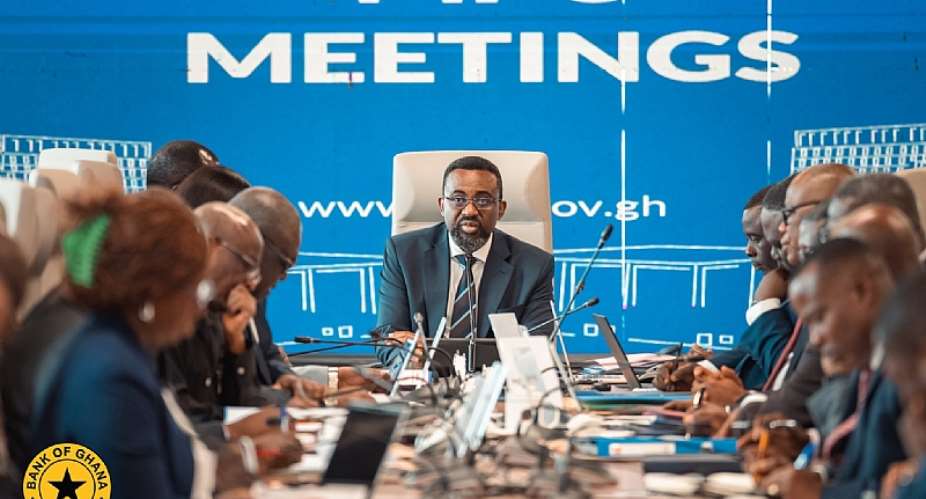
The Bank of Ghana’s Monetary Policy Committee (MPC) has maintained the monetary policy rate at 14% for the third consecutive time.
The decision was announced on Thursday, September 24, during a press briefing held at the Bank of Ghana’s headquarters in Accra following the MPC’s 132nd meeting.
The latest decision keeps the benchmark policy rate unchanged as the central bank continues to assess prevailing economic conditions.
The central bank said its decision was supported by resilient domestic economic activity, easing underlying inflationary pressures and strong performance in the external sector, although uncertainty in the global economy remains elevated.
Economic activity during the first half of 2026 remained resilient, the BoG said, with easing credit conditions, increased lending to the private sector and improved business and consumer confidence supporting growth.
“Based on these considerations, the Monetary Policy Committee viewed the balance of risks to inflation and growth as broadly balanced, and the committee voted by a unanimous decision to maintain the monetary policy rate at 14.0 percent,” the Governor said.
Inflation pressures remain
The MPC noted that headline inflation increased in August, attributing the rise mainly to the pass-through from utility tariff adjustments and higher crude oil prices.
The Bank, however, said underlying inflationary pressures continued to ease, with inflation expectations and core inflation measures pointing towards moderation.
“Despite this, all the inflation expectations and core inflation measures are indicating a moderation in underlying inflation,” the Governor said.
Although headline inflation remains below the lower bound of the BoG’s medium-term target band, the Committee expects it to move into the target range over the coming quarters.
The MPC identified higher utility tariffs, rising ex-pump petroleum prices and their potential effect on transport fares as some of the key upside risks to inflation. Other risks include a stronger US dollar resulting from higher US interest rates and possible spillovers from disruptions to global supply chains.
The Bank said inflationary pressures could, however, be contained by continued fiscal consolidation, improved food supply conditions and exchange-rate stability.
Trade surplus rises to $8.85 billion
Ghana’s external sector also recorded stronger performance during the first 8 months of 2026, with the trade surplus increasing to $8.85 billion from $6.69 billion over the corresponding period in 2025.
The increase was driven mainly by higher export earnings from gold, cocoa and crude oil.
Total exports rose to $22.4 billion during the first 8 months of 2026, compared with $17.9 billion during the same period a year earlier.
Imports also recorded significant growth, reaching $13.58 billion, up 20.8% from $11.24 billion in the corresponding period of 2025.
According to the BoG, the increase in imports was largely driven by higher oil and gas import values, reflecting increased crude oil purchases for domestic refining activities.

 I will unite Africa, Caribbean and Latin America into world's biggest trading bl...
 Mahama petitioned to halt Sentuo Airport Garden City construction after sod cutt...
 ‘No human civilisation deserves to be annihilated’ – Mahama jabs Trump
 Government should not fund the $4 billion Accra-Kumasi Expressway project — Alan
 BoG to introduce upgraded Ghana cedi banknotes with enhanced security features, ...
 Bank of Ghana keeps policy rate at 14% for third straight time
 Democracy must deliver tangible social benefits to citizens – Mahama
 ‘We will process our minerals at home’ – Mahama warns against scramble for Afric...
 Court to rule on bail applications of six accused in 3.9-tonne cocaine seized in...
 [Full Text] Mahama addresses 81st Session of the United Nations General Assembly...


