




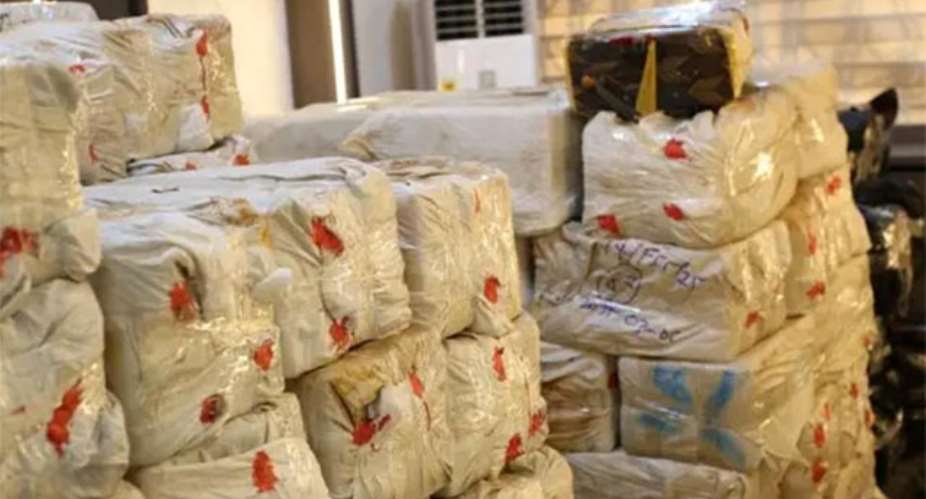
The recent cocaine-related cases involving Ghana should not be treated as isolated incidents. They raise serious questions about Ghana’s vulnerability to international cocaine trafficking and, more importantly, the possibility that some of these consignments could eventually find their way into the local market.
Between January 2025 and July 2026, Ghana reported intercepting more than 8.5 tonnes of assorted narcotic drugs. In March 2025, Ghanaian authorities intercepted more than 3.3 tonnes of cocaine. Ghana has also been linked to several recent international drug-trafficking cases. In June 2026, Australian authorities seized approximately 320 kg of methamphetamine from a shipment of charcoal originating from Ghana. In September 2026, South African authorities arrested a passenger arriving from Accra after allegedly discovering suspected heroin worth more than R2 million at OR Tambo International Airport. French authorities also intercepted approximately four tonnes of suspected cocaine in a container originating from Ghana in September 2026.
Although the busts should not be read as 8.5 tonnes of cocaine alone, the cocaine seizures were still significant and highlight the scale and international reach of Ghana-linked drug trafficking during this period. These cases raise an obvious question: If these are consignments that have been detected, what might be escaping detection?
We should be careful not to invent a precise figure for cocaine supposedly hidden or circulating in Ghana. International estimates can suggest that seizures represent only a fraction of illicit trafficking, but they cannot tell us precisely how many tonnes of cocaine are currently inside Ghana. The documented seizures are enough, however, to justify a serious national response.
THE REAL CONCERN: KEEPING COCAINE OUT OF THE LOCAL MARKET
Ghana must not become both a transit route and a destination market.The greatest concern should be preventing internationally trafficked cocaine from being diverted into Ghanaian communities, particularly where it could become accessible to young people. This requires a strategy that starts at Ghana’s ports and borders and continues all the way into communities and schools.
WHAT CAN GHANA DO?
Community-Based Strategies
I. Coastal and fishing-community intelligence network
Establish confidential reporting channels through fishing associations, canoe owners, landing beaches and coastal community leaders so suspected encounters with offshore vessels or unusual activity can be reported directly to NACOC, Marine Police, Customs or other designated authorities. Reports should be verified through formal investigation rather than treating fishermen collectively as suspects.
- Safeguard emergency/ambulance services against diversion
Strengthen tracking, dispatch records, GPS/vehicle logs and post-mission documentation for ambulances and other authorised vehicles, with targeted audits where intelligence indicates possible misuse. This protects legitimate emergency services while making diversion for illicit purposes harder to conceal.
Global Strategies
1. Strengthen intelligence-led enforcement
NACOC, Customs, Police, financial-intelligence agencies, port authorities and other relevant institutions should strengthen intelligence sharing. The emphasis should be on identifying the networks behind the consignments, rather than focusing only on couriers.
2. Strengthen port and cargo controls
Ghana should continue investing in risk-based cargo screening, container assessment, scanning technology, customs intelligence and stronger oversight of high-risk supply chains.
The objective should be to identify suspicious consignments while allowing legitimate international trade to continue efficiently.
3. Follow the money
Large-scale cocaine trafficking requires financing.Investigators should therefore follow suspicious financial flows and, where evidence establishes links to trafficking, pursue the proceeds and assets associated with the criminal network through the appropriate legal processes.
4. Build a rapid inter-agency response system
When a major cocaine shipment is detected, the response should not end with the seizure. A coordinated investigation should examine its origin, financing, logistics, handlers, intended destination and possible links to other consignments.
5. Prevent domestic diversion
Every major seizure should trigger an assessment of whether the trafficking network has previously supplied the Ghanaian market. This would help authorities identify potential local distribution networks and prevent cocaine from moving from international trafficking routes into Ghanaian communities.
6. Strengthen international cooperation
The recent international seizures demonstrate that Ghana cannot address the problem alone. Ghana should deepen cooperation with international customs and law-enforcement agencies to exchange intelligence on consignments, trafficking networks, financial flows and repeat offenders.
7. Protect Ghana’s young people
Prevention must begin before cocaine reaches the streets. Schools and communities need sustained, evidence-based drug-prevention programmes, counselling, early intervention and referral systems. Young people should be equipped with accurate information about the risks of cocaine and other dangerous substances rather than relying solely on punitive approaches after drug use has already occurred.
8. Expand treatment and rehabilitation
Where young people or other community members develop substance-use problems, treatment and rehabilitation should be accessible. A national response should therefore prioritize readily implementable measures that integrate prevention and enforcement strategies. Failure to adopt such an approach may necessitate escalation to more costly phases, including early intervention, treatment, and rehabilitation.
TURNING THE CHALLENGE INTO AN OPPORTUNITY
The current situation also presents an opportunity for Ghana. Instead of responding to each cocaine seizure as a separate crisis, Ghana can use the information generated by these cases to build a national cocaine-trafficking intelligence and prevention system.
- Every seizure can become intelligence.
- Every investigation can reveal a network.
- Every financial investigation can identify facilitators.
- Every disrupted shipment can provide information about trafficking methods.
- And every prevention programme can help ensure that cocaine does not develop into a larger domestic market.
The goal should therefore be more ambitious than simply seizing cocaine.Ghana should aim to: Detect the network → intercept the shipment → follow the money → dismantle the network → prevent domestic diversion → protect young people → provide treatment where needed → strengthen the system using lessons from every case.
The current cocaine cases should be a warning, but they can also become a turning point.
Ghana has an opportunity to demonstrate that it can protect its borders, safeguard legitimate trade, disrupt international cocaine networks and, most importantly, prevent Ghanaian communities and young people from becoming the next market for an international drug trade.
By: Dr. Moses Ackah Anlimachie (PhD) Centre for the Advancement of Rural Education and Inclusive Education Research
Department of Education
Sol Plaatje University, Kimberley, Soutth Africa
PB X5008, 8301, Kimberley, Northern Cape, South Africa [email protected]


 Loaded Transit Truck Left for Weeks Exposes Safety, Enforcement and National Sec...
 GRIDCo CEO gives December deadline for improved power supply in Ashanti Region
 GES to remove Twene Amanfo SHS teachers from Masters on Duty positions over stud...
 Speaker Bagbin urges PAC to detain officials who fail to account for public fund...
 Audit Service recovers over GH¢18bn in public funds between 2022 and 2026 – Audi...
 Mining Conference: Local Government Minister puts Regional Ministers, MMDCEs on ...
 'Illegal mining is direct assault on national security' — Lands Minister vows de...
 'Chiefs must protect lands from galamsey for generations unborn' — National Hous...
 'I’ll make you impotent' – Wife threatens husband on live radio over 'baby mamas...
 NIA begins nationwide crackdown on illegal Ghana Card photocopying


