




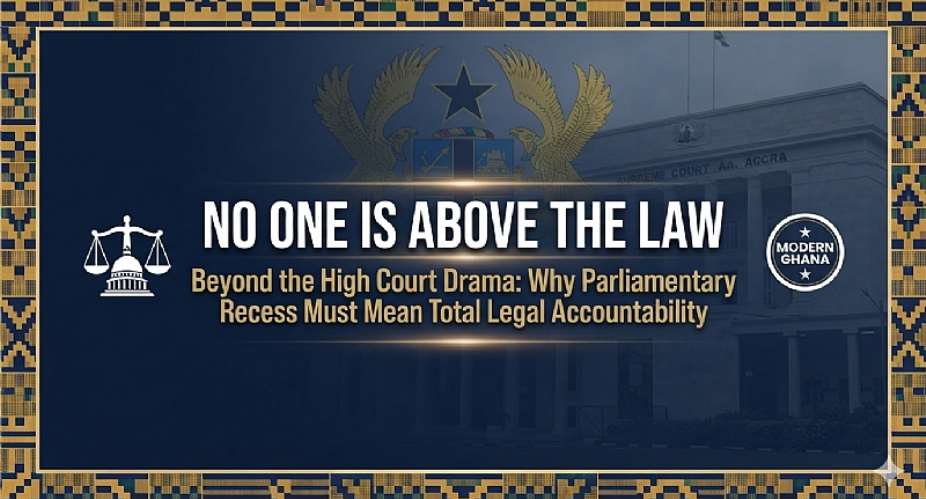
The Courtroom Clash and the Soul of Our Democracy
The recent, dramatic confrontation at the Accra High Court forecourt involving the Economic and Organised Crime Office (EOCO) and Manhyia South MP Nana Agyei Baffour Awuah has sent shockwaves through Ghana's political landscape. When state law enforcement attempts to detain a sitting Member of Parliament on court premises—and that lawmaker forcefully drives away to evade custody—it signals a dangerous fracture in our institutional framework. This incident is not merely a political scandal; it is a critical litmus test for the rule of law in Ghana.
For far too long, the toxic narrative that public office creates a class of "untouchables" has eroded public trust in our democracy. While the Majority Chief Whip rightly warns that chaotic public arrests damage Ghana’s international image, the counter-truth is equally absolute: Parliament is currently on recess, and no single individual, regardless of their title, is above the laws of the Republic of Ghana. To prevent this incident from degenerating into a partisan shouting match, we must objectively examine the boundaries of parliamentary immunity, the limits of law enforcement, and how we can safeguard our democratic integrity.
Core Areas of Concern: Where the System Fractured
- Abuse of Privilege during Recess: Parliamentary immunity is designed to protect lawmakers from malicious distractions while executing state duties, not to serve as a perpetual shield against criminal or civil accountability.
- Law Enforcement Protocol: State agencies like EOCO must operate with flawless professionalism, ensuring clear identification and respecting court sanctity to avoid chaotic public spectacles that undermine state authority.
- Institutional Defiance: Public officials failing to honor official law enforcement invitations sets a destructive example for ordinary citizens, fostering a culture of impunity.
Recommendations for Immediate Reform
To ensure that state institutions retain their integrity and public officials remain accountable, the following structural actions are highly recommended:
- Clear Guidelines on Parliamentary Recess: The Supreme Court or the Rules of Parliament must explicitly clarify that when Parliament is not in session, MPs hold no special immunity against standard law enforcement procedures and investigations.
- Strict Law Enforcement Protocols: State investigative bodies must follow strict, professional protocols when engaging high-profile figures. Arrests should be coordinated through formal channels to avoid public chaos and loss of dignity for state apparatuses.
- Sanctions for Non-Compliance: Any public official, including MPs, who repeatedly ignores official statutory invitations without a verified legal or medical excuse must face immediate legal or parliamentary sanctions for contempt.
- Civic Education on Civic Equality: National bodies like the NCCE must intensify education reminding Ghanaians that Article 17 of the Constitution guarantees equality before the law, meaning political status does not grant legal exemption.
A Wake-Up Call for Ghana
Ghana’s democratic credentials cannot survive if the public perceives that there is one set of rules for the ruling elite and another for ordinary citizens. The EOCO-MP standoff must serve as a definitive wake-up call. True democratic stability does not come from protecting the elite from scrutiny under the guise of "national image." It comes from showing the world that our laws work equally for the street hawker and the lawmaker. Parliament is on break, but the Constitution never sleeps. It is time for our leaders to lead by example, respect state institutions, and reaffirm that in this republic, the law remains supreme.
✍️ Submitted by:
Retired Senior Citizen
For and on behalf of all Senior Citizens of the Republic of Ghana 🇬🇭
Teshie-Nungua
[email protected]

 I will unite Africa, Caribbean and Latin America into world's biggest trading bl...
 Mahama petitioned to halt Sentuo Airport Garden City construction after sod cutt...
 ‘No human civilisation deserves to be annihilated’ – Mahama jabs Trump
 Government should not fund the $4 billion Accra-Kumasi Expressway project — Alan
 BoG to introduce upgraded Ghana cedi banknotes with enhanced security features, ...
 Bank of Ghana keeps policy rate at 14% for third straight time
 Democracy must deliver tangible social benefits to citizens – Mahama
 ‘We will process our minerals at home’ – Mahama warns against scramble for Afric...
 Court to rule on bail applications of six accused in 3.9-tonne cocaine seized in...
 [Full Text] Mahama addresses 81st Session of the United Nations General Assembly...


