




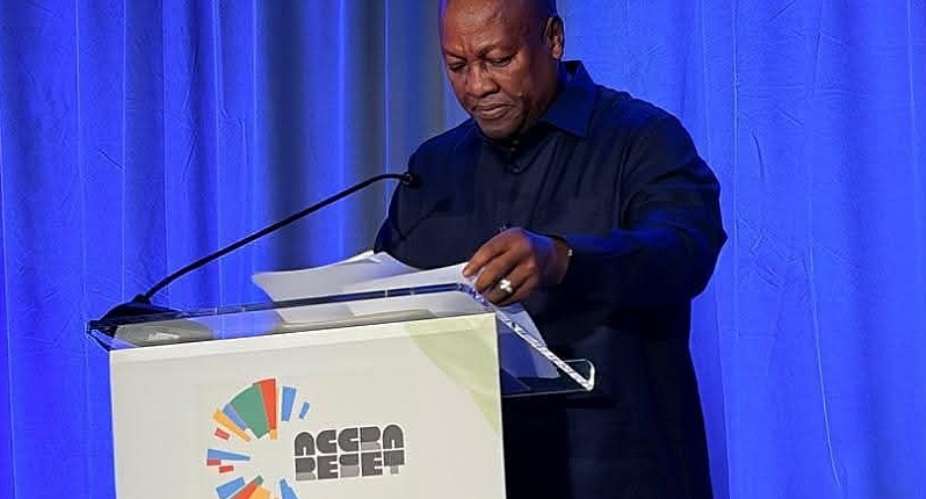
President John Dramani Mahama has launched the report of the Accra Reset Presidential Council, declaring that Ghana will move beyond designing a new global health framework to ensuring that its recommendations are implemented.
Dubbed “A Sovereign Future for Health”, the report contains 10 practical recommendations aimed at strengthening global health sovereignty and was launched on the sidelines of the 81st United Nations General Assembly in New York.
Speaking at the launch, President Mahama said the Presidential Council had completed its assignment and that the responsibility had now shifted to governments and other stakeholders to turn the recommendations into tangible outcomes.
“The responsibility now falls on us to deliver its promise. We have come full circle; let us not go around in circles.
“Let this New Global Bargain begin today: Ownership backed by real control, Cooperation defined by human dignity; and promises that manifest as real protection for that baby girl born tonight, whether in Kathmandu, in Arusha, or in Damongo.”
The President said the Accra Reset would not be allowed to become another ambitious proposal that loses momentum after being introduced at an international diplomatic gathering.
“We are now moving from design to execution,” he said, noting that visionary ideas were too often launched with great enthusiasm only to “die quietly in New York’s diplomatic corridors”.
“We will not let that happen to the Accra Reset,” President Mahama stated.
He said Ghana and the Accra Reset Presidential Council would, in the coming months, engage governments, global health institutions, development finance organisations, philanthropies and private-sector actors to transform the report’s recommendations into country-level compacts.
President Mahama also called for strategic partnerships with institutions across the Global South, including Brazil's Fiocruz and leading organisations in India, Indonesia, the Gulf and Africa.
He said the objective was to establish self-sustaining networks linking research, regulatory oversight, local manufacturing and dependable distribution systems.
According to the President, the push for greater health sovereignty should not be interpreted as a move towards isolationism. Rather, he said, it was about creating a more balanced form of interdependence based on equality and mutual respect.
He argued that stronger and more self-reliant countries in Africa and Asia would not undermine the interests of developed countries, but would instead contribute to stronger global health security.
President Mahama welcomed leaders and representatives from France, Spain, the United Kingdom, the G77, the Organisation for Economic Co-operation and Development (OECD) and the Commonwealth who attended the event.
He also expressed appreciation to former British Prime Minister Gordon Brown for accepting the responsibility of mobilising political support around what he described as the New Global Bargain.
Responding to arguments that structural reforms should be delayed until geopolitical tensions around the world subside, President Mahama said the current global challenges made reform even more necessary.
“I respectfully disagree. Crisis is precisely when new paradigms are forged,” he said.
He described health as one of humanity’s most valuable assets and said this was why it had been selected as the first area of focus under the global reset, with maternal and child health serving as the initial test of the proposed framework.
President Mahama cited global maternal mortality figures, noting that nearly seven out of every 10 maternal deaths occur in Sub-Saharan Africa. He added that Ghana’s maternal mortality situation remained three times above the recommended Sustainable Development Goal target.
“This is unacceptable,” he said.
The President also highlighted the Mother Africa initiative, championed by Tanzanian President Samia Suluhu Hassan, and the Business United for Mothers, Babies and Youth (BUMBY) campaign as efforts aimed at bringing government policy and corporate responsibility together to improve outcomes for mothers and children.
He said the initiatives would provide an opportunity to test the proposed financial and governance architecture in real time while delivering measurable results.
President Mahama further thanked World Health Organisation (WHO) Director-General Dr Tedros Adhanom Ghebreyesus for his support for efforts to reform global health systems.
He said Ghana’s planned assumption of the African Union Chairmanship in 2027 would provide an opportunity to place the Reset Agenda at the centre of Africa’s collective policy discussions.
He added that Ghana would also work with the Non-Aligned Movement and the G77 plus China to advance the agenda.
 'It will not die quietly in New York’s diplomatic corridors' — Mahama launches A...
 Akatamanso War: The victory that gave Akuapem's Odwira a memory, meaning and ide...
 We should make it easier for Africans to travel and invest across the continent ...
 Mahama turned around Ghana’s economy in a very short time – Dangote
 September 22: Cedi sells at GHS12.15 on forex market, GHS11.56 on BoG interbank
 We need to train judges on new laws to ensure proper application – Barker-Vormaw...
 Ghana’s democracy under pressure; youth must speak to defend their freedoms – Os...
 Ghana’s independence must translate into economic empowerment -- CPP's Nana Frim...
 Don’t just prosecute couriers, go after drug financiers – Catholic Bishops urges...
 ‘No ownership without control’ – Mahama pushes new global health financing model...


