




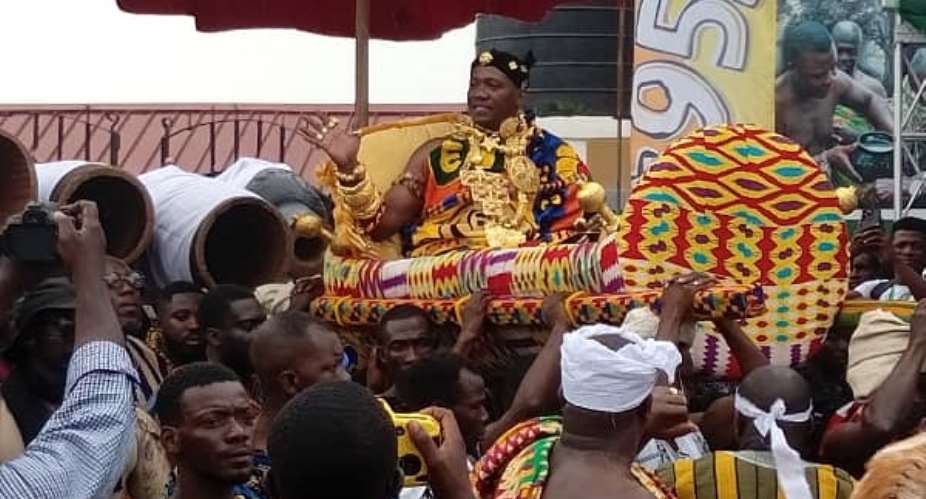
Two centuries after the clash at Akatamanso near Dodowa, the Battle of August 7, 1826, remains more than a chapter in the military history of the Gold Coast.
For Akuapems, it became a defining moment through which an existing political state reaffirmed its independence, its constituent communities strengthened their sense of common purpose and a victory on the battlefield was eventually transformed into one of Ghana’s most enduring traditional festivals – Odwira, which in Akan means “purification”.
Historian and Genealogist at the Institute of African Studies, University of Ghana, Mr Kwaku Darko Ankrah, says the significance of Katamanso to Akuapem lies not simply in the defeat of the Asante army, but in what the victory allowed the people to preserve and consolidate.
He explained in an interview with the Ghana News Agency that Akuapem had already established its political and spiritual autonomy following the formation of the Akuapem State in the 18th Century.
The 1826 conflict, therefore, did not create Akuapem’s independence but rather became a moment when the people defended that independence against the possibility of being absorbed into a wider Asante political order.
A coalition born out of survival
The origins of the Akatamanso War lay partly in the military confrontation of 1824, when Asante forces defeated a British-led force at Nsamankow and killed Governor Sir Charles MacCarthy.
This defeat altered the political calculations of the coastal states.
When Asantehene Osei Yaw Akoto subsequently moved south in 1826, the prospect of an Asante victory carried implications beyond the immediate battlefield.
For the coastal and southern states that joined the resistance, defeat could mean the loss of political autonomy and the extension of Asante authority over their territories.
Akuapem was therefore part of a broader coalition in which different communities, despite their own political and historical differences, found a common interest in resisting Asante expansion.
Mr Ankrah said Akuapem’s participation also had a historical dimension of its own. The political formation of Akuapem had followed the defeat of Akwamu and the subsequent Abotakyi political settlement in 1733 – an arrangement involving Guan, Kyerepong and Akan communities and the Akyem military leadership.
That earlier history had established a political community whose constituent groups were not necessarily identical in origin. Therefore, Akatamanso offered another test of whether those different groups could act as one. And they did.
When separate communities became one force
According to Mr Ankrah, Akuapem did not go to the Akatamanso war as a single homogeneous ethnic group. Its various military groups contributed warriors to the wider allied force.
He cited historical accounts, including the work of Wyndham, as containing names of Akuapem warriors who participated in the campaign.
Among those he mentioned were warriors and chiefs associated with Larteh, Amanokrom and other Akuapem communities.
He also referred to Nana Addo Dankwa I, the then Okuapehene, identifying him as having participated in the fighting, while citing the battlefield exploits of Akonfla of Larteh, who, according to tradition, acquired the appellation “Ojiafana” following his conduct during the battle.
Such accounts, whether preserved in written records or oral traditions, reveal something important about the political meaning later attached to Akatamanso.
Victory was not remembered merely as a military achievement. It became evidence that communities with different historical origins could defend a common political home.
That lesson remains central to the meaning of Odwira today.
From battlefield trophy to sacred symbol
One of the most powerful traditions surrounding the battle concerns sacred objects said to have been taken from the defeated Asante forces.
Mr Ankrah identified the most important of these as the object known in Akuapem tradition as Odwira Apafram and the Odosu, which was initially associated with the religious celebration of Odwira among the Asante then. 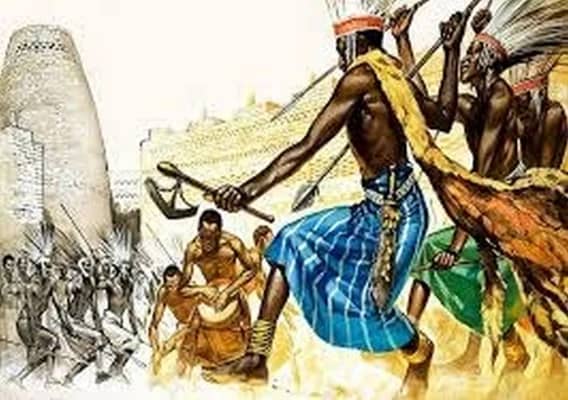
According to tradition, it was taken during the Asante retreat and subsequently brought into Akuapem.
Other objects and military materials were also reportedly captured. However, it was the sacred object that acquired the greatest significance. The capture transformed a military trophy into a ritual symbol.
Instead of allowing the victory to disappear into oral memory, the Akuapem incorporated the object into a new ritual framework through which the community could continually recall the achievement of its ancestors.
Mr Ankrah said that was one of the reasons festivals are so important in African societies.
A festival, he explained, can preserve a historical event by placing it within a continuing cultural and sacred cycle.
“A battle lasts for hours but a festival can make its memory last for generations.”
The birth of an annual celebration
Akuapem tradition associates the establishment of the Odwira festival with the reign of the 19th Okuapehene, Nana Addo Dankwa I, who ruled from 1811 to 1835.
Available accounts place the first Akuapem Odwira celebration in October 1826, shortly after the Akatamanso victory. 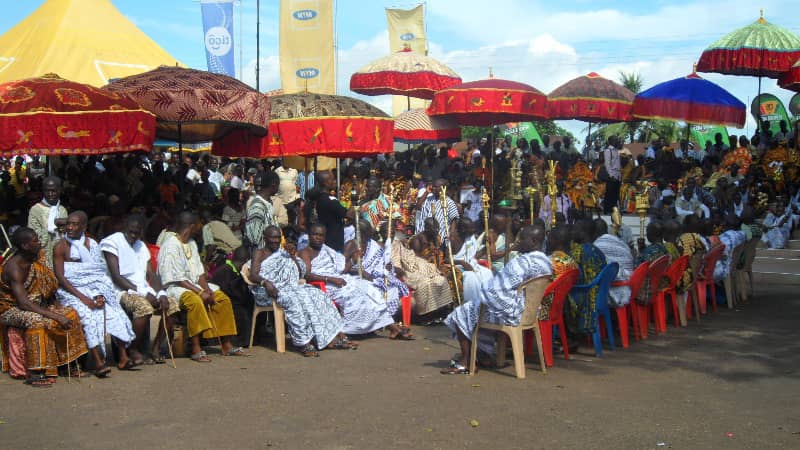
The festival therefore carried several meanings at once: it commemorated victory, it expressed gratitude to the ancestors, it marked spiritual purification, it celebrated the harvest and, perhaps most importantly, it gave the diverse communities that constituted Akuapem a common ritual space.
Mr Ankrah argues that the appropriation of the sacred object associated with Odwira helped to provide such a unifying symbol as Akuapem derived from the phrase ‘Ekuw Apem’ which literally means “a thousand groups”, which consisted of communities with different historical backgrounds such as the Guan, Kyerepong and Akan groups.
The ritual object, he said, could therefore function as a collective symbol rather than belonging exclusively to one constituent community.
More than a harvest festival
Today, Odwira is sometimes viewed primarily through its colourful processions, drumming, dancing, traditional regalia and communal celebrations.
However, beneath the pageantry is a historical narrative of survival. The festival’s rituals of preparation, purification, remembrance of ancestors, new yam and the cleansing of sacred stools are part of a much older Akan ritual world.
Yet in Akuapem, these practices acquired a distinctive historical meaning after the Akatamanso conflict.
The festival became a cultural vessel into which the community poured memories of political struggle, ancestral sacrifice and collective survival.
That is why Mr Ankrah believes that the younger generation of Akuapems must understand Odwira beyond entertainment.
“The festival does not only represent enjoyment,” he said, stressing its message of collective unity.
For him, its deeper lesson is that people who possessed different historical identities could come together to create and defend a political community.
Odwira two centuries on
The 200th anniversary of the Akuapem Odwira tradition in 2026 therefore offers an opportunity to ask what exactly is being celebrated.
It goes beyond just the defeat of an army to the preservation of a political community. It is the memory of ancestors who fought alongside other southern peoples as well as the reaffirmation of Akuapem’s composite identity and it is the transformation of historical memory into a living cultural institution.
The significance of Katamanso to contemporary Akuapem lies precisely there: the battle ended in 1826, its political consequences endured and its memories were ritualised.
And through Odwira, a battlefield victory became an annual conversation between the past(ancestors) the living(present) and the unborn) future.
Two hundred years later, that conversation still continues.
By Christiana Afua Nyarko

 'It will not die quietly in New York’s diplomatic corridors' — Mahama launches A...
 Akatamanso War: The victory that gave Akuapem's Odwira a memory, meaning and ide...
 We should make it easier for Africans to travel and invest across the continent ...
 Mahama turned around Ghana’s economy in a very short time – Dangote
 September 22: Cedi sells at GHS12.15 on forex market, GHS11.56 on BoG interbank
 We need to train judges on new laws to ensure proper application – Barker-Vormaw...
 Ghana’s democracy under pressure; youth must speak to defend their freedoms – Os...
 Ghana’s independence must translate into economic empowerment -- CPP's Nana Frim...
 Don’t just prosecute couriers, go after drug financiers – Catholic Bishops urges...
 ‘No ownership without control’ – Mahama pushes new global health financing model...


