




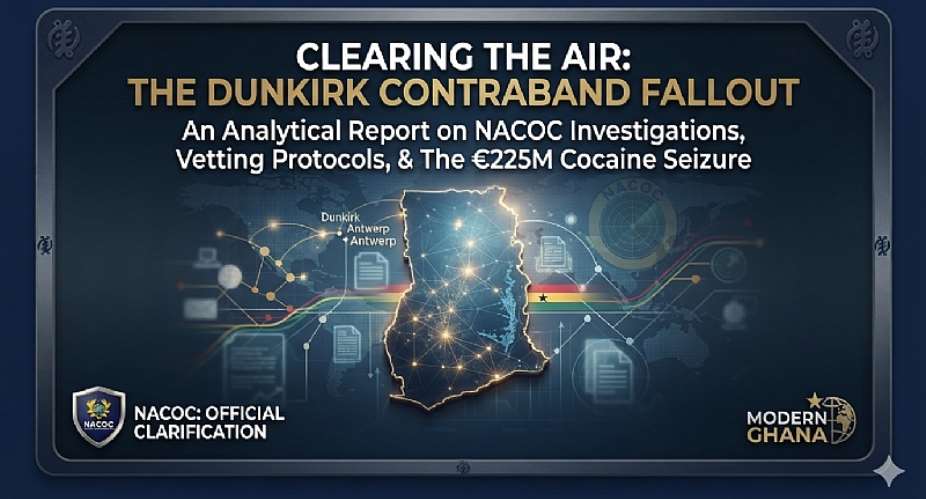
The interception of 3.9 tonnes of cocaine valued at €225 million by French customs at the Port of Dunkirk has escalated from a complex transnational narcotics case into a high-stakes domestic debate over national security integrity. In a democratic framework like Ghana’s, public infrastructure stability relies heavily on institutional clarity and the psychological decoupling of active criminal probes from partisan rhetoric. Following viral claims linking an arrested suspect to presidential protection units, an objective analysis of official institutional timelines is necessary to separate strategic cross-border enforcement from political speculation. This brief systematically examines NACOC's empirical statements to provide an analytical roadmap for structural reforms in border security and state protocol vetting.
THE 5 W'S OF THE TRANSNATIONAL DRUG SCANNING CONTROVERSY
- Who is involved: The primary actors are the Narcotics Control Commission (NACOC), international law enforcement partners (French Customs), three arrested Ghanaian facilitators, and a notorious Dutch fugitive, Jos Leijdekkers (alias "Bolle Jos"). On the political perimeter, allegations raised by New Tafo MP Vincent Ekow Assafuah drew former President John Dramani Mahama and political leadership into the discourse.
- What happened: French authorities intercepted a shipment of plastic waste originating from Ghana containing 3.9 tonnes of concealed cocaine. Domestically, this led to the arrest of three local operatives who had been under state surveillance for up to two years. Concurrently, claims emerged alleging that a key suspect, Musah Atta, operated within the official presidential escort, a claim subsequently refuted by NACOC officials.
- Where it occurred: The operational seizure occurred at the Port of Dunkirk, France, with part of the shipment destined for Antwerp, Belgium. The domestic intelligence, monitoring, and subsequent tactical arrests were executed within the sovereign borders of Ghana by NACOC's enforcement units.
- When it took place: The international seizure occurred on September 10, 2026, leading to a swift series of local arrests and an official press directive from NACOC on September 14, 2026. Clarifications regarding presidential security details were broadcasted on September 20, 2026.
- Why it matters: This case exposes systemic gaps in routine port scanning and points to sophisticated methods utilized by international drug syndicates to exploit legitimate commercial channels. Furthermore, it highlights how unvetted proximity to state officials can be weaponized in the media to undermine the international standing of the republic's highest executive offices.
CRITICAL BREAKDOWN OF NACOC'S OFFICIAL PRESS STATEMENTS
- Structural Surveillance Chronology: According to NACOC’s Acting Director of Public Affairs, PNCO Francis Opoku Amoah, the three local suspects were not apprehended on a whim. They had been actively placed under close state surveillance for a duration spanning 12 to 24 months before tactical containment.
- Explicit Denial of Escort Status: Speaking officially on public media, NACOC Deputy Director-General Alexander Twum-Barimah definitively stated that preliminary background checks failed to establish any link between the suspects in custody and the state security or presidential escort details of John Dramani Mahama or his contemporaries.
- Transnational Network Mapping: Official statements confirm that the Ghanaian suspects were functioning as local logistical proxies and front-line facilitators for the "Bolle Jos" network, though intelligence indicates the primary Dutch fugitive has not physically entered Ghanaian territory.
STRUCTURAL SUGGESTIONS AND RECOMMENDATIONS
- Re-evaluating Port Enforcement Mandates: Policy directives must address concerns regarding the physical absence of specialized NACOC personnel during routine port checks, ensuring their specialized expertise complements the automated scanning systems of the Ghana Revenue Authority.
- Digital Protocol Vetting Zones: State protocol should institute computerized, biometric, and rapid background checking procedures for any individuals granted access to restricted VIP enclosures at public functions to prevent unvetted photo opportunities.
- Depoliticized Investigative Support: Parliament and civil society groups must allow NACOC and the Attorney General's office the judicial autonomy to follow the evidence trail internationally without domestic partisan pressure distorting the facts.
- Public Verification Mechanisms: Media houses and citizens should cross-reference viral imagery with active institutional databases, recognizing that casual proximity at open events does not correlate with institutional employment or complicity.
The €225 million Dunkirk cocaine bust represents a significant operational challenge that tests the institutional resilience of Ghana's security services. NACOC’s technical updates indicate a robust long-term intelligence operation that should not be obscured by unverified political narratives. By focusing on port scanning vulnerabilities, improving VIP security vetting boundaries, and treating transnational organized crime as a strict matter of national security rather than a political talking point, Ghana can preserve its domestic security infrastructure and fortify its international reputation as an unyielding opponent of global narcotics networks.
✍️ Submitted by:
Retired Senior Citizen
For and on behalf of all Senior Citizens of the Republic of Ghana 🇬🇭
Teshie-Nungua
[email protected]

 'It will not die quietly in New York’s diplomatic corridors' — Mahama launches A...
 Akatamanso War: The victory that gave Akuapem's Odwira a memory, meaning and ide...
 We should make it easier for Africans to travel and invest across the continent ...
 Mahama turned around Ghana’s economy in a very short time – Dangote
 September 22: Cedi sells at GHS12.15 on forex market, GHS11.56 on BoG interbank
 We need to train judges on new laws to ensure proper application – Barker-Vormaw...
 Ghana’s democracy under pressure; youth must speak to defend their freedoms – Os...
 Ghana’s independence must translate into economic empowerment -- CPP's Nana Frim...
 Don’t just prosecute couriers, go after drug financiers – Catholic Bishops urges...
 ‘No ownership without control’ – Mahama pushes new global health financing model...


