




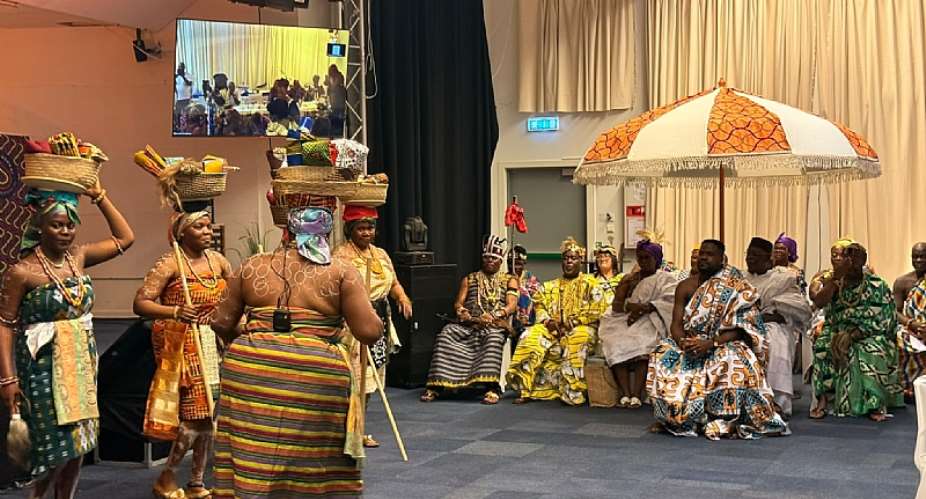
The Ewe Union in Norway, known as EweNor, was formally inaugurated in Oslo on Saturday, 5 September 2026 in a colourful celebration of Ewe identity, unity and cultural heritage. Around 250 people attended, including about 90 participants from Ewedukor Germany.
The gathering brought together traditional leaders, representatives of the diplomatic corps, families, friends and African community organisations in Norway. These included the Union of Nigerian Nationals in Norway, Benin-Norway Association, Ghana Union Norway, Ghana Women’s Association in Norway, Northern Ghanaian Association in Norway and Asanteman Norway. Representatives of African and Norwegian businesses also attended, giving the occasion a broad diplomatic, community and business presence.
Traditional dress, cultural displays, music and dance gave the inauguration the character of a major Ewe communal celebration. Chiefs and elders represented continuity with Ewe traditional institutions, while the large delegation from Germany demonstrated the growing connections among Ewe communities in Europe.
One people across borders
The main message of the inauguration was that Ewes from Ghana, Togo, Benin and Nigeria remain connected by language, kinship, festivals, music and shared historical memory. Colonial borders divided the ancestral homeland but did not erase this common identity.
In the founding address, Dr Kofitsyo Sewornu Cudjoe traced the Ewe people's journey from Ketu and Tado to Notsie, and from Notsie to their present settlements. Notsie remains central to Ewe historical memory. The story of the people’s escape from King Agokoli represents courage, unity and the determination to live in freedom. The establishment of EweNor adds a new chapter to this journey, from Notsie to Norway.
The address placed Ewe history within the wider Gbe civilisation and recognised the close historical and cultural relationships among Ewe, Aja, Fon, Gen and Mina peoples. It also celebrated Ewe contributions to politics, education, diplomacy, science, business, space exploration, literature and music, with particular recognition of women as traders, entrepreneurs and guardians of community life.
Heritage and participation in Norway
In his chairman’s remarks, Dr Cudjoe described EweNor as a bridge between generations, nations and cultures. The Union should become a home where young people growing up in Norway can learn the Ewe language, hear the stories of their ancestors and understand Ewe music, dance and community values.
Cultural preservation, however, should not mean withdrawal from Norwegian society. EweNor aims to be an open bridge between Ewe heritage and Norway, sharing Ewe language, food, history, music, dance, art and scholarship with schools, universities, cultural institutions and the wider public. Children in the diaspora should be able to grow up as confident members of Norwegian society while knowing where their families came from.
The cultural performances expressed this purpose. In Ewe society, drumming, singing and dancing do more than entertain. They carry history and social knowledge across generations. Dances such as Agbadza, Borborbor, Gahu, Kinka and Atsiagbekor bring elders, adults, young people and children into a shared cultural space. In Oslo, these traditions were adapted to a diaspora setting and shared with guests from different backgrounds.
Awadada accepts role as founding patron
The guest of honour, Togbe Agbesi Awusu II, the Awadada of Anlo State, conveyed greetings from the Awoamefia of Anlo, Togbe Sri III, and from the chiefs, queens and people of Eweland. He commended the founders for uniting Ewes from Ghana, Togo, Benin and Nigeria around a common purpose.
The Awadada observed that EweNor combines cultural preservation with the well-being, integration and advancement of its members. A strong community network can reduce isolation and help members navigate education and working life in a new country. He also reflected on how European colonial partition disrupted older patterns of movement, trade, and cooperation, placing Ewe communities under different colonial administrations.
Togbe Agbesi Awusu II accepted the invitation to serve as Honorary Founding Patron of EweNor. He advised the Union to remain non-profit and non-political, protect its cultural and traditional foundation, and support education, health, economic development and cultural preservation in members’ countries of origin. His acceptance created an important link between the new organisation and traditional leadership in Eweland.
The Agbogbomefia of the Asogli State in Ho, Togbe Afede XIV, also sent a message of goodwill, wishing EweNor an excellent and memorable inauguration. He accepted a certificate of Honorary Founding Patron from EweNor, which Dr Kofitsyo Sewornu Cudjoe will formally present to him this week.
A new chapter for Ewes in Norway
In his address, the Chairperson of Ewe Union in Norway, Mr Theophilus Sewornu Dogbeten, said EweNor was established as a common home for all Ewes in Norway, regardless of their town, clan, country or generation. He encouraged members to let differences in nationality, dialect, and local tradition enrich the Union rather than divide it. He described Ewe culture as their identity, the Ewe language as their voice, heritage as their legacy, unity as their strength and progress as their shared destination. The successful inauguration showed the strength of this vision.
EweNor’s activities are organised under five programme areas: culture and heritage; children, youth and families; health and wellbeing; education, careers and mentorship; and community and social support. The Union has already started its Health Seminar Series with seminars on vitamin D, cardiovascular diseases, and diabetes. It is also about to ship a container of medical equipment for donation to hospitals and clinics in Eweland. Through these programmes, EweNor will engage children and young people, support its members, preserve the Ewe language and culture, and develop partnerships with Norwegian society and Ewe communities elsewhere.
The message of the day was captured in the Ewe expression, “Ŋgɔyiyi le ɖekawɔwɔ me”, meaning progress is achieved through unity. On 5 September 2026, Ewes in Norway honoured their ancestors' journey and began a new journey of their own.


 'It will not die quietly in New York’s diplomatic corridors' — Mahama launches A...
 Akatamanso War: The victory that gave Akuapem's Odwira a memory, meaning and ide...
 We should make it easier for Africans to travel and invest across the continent ...
 Mahama turned around Ghana’s economy in a very short time – Dangote
 September 22: Cedi sells at GHS12.15 on forex market, GHS11.56 on BoG interbank
 We need to train judges on new laws to ensure proper application – Barker-Vormaw...
 Ghana’s democracy under pressure; youth must speak to defend their freedoms – Os...
 Ghana’s independence must translate into economic empowerment -- CPP's Nana Frim...
 Don’t just prosecute couriers, go after drug financiers – Catholic Bishops urges...
 ‘No ownership without control’ – Mahama pushes new global health financing model...


