




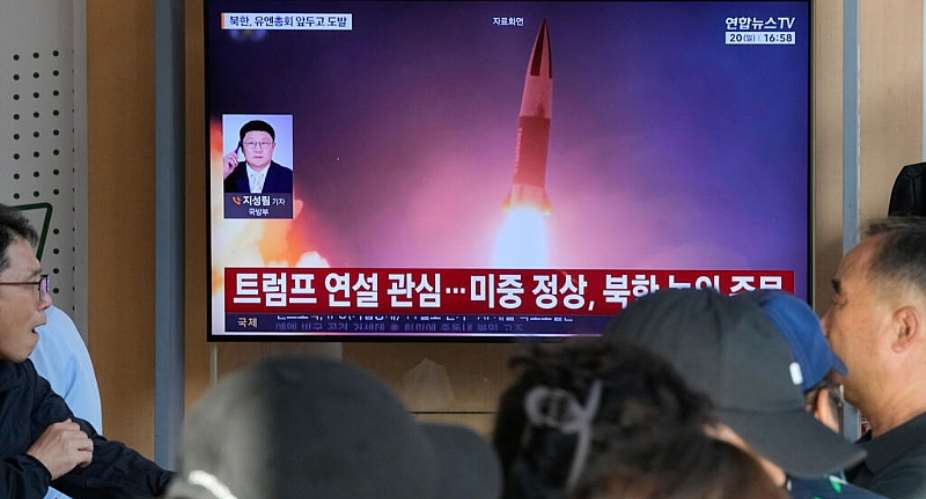
North Korea fired two short-range ballistic missiles into the sea off its eastern coast on Sunday, South Korea's military said, with the second flying more than 600 kilometres (370 miles).
The launches came days after Pyongyang reasserted its status as a nuclear-armed state and rejected a United Nations resolution demanding it halt its nuclear activities.
Read more North Korea launches second set of short-range ballistic missiles in a week
South Korea's military said the first missile was launched at around 3:00pm (06:00 GMT) from the Wonsan area and flew around 450 kilometres into the East Sea, a body of water also called the Sea of Japan.
"Our military detected an additional short-range ballistic missile launched from the Wonsan area of North Korea towards the East Sea at around 5:50pm," South Korea's Joint Chiefs of Staff (JCS) said.
The second missile "flew more than 600 kilometres, and South Korean and US authorities are conducting a detailed analysis to determine its exact specifications", it said.
The JCS said South Korea, the United States and Japan had been "tracking and sharing relevant developments from the initial stage of the launch".
Japan lodged a "stern protest" with North Korea over the launches, condemning them as a threat to regional peace and security, the Kyodo news agency cited the government as saying.
South Korea's presidential National Security Office convened an emergency security meeting following the first launch and assessed its impact on national security, the presidential office said.
The government called on Pyongyang to "immediately cease" its ballistic missile launches, describing Sunday's firings as a "grave act" that violated UN Security Council resolutions.
'Absolute' status
The launches came eight days after North Korea fired multiple short-range ballistic missiles towards the East Sea as part of what it later described as a joint firepower drill.
That exercise involved long-range artillery and missiles, with the weapons "hitting the targets with 100 percent accuracy", state media reported.
North Korea accused "hostile forces" of seeking to end the country's nuclear programme during this week's General Conference of the International Atomic Energy Agency (IAEA).
A foreign ministry spokesperson said the IAEA resolution "has no effect on the DPRK's position as a nuclear weapons state", using the acronym for North Korea's official name.
The North's status as a nuclear power is "guaranteed by the actual nuclear deterrent and irreversibly and permanently fixed by the supreme law of the state", the spokesperson said.
Kim Yo Jong, the powerful sister of North Korean leader Kim Jong Un, recently said the country's nuclear-armed status was "absolute" and called those hoping for its denuclearisation "idiots".
US President Donald Trump said in August that North Korea possessed 57 "very powerful" nuclear weapons, while South Korea has put the figure at between 80 and 120.
(FRANCE 24 with AFP)


 Nigeria's onion dispute with Ghana tests West African free trade
 Uganda suspends military ties with Turkey over extradition of Museveni critic
 US fears wider Middle East escalation after Houthi attack Riyadh
 Pop star Ed Sheeran calls Gaza situation “unjustifiable” amid controversy
 'We have spent 60years arguing about Nkrumah and rather less time doing what he ...
 Judge recounts attempted MoMo scam on him moments after jailing scammer
 'Systemic failure due to NACOC removal from port inspections' – Inusah Fuseini o...
 Foreign Affairs Ministry releases 200-page RTI response on GH¢49.7m South Africa...
 Chartered flights account for GH¢27.18m of South Africa evacuation cost


