




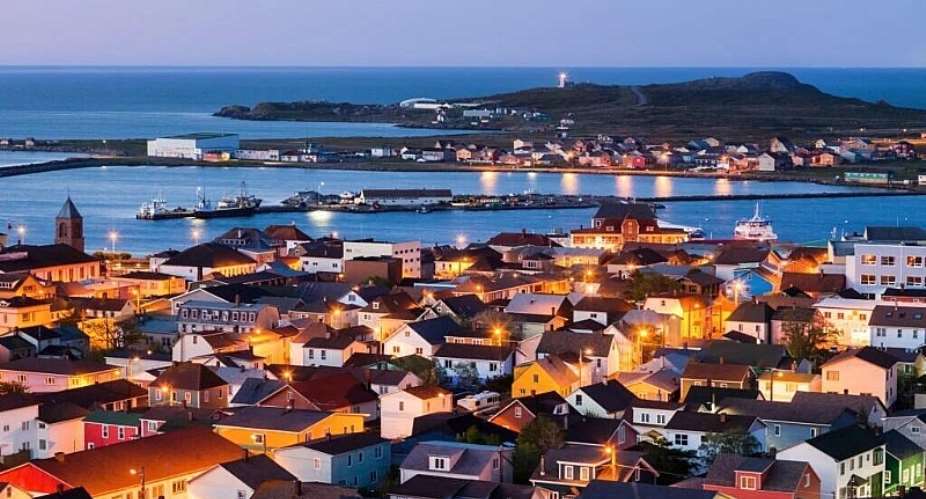
Home to around 6,000 people and lying about 20 kilometres off Newfoundland, the archipelago is the last surviving territorial remnant of France's former North American empire – French soil beside Canada but more than 4,000 kilometres from Paris.
Carney's trip on Sunday will be the first official visit to the islands by a Canadian prime minister. It comes as Canada looks increasingly towards Europe and both sides explore a much closer relationship.
Just days before the meeting, European Commission President Ursula von der Leyen proposed an unprecedented new relationship with Canada, potentially giving it a new form of association with the European Union.
Canada is not seeking full EU membership, but Carney on Thursday welcomed the ambition behind the proposal and called for a much stronger alliance with Europe.
The two sides are looking at deeper cooperation in defence, energy, critical minerals, artificial intelligence, space and digital trade, although exactly what “associate membership” would mean has yet to be defined. Map showing the French archipelago of Saint Pierre and Miquelon off the coast of Newfoundland, Canada
Macron, Carney to visit French Atlantic islands with sovereignty message to Trump
France beside Canada
That makes Saint-Pierre and Miquelon an unusual and symbolic place for Macron and Carney to meet.
Although Saint-Pierre and Miquelon is French territory, it is not part of the European Union, but has a special relationship with the bloc. The unusual status adds another twist to the choice of the archipelago for talks about closer ties between Canada and Europe.
France has warmly welcomed the prospect of strengthening ties with Canada.
“We are committed to forging ever closer ties with Canada,” Foreign Minister Jean-Noël Barrot said on Thursday, pointing ahead to Macron's meeting with Carney in Saint-Pierre and Miquelon.
Closer relations with Canada were “a very good idea”, Europe Minister Benjamin Haddad said, while cautioning that the precise institutional form still had to be worked out.
The French reaction came after US President Donald Trump threatened further tariffs if Washington judged the EU initiative hostile, calling the proposed relationship with Canada “laughable”.
It was not for the United States to determine Europe's geopolitical choices, Haddad responded, while Barrot said sovereignty was “non-negotiable”.
Canada's Carney seeking closer EU ties, to attend State of the EU address
A history of sovereignty disputes
The choice of Saint-Pierre and Miquelon also carries its own history of disputes over sovereignty.
France and Britain fought over the islands for generations before they became definitively French in 1816. More than a century later, they became the focus of a wartime dispute involving Charles de Gaulle and US president Franklin Roosevelt.
In December 1941, Free French forces seized control of the islands from authorities loyal to the Vichy government, despite strong objections from Washington, which wanted to preserve the status quo.
A Christmas Day vote overwhelmingly backed the islands' rallying to Free France, adding to tensions between de Gaulle and Roosevelt. Free French Naval Forces (FNFL) moored off Miquelon in December 1941.
Eighty-five years later, the circumstances are different. But a territory once caught in an argument between France and the United States over sovereignty is again being used to underline the freedom of countries to choose their own partnerships.
France and Canada have also clashed over the waters surrounding the islands.
For much of the modern era, their importance was determined by fishing. Disputes over access to rich North Atlantic stocks and maritime boundaries culminated in international arbitration in 1992.
The ruling granted France a 12,400-square-kilometre exclusive economic zone around the archipelago, including an unusual corridor stretching 200 nautical miles south but only 10.5 nautical miles wide – a strip sometimes nicknamed the “French baguette”.
The ruling coincided with Canada's moratorium on cod fishing, bringing Saint-Pierre and Miquelon's industrial fishing industry virtually to a halt and dealing a severe blow to the islands' economy.
Relations subsequently became more cooperative, with a 1994 bilateral agreement establishing a framework for managing shared fish stocks.
Canada's Carney seeking closer EU ties, to attend State of the EU address
From cod to quantum technology
The agenda for Sunday's meeting shows how much the relationship has changed.
Macron and Carney are due to discuss aerospace, energy, critical minerals and advanced technologies including quantum computing, satellites and supercomputing – sectors far removed from the fishing disputes that long shaped relations between the islands and their Canadian neighbour.
The discussions also closely mirror the wider agenda now taking shape between Canada and Europe.
Von der Leyen has proposed moving beyond the existing CETA trade agreement towards what she called an “Alliance for the Future”, covering defence industries, energy, batteries, critical minerals, AI, quantum technology, cyber security and economic security.
“We share one ocean, one set of values, one way of seeing the world,” she told Carney in Strasbourg on Wednesday. The French island of Miquelon lies just off Canada's Atlantic coast.
Carney went further in an address to the European Parliament on Thursday, calling for a broad strategic alliance spanning critical minerals, defence, AI, computing, energy, space and payments.
But the shape of that relationship remains unresolved. There is currently no formal EU status of “associate member” and the proposal would need the backing of EU member states.
Conservative leader Pierre Poilievre has backed closer trade and defence cooperation with Europe while warning against any arrangement that could see Canadians subject to European taxation, regulation or border policies.
Canada also remains deeply integrated economically and militarily with the US. But Carney has pledged to expand trade beyond the US as his government seeks to diversify Canada's international partnerships.
Away from Sunday's geopolitical discussions, Saint-Pierre and Miquelon is confronting challenges much closer to home.
On Miquelon, a village of several hundred people is preparing to move to higher ground because of coastal erosion, flooding and rising sea levels, with climate change expected to make the present settlement increasingly vulnerable.
The visit will also bring rare international attention to a territory that has often complained of being overlooked by Paris.
(with newswires)


 Highly influential people sponsoring Ghana Jollof TikTok activities – CID
 'Ghana Jollof' case: Bawumia's condemnation of nurse's arrest is hypocritical – ...
 Ahafo Ano South West MP involved in road accident
 Constitutional Review alone will not solve Ghana’s problems – Kwesi Pratt Jnr.
 East Legon Football Academy applauds NPA Boss for supporting youth football
 Gov't didn't show NPP enough respect in constitutional review process – Martin K...
 September 18: Cedi sells at GHS12.15 on forex market, GHS11.53 on BoG interbank
 Lawyer challenges two-week remand of Salomey over connection to wanted 'Ghana Jo...
 Minority calls for NSA boss Ampofo Ankrah, others to be dismissed over alleged 2...
 ‘You gave us GH¢60,000 to run 66 offices nationwide and expect us to function?’ ...


