




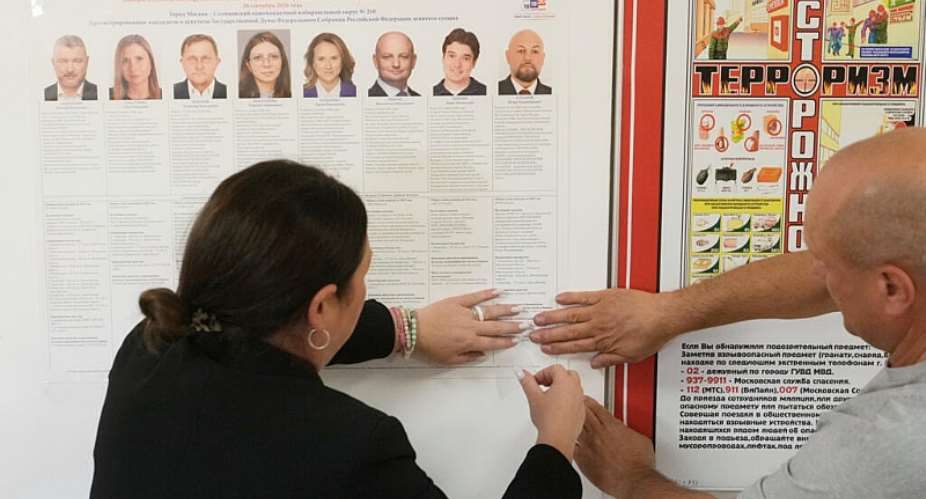
Russia has barely appeared to be in election mode, with minimal coverage on state-controlled television.
The low-key campaign is deliberate, political analysts told RFI.
“The Kremlin has carried out a sort of special operation around this election campaign, instructing the media under its control to drastically reduce their coverage of the elections,” Alexander Morozov, a Russian political scientist and researcher at the New Eurasian Strategies Centre, told RFI.
Kremlin critic leaves Moscow for Paris after ban from running for election
A subdued campaign
The aim is to avoid adding to uncertainty among Russians after years of conflict, Morozov argued.
“The war has been going on for a long time and the population feels a great deal of uncertainty about the future,” he said.
An official in the presidential administration called for the campaign to have a “therapeutic” character – designed to reassure rather than stir political debate, Morozov said.
Issues that might otherwise have dominated an election campaign – including military losses, the economic cost of the conflict, fears of further mobilisation and questions over what follows the war – have received limited attention.
Candidates themselves are also operating within narrow boundaries.
“They are not allowed to criticise military operations, the conduct of the war or the Kremlin,” said Nikolai Petrov, a political scientist at the New Eurasian Strategies Centre.
“They may only denounce certain failings on the part of the authorities, criticise them for not carrying out Vladimir Putin's orders quickly enough, or raise local issues.”
Russia election to tighten Putin's grip, opponents stage noon protest
Opposition candidates
Opposition candidates have faced a series of court challenges and disqualifications during the campaign.
The liberal Yabloko party – Russia's only registered party to have openly campaigned against the war – has faced much of the pressure. Russia's Supreme Court cancelled the registration of its nationwide list of candidates in August, citing electoral-law violations including alleged copyright infringements and funding issues. The ruling was upheld on appeal.
Individual candidates have also been removed from races.
Yabloko candidate Dmitry Smirnov in Nizhny Novgorod had his registration cancelled following a dispute over a photograph of late Motorhead singer Lemmy Kilmister. A German cross worn by the musician in the image was judged by an expert in the case to resemble Nazi symbolism.
Another Yabloko candidate was barred following posts containing Facebook and Instagram logos without the required reference to their parent company Meta, which Russia has designated an “extremist” organisation.
Other cases have involved photographs of late opposition leader Alexei Navalny or references to organisations associated with him that have been banned by Russian authorities.
Independent monitors and media have documented dozens of opposition candidates being removed or prevented from standing in federal and regional elections, many over alleged displays of “extremist” symbols.
War and the ballot
Yabloko had called for a ceasefire and negotiations to end the fighting in Ukraine, a position that distinguished it from the other registered parliamentary parties.
The authorities were less concerned about Yabloko winning seats than about allowing the election campaign to become a measure of support for ending the war, Petrov said.
“The Kremlin was not worried that a few Yabloko candidates might get into the Duma,” he said. “It feared that their appeal might elicit a positive response and show that support for a ceasefire was not as marginal as it wanted people to believe.”
Although Yabloko's federal list has been excluded, a small number of its candidates are still standing in individual constituencies. Reuters reported this week that the party remains the only registered political organisation openly campaigning against the war.
United Russia, the party closely associated with President Vladimir Putin, currently dominates the State Duma, while the other parties represented in parliament have broadly backed the Kremlin's conduct of the war.
The vote is also about shaping the next parliament around the political order that has emerged during the conflict, Morozov said.
“The aim is to form a Duma whose members would present themselves, alongside Vladimir Putin, as the architects of victory over Ukraine,” he said.
The composition of parliament is only part of what is at stake, Petrov argued.
“These elections are about the government's image and the reaffirmation of its authority,” he said.
Voting continues until Sunday after a campaign that has offered Russians relatively little public debate over the issue that has transformed their country more than any other over the past four years – the war in Ukraine.


 Ahafo Ano South West MP involved in road accident
 Constitutional Review alone will not solve Ghana’s problems – Kwesi Pratt Jnr.
 East Legon Football Academy applauds NPA Boss for supporting youth football
 Gov't didn't show NPP enough respect in constitutional review process – Martin K...
 September 18: Cedi sells at GHS12.15 on forex market, GHS11.53 on BoG interbank
 Lawyer challenges two-week remand of Salomey over connection to wanted 'Ghana Jo...
 Minority calls for NSA boss Ampofo Ankrah, others to be dismissed over alleged 2...
 ‘You gave us GH¢60,000 to run 66 offices nationwide and expect us to function?’ ...
 Russia seizes assets of Swiss food giant Nestle and three French firms
 Russia votes in parliamentary election as war in Ukraine drags on


