




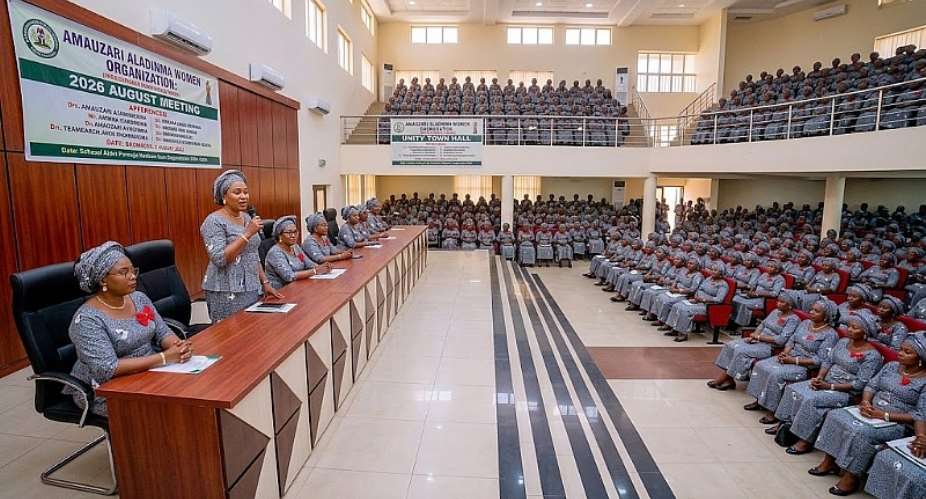
The August meeting for 2026 has come and gone. Every August, a remarkable and quiet mass migration of Igbo women takes place across the world. From the affluent suburbs of London and Houston to the bustling commercial hubs of Lagos, Johannesburg, and Toronto, thousands of women clear their schedules, step away from corporate offices and small-scale businesses, and board flights bound for South-Eastern Nigeria. Their destination is not the usual glamorous holiday resort, but their ancestral homes. They must return home to their villages for the annual August Meeting, the massive, fortnight-long congress where Igbo women gather to deliberate on local governance strategies, resolve community disputes, build impressive local infrastructure, and chart the socio-economic future of their homeland.
To step into a village hall during the peak of the August Meeting is to witness an extraordinary sight. Hundreds, sometimes thousands, of women sit in orderly rows, arrayed in uniform, vibrantly tailored Ankara or lace fabrics paired with identical, high-folded head wraps. The visual impact is immediate and intentional: a sea of heads in absolute uniformity, where individual backgrounds appear to have dissolved into a formidable and collective sense of belonging. Yet, this sensation of sisterhood was not built overnight. The August Meeting has become a cultural phenomenon among Igbo women precisely because it evolved into a space of radical equality, born out of a painful history of class divide.
Decades ago, as Nigeria underwent rapid economic expansion and the Igbo Diaspora prospered in urban centres, the August Meeting looked very different. A get-together that had started as a modest gathering of rural mothers and returning urban wives gradually metamorphosed into an arena for ostentatious and arrogant display of wealth. Women who had achieved financial success in the big cities or abroad began using the annual homecoming as a runway to flex their social status.
They would arrive in the villages draped in expensive, imported Dutch wax silks, heavy gold jewelry, and elaborate headpieces. They drove high-end vehicles into dusty village square venues, surrounded by retainers and attendants. In the meeting halls, this financial muscle translated into sociopolitical swagger. Wealthier women dominated discussions, hijacked decision-making processes, and held sway over their poorer counterparts. Rural women who had stayed behind in the villages, tilled the soil, maintained the homesteads, and bore the daily brunt of rural hardship found their voices suppressed and their opinions disregarded by the affluent elites.
The result was resentment, and it was profound. A toxic atmosphere of class warfare began to poison the annual gathering. Poorer women felt humiliated and alienated in their own ancestral homes. Inevitably, they began to view the meeting as no longer a force for communal progress, but as a stage for elitist display of arrogance and impunity. Attendance began to drop as rural women boycotted sessions to avoid the subtle insults and psychological strain of being treated as second-class citizens in their own ancestral homes.
Recognizing that this growing divide was threatening to destroy the fabric of their collective power and social influence, the leadership of the women’s assemblies made a revolutionary moral decision. They instituted a strict rule: the dress code mandate.
Under this directive, a specific fabric, pattern, and color scheme—known as the asoebi or uniform—was chosen for each year’s assembly. Every woman, regardless of whether she was a millionaire living in London or a subsistence farmer living in the village, was required to wear the exact same attire. Displays of excessive gold jewelry and ostentatious personal styling were banned or heavily discouraged during official sessions. To ensure affordability, the fabric was selected at a price point accessible to everyone, with wealthier members or local fundraising committees often subsidizing the cost for those who could not afford it.
This shift transformed the morality of the August Meeting. By stripping away visual indicators of wealth, the uniform established a neutral ground where every woman held equal standing. It disarmed impunity and restored dignity to the poorer rural women, whose lived experiences and daily presence in the village were once again valued as vital knowledge. The uniform became a visual pledge that inside the assembly hall, a woman was judged solely by the wisdom of her counsel, her dedication to the community, and her willingness to work for the common good. That directive fostered a profound, enduring sense of belonging among all Igbo women—a unity that remains the bedrock of the meeting’s modern success to this day.
With class friction contained, the August Meeting blossomed into an unmatched engine of grassroots development and civic authority. Today, the structure of the meeting resembles a highly efficient, hyper-local parliament. It operates across multiple tiers: starting at the ‘umunna’ (extended family or lineage) level, advancing to the village branch, and culminating at the autonomous community level under the leadership of a female President-General.
The agenda of the August Meeting is exhaustive. First and foremost is peacebuilding and conflict mediation. Disputes that could otherwise fester for years in expensive, sluggish formal courts such as land boundary quarrels between neighbors, family inheritances, marital breakdowns, and female chieftaincy frictions are brought before the assembly. With a combination of maternal moral authority, deep cultural memory, and social leverage, the women hear testimony and hand down binding resolutions. The sanctions for defying the assembly are severe: social ostracization or fines, which few women in Igbo society would be willing to risk.
Beyond conflict resolution, the meeting operates as a decentralized, self-funding municipal council. Because state government presence in rural Nigeria can often be sparse, these women take local infrastructure into their own hands. They tax themselves, raise funds from Diaspora donors, and execute major public works. Over the decades, Igbo women through their August Meetings have financed and built civic halls, healthcare clinics, maternity wards, clean water boreholes, markets, and secondary school blocks. They fund scholarship schemes for underprivileged children, pay medical bills for indigent widows, and set up micro-credit funds to enable local women to start small trading businesses.
This extraordinary capability mirrors another famous socio-economic phenomenon originating from the same region: the Igba Boyi, or the Igbo Business Apprenticeship System.
The apprenticeship system, a male-dominated, informal venture capital and mentorship engine, where established business owners train young men and launch them with seed capital, has earned worldwide acclaim. Scholars and business schools across the globe, including Harvard, have studied it as one of the world’s most effective informal wealth-generation networks. Through the apprenticeship framework, the Igbo people rebuilt their economic footprint from total devastation following the 1967–1970 Nigerian civil war without relying on foreign aid or state intervention.
Yet, while the male-led apprenticeship system drives private capital accumulation and entrepreneurship, the women-led August Meeting provides the crucial public counterpart: civic cohesion, social security, and physical infrastructure. The two systems are two sides of the same cultural coin—demonstrating a deep-rooted Igbo philosophy of self-reliance, decentralized governance, and mutual responsibility.
Just as the business world looked to the apprenticeship system to reimagine venture capital and mentorship, the global stage could soon look to the August Meeting as a model for Diaspora engagement, women's empowerment, and community development. There is immense, untapped potential for the August Meeting to transcend its regional boundaries and evolve into an international attraction and reference point for global governance.
Consider the challenge facing modern Diaspora communities across the globe, from the Caribbean to South Asia. Many struggle to find reliable, transparent, and structured ways to channel remittances back into long-term infrastructure in their home countries. The August Meeting offers a battle-tested blueprint for how Diaspora capital can be directly paired with local accountability to deliver tangible public goods without leakages or administrative bloat.
Furthermore, in an era where global development agencies spend billions attempting to design top-down, sustainable development programmes in the Global South, the August Meeting stands as a living case study in organic, hyper-local sustainability. International researchers, policymakers, feminist scholars, and social impact investors could gather in South-Eastern Nigeria every August to observe firsthand how thousands of women mobilize resources, maintain civic discipline, and govern outside the orthodox structures of the state.
The meeting also possesses remarkable potential for social impact and cultural tourism. With thoughtful promotion, the August Meeting could invite women leaders, activists, and tourists from the global Black Diaspora and beyond to witness this festival of womanhood, public service, and organized power. It could serve as the backdrop for global summits on grassroots democracy, where delegates do not meet in sterile convention centres, but sit alongside rural mothers under open-air pavilions, learning how real community consensus is forged.
What makes the August Meeting a true sensation among Igbo women is that it gives them something that modern society often denies women elsewhere: undisputed, organized institutional power. In a world where female leadership is still frequently framed as an exception or a hard-won concession, the August Meeting is a space where women reign supreme, exercising absolute authority over the social and civic lives of their ancestral domains.
As the month of August draws to a close, the uniform fabrics are carefully packed away, and the women return to their daily lives in Lagos, London, or Atlanta. Behind them, in hundreds of quiet villages across Nigeria, roads have been graded, medical facilities opened, scholarships awarded, and long-standing feuds laid to rest. The August Meeting is far more than a nostalgic trip back to one’s roots or a parade of matching dresses. It is a masterclass in moral unity, collective economic power, and grassroots governance—a tradition whose principles deserve to be celebrated and emulated far beyond the shores of Nigeria.


 Highly influential people sponsoring Ghana Jollof TikTok activities – CID
 'Ghana Jollof' case: Bawumia's condemnation of nurse's arrest is hypocritical – ...
 Ahafo Ano South West MP involved in road accident
 Constitutional Review alone will not solve Ghana’s problems – Kwesi Pratt Jnr.
 East Legon Football Academy applauds NPA Boss for supporting youth football
 Gov't didn't show NPP enough respect in constitutional review process – Martin K...
 September 18: Cedi sells at GHS12.15 on forex market, GHS11.53 on BoG interbank
 Lawyer challenges two-week remand of Salomey over connection to wanted 'Ghana Jo...
 Minority calls for NSA boss Ampofo Ankrah, others to be dismissed over alleged 2...
 ‘You gave us GH¢60,000 to run 66 offices nationwide and expect us to function?’ ...


