




At least 124 environmental defenders were killed worldwide in 2025, Global Witness figures show, as communities from Peru to the Philippines organise against threats ranging from drug trafficking to mining.
At least 2,375 people have been killed since 2012 for defending their land, rights or livelihoods, the group said.
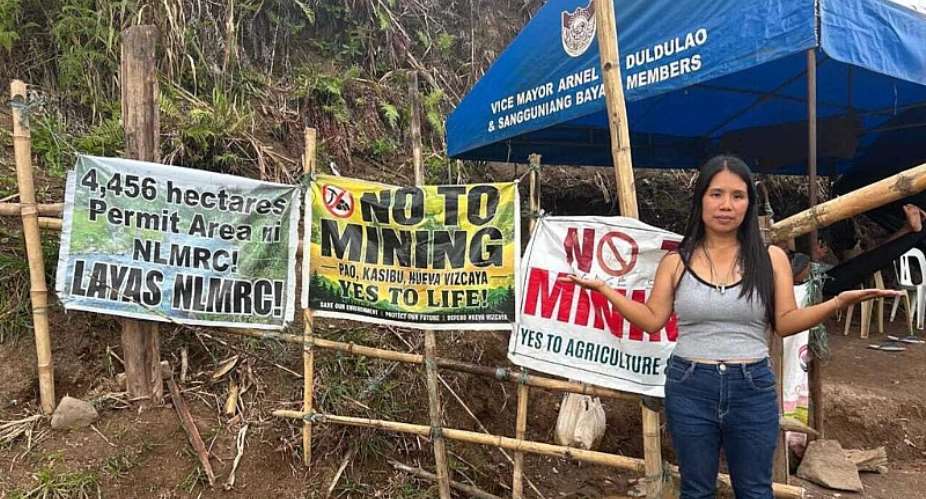
In Kasibu, in the northern Philippine province of Nueva Vizcaya, residents have erected a bamboo barrier and set up a camp to block trucks carrying fuel and equipment to a proposed mining site.
Police, backed by soldiers, arrested 13 people during confrontations in August. All have since been released, but more than 30 legal cases have been brought against members of the community, local campaigner Leijin Dugay told RFI.
“I was injured trying to stop my father being arrested,” Dugay said. Her father was freed after villagers raised $1,800 for bail.
“It is painful to see that instead of upholding peace and order, the police are siding with the big mining operations that are destroying our community.”
More than killings
Environmental defenders are not necessarily environmental activists. As defined by the United Nations, they are often ordinary people protecting where they live.
“Among the environmental defenders we meet and those recorded by Global Witness, we often simply find women and men defending a village or a forest, without necessarily being part of a protest movement or a non-governmental organisation,” Michel Forst, the UN special rapporteur on environmental defenders, told RFI.
“They are defending their right to live on their land. They are threatened by companies in particular and sometimes by states too. They are defending their everyday lives.”
The 124 deaths documented in 2025 were the lowest annual total since 2014, when 117 people were killed.
“We need to be careful in interpreting this decline, positive as it is, because it does not mean the situation has improved,” said Toby Hill of Global Witness.
“These figures are very likely underestimates, because many cases go unreported. The situation remains extremely dangerous for the people and communities who mobilise to defend their land, their cultures and the ecosystems that are so critical for our climate.”
The apparent decline also needs to be viewed in the context of increasingly repressive governments, which can make it extremely difficult for civil society groups to document human rights abuses, said Hill, who has worked extensively in Latin America.
“In some repressive contexts, particularly in Africa and Asia, civil society and victims risk reprisals for reporting or documenting these abuses.”
Deadly attacks are only one form of repression. Harassment campaigns and online attacks aimed at isolating defenders are increasing, along with the use of tougher laws to criminalise individuals and organisations supporting them.
“This fall [in killings] can partly be explained by this diversification of repression strategies aimed at forcing defenders into silence,” Hill said.
Indigenous knowledge steers new protections for the high seas
Danger zones
Latin America accounted for 85 percent of the deaths and has remained the most dangerous region since Global Witness began keeping records. Colombia had 39 deaths, the highest toll of any country for the fourth consecutive year.
Brazil had 26, more than twice the previous year's figure, mainly in Rondonia and Para states, where the Cop30 UN climate conference was held in November 2025.
Honduras and the Philippines each had 12 deaths, followed by Mexico and Guatemala. Representatives of Amazonian indigenous peoples block the entrance to the Cop30 UN climate conference in Belém, Brazil, in November 2025, demanding respect for their rights and territories. At least 26 environmental defenders were killed in Brazil in 2025.
Among those killed in Africa was Fiston Wilondja Mazambi, a journalist in eastern DR Congo who had been investigating allegations of illegal gold mining. In Tanzania, Global Witness also recorded the deaths of Hamprey Mhaki and Kulwa Igembe, both villagers living in the Ruaha National Park.
In Europe, its list includes Corsican farmer and trade unionist Pierre Alessandri, who was shot on his farm on 17 March 2025. The motive for his killing remains unclear.
Land under pressure
More than three-quarters of those killed worldwide were small farmers, people of African descent or indigenous people, Global Witness said.
Land disputes accounted for half of the deaths. The figure shows governments are failing to mark out territories and resolve land claims, creating conditions for attacks on people defending their land, Hill said.
Brazil's government has formally recognised 17 indigenous territories since President Lula began his third term in January 2023. Four have been approved since Cop30 in November 2025, out of 10 promised at the time, while hundreds remain unresolved, Global Witness said.
Extractive industries are another source of danger. Global Witness linked 11 deaths to mining projects. Defenders also face threats linked to logging, agribusiness, dam projects, drug trafficking and criminal groups.
Companies and criminal groups can exploit weak state control – and in some cases the approval of authorities – to gain access to natural resources on land used by local communities, some of which have no formal title to it.
Madagascar's 'people of the forest' confront life beyond the woods
In Nigeria's Cross River State, the Ekuri community has spent decades protecting 33,600 hectares of rainforest that it owns and manages. Community patrols monitor the forest for illegal logging, but defenders have faced intimidation, arrest and detention while trying to keep loggers out.
Global Witness, citing work by the Global Forest Coalition, reported “intimidation, arrests and detentions following complaints linked to interests in illegal logging”.
Drug trafficking poses another threat. From Peru to Honduras and Colombia's Cauca department, cocaine routes compete with indigenous communities for land.
In the Colon department of Honduras, 10 deaths were documented amid a violent land conflict in the fertile Bajo Aguan valley. Farmers there face palm oil businesses allied with cocaine traffickers seeking partners to launder money.
Honduras's government, backed by the US, has recently passed at least two laws affecting the conflict. One broadens the definition of a terrorist group, allowing farmers' organisations to be criminalised. Another favours agribusiness companies over the rights of local residents.
Community resistance
In the Peruvian Amazon, 35 indigenous leaders have been killed since 2020, “mainly by criminal groups seeking to replace virgin forest with coca crops”, said Jorge Pérez Rubio, head of indigenous rights organisation AIDESEP.
The Kakataibo, an indigenous people living in the Peruvian Amazon, responded to growing pressure on their territory by setting up their own Indigenous Guard in 2022. The community-run group, which has more than 150 members, patrols the area for threats including illegal coca cultivation, logging and land grabbing.
Drug traffickers are believed to control three-quarters of 75 border posts inside the Amazon rainforest.
Across the Pacific, the Philippines, like neighbouring Indonesia, is a dangerous place for communities resisting the exploitation of natural resources.
Around 8,000 people live from subsistence farming in Kasibu municipal district, which has about 30 villages and produces lemons, ginger, cereals, rice and maize. Surrounded by mountain ranges, the area is also an important water source.
Nueva Vizcaya has rich deposits of gold and copper sought by North Luzon Mineral Resources Corporation, a privately owned company with Philippine and Chinese capital. The company has carried out exploration work under a permit issued in June 2025.
Twenty years after Probo Koala, Africa still grapples with 'waste colonialism'
The project would affect 4,456 hectares of natural land and eight villages. Residents fear irreversible damage, including water pollution from chemicals used to extract minerals.
A free, prior and informed consent process, required for indigenous communities, was carried out. But only 80 people took part, including fewer than 10 community representatives, rather than the wider affected population, campaigner Dugay said.
Most residents oppose the project, although some villagers support it because they are attracted by the company's “easy money”, she told RFI.
Forst said companies had a responsibility to reduce the risk of human rights abuses linked to their activities.
“We are asking companies to do better in implementing due diligence, in other words to prevent and mitigate all risks of human rights violations,” the UN expert said. “Many have adopted plans because they are required to, but when you go out into the field, which I do, these plans are not being properly implemented.”
In Kasibu, meanwhile, the standoff at the bamboo barrier continues, with Dugay reporting harassment and intimidation.
While she does not fear for her life, she said she was prepared to give it to “protect our rights for the sake of future generations”.
This story was adapted from the original version in French by Géraud Bosman-Delzons.


 'When I go to sleep, I know I haven’t done anything wrong' – Finance Minister
 Police arrest Klo-Agogo SHS accounts clerk over alleged defilement of female stu...
 Mahama directs formation of inter-agency task force to curb rising drug traffick...
 10 people including 4 customs officers held over drug trafficking through Ghana ...
 Minority chases Sports Minister to provide detailed account of GH¢58million Worl...
 Kwabenya court denies bail to six accused over 3.9tonne cocaine shipment
 Mahama reaffirms commitment to establish University in Ahafo Region
 Nyindam explains decision to back Agyarko over Boadu in NPP chairmanship race
 Trump threatens EU with tariffs over 'laughable' Canada association plan
 Exporters need better access to credit, infrastructure – Bawumia


