




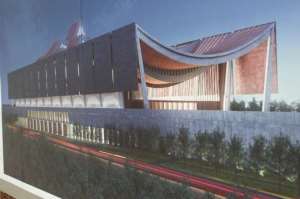
In the lead-up to the 2016 general elections, the then presidential candidate of the New Patriotic Party (NPP), Nana Addo Dankwa Akufo-Addo, pledged to God that, should he win the election, he would construct and dedicate a National Cathedral to the glory of God as an expression of gratitude on behalf of the nation. He subsequently won the election and was sworn into office as President of the Republic of Ghana. True to his pledge, President Akufo-Addo allocated state land for the construction of the Christian edifice. The vision was later expanded beyond a personal expression of faith into a national, interdenominational project intended, among other purposes, to host official state religious events and promote interfaith relations, religious tolerance, harmony, and peaceful coexistence.
The decision to commit state resources to the construction of the National Cathedral, however, has generated mixed reactions among Ghanaians. To some, the project represents a testament to the President's devotion to God and his commitment to strengthening Ghana's long-standing tradition of faith, unity, religious harmony, and peaceful coexistence. To others, the National Cathedral originated from an individual's personal vow to God and, therefore, should not have necessitated the commitment of public resources to its construction. This fundamental difference in perception has continued to shape public discourse surrounding the project, particularly amid concerns over its financing, management, and completion.
Despite the controversies, the Christian Council of Ghana and other stakeholders remain committed to seeing the project completed and ultimately dedicated to God. Beyond the debates over its origin, financing, and implementation, the National Cathedral project raises broader questions about the relationship between faith and the secular state, the place of religion in Ghana's public life, and the role such a national religious institution could play in promoting interfaith friendship, religious tolerance, national unity, and peaceful coexistence.
The National Cathedral project, in my candid opinion, serves a purpose far greater than providing a place of worship for Christian congregations. In Ghana’s religiously pluralistic society, one of our greatest achievements has been the relatively peaceful coexistence among people of different faiths. Religious tolerance, interfaith dialogue, friendship, and mutual respect have contributed significantly to the country’s social stability and national cohesion.
The National Cathedral has the potential to become a powerful symbol of this enduring spirit of interfaith friendship, harmony, and national unity. Although conceived primarily as a Christian religious edifice, its significance can extend beyond Christianity to reflect Ghana’s broader commitment to peaceful coexistence among people of diverse religious and cultural backgrounds.
Beyond its religious function, the National Cathedral could also generate considerable economic and tourism prospects for Ghana. Not only would Ghanaian youth, women and men be employed in various artisanal roles during its construction, but several of them may also be retained as property managers, drivers, cleaners, and gardeners, among other roles. Properly developed and managed, it could become a major attraction for visitors interested in Ghana’s religious heritage, architecture, culture, and remarkable tradition of religious tolerance. It could offer tourists an opportunity not only to appreciate Ghana’s faith traditions but also to experience the social harmony that has characterised the country for decades.
The facility could further serve as a national and international venue for major religious, cultural, diplomatic, and social gatherings. Events of national and international significance that have traditionally been hosted at places such as the Independence Square or the State House could, where appropriate, be accommodated at the Cathedral. This would give the facility a broader national purpose while complementing, rather than competing with, existing national institutions and public spaces.
Around the world, several countries have developed prominent religious and faith-related edifices that have acquired significance beyond their immediate religious functions. Among these countries are:
Ghana – Home to the National Mosque at Kawukudie, along the Kanda Highway, Accra, is one of West Africa's largest mosques.
Nigeria - Famous for its National Christian Centre, a non-denominational place of worship used by Christians from various backgrounds and traditions.
United States – Features the Washington National Cathedral in the District of Columbia, which serves as a national house of prayer and the seat of the Episcopal Diocese of Washington.
Ivory Coast (Côte d'Ivoire) – Houses the Basilica of Our Lady of Peace in Yamoussoukro, often noted as one of the largest and highest Christian church buildings in the world.
Indonesia – Features the Istiqlal Mosque in Jakarta, which is the national mosque of Indonesia and the largest mosque in Southeast Asia.
India – Renowned for unique national and international spiritual landmarks, such as the Lotus Temple (a Bahá'í House of Worship) in New Delhi, alongside historic temples designated as national heritage sites.
Russia – Features the massive Cathedral of Christ the Saviour in Moscow, functioning as the central cathedral of the Russian Orthodox Church.
Such landmarks often become part of a nation's cultural identity, heritage, tourism landscape, and expression of its values. Ghana, with its strong tradition of religious tolerance and peaceful coexistence, has an opportunity to develop a landmark that reflects these values in its own distinctive context.
The National Cathedral, therefore, should not be viewed solely through the lens of denominational worship. Its potential significance lies in what it could represent: faith, national identity, interfaith friendship, cultural heritage, tourism, and peaceful coexistence.
In my view, the time is ripe for Ghana to achieve this milestone. If conceived and managed inclusively, transparently, and in a manner that reflects the nation's religious diversity, the National Cathedral could become more than a place of worship—it could stand as a lasting symbol of Ghana's commitment to unity in diversity and peaceful coexistence.
ISAAC PRINCE GLORIER
Peacebuilding Professional
[email protected]

 'Some NPP members did not vote in 2024 election because I left NPP' – Alan Kyere...
 How €225 million cocaine from Ghana traced to fugitive Dutch drug kingpin based ...
 'Galamsey remains an existential threat' – Gyampo demands more action
 'I’m like Akpeteshie, I don’t need adverts to win' – Hawa Koomson storms home tu...
 'Excessive bail conditions must be reviewed' – GBA President
 Ketu South: Four-year water crisis deepens hardship in Agbozume
 Show evidence of higher operating costs to justify fare hike – NPA CEO to transp...
 Four Ghanaians arraigned over alleged €225 million cocaine shipment to France
 Agbogbloshie: Police kill suspected robber, recover AK-47, 186 rounds of ammunit...
 DVLA opens 29 new offices in 18 months; 62 offices nationwide - CEO



Comments
A symbol of high-powered scamming, fake evangelism, and money laundering. The stolen state land can be recovered and used to build residences for medical doctors and nurses.