




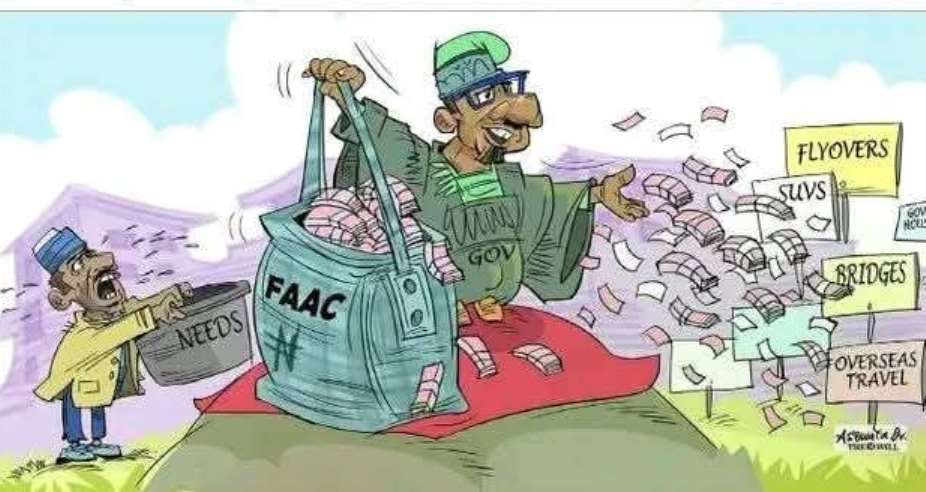
Nigeria's state governors are sitting on the largest pool of subnational revenue in decades yet, according to a front-page investigation by THEWILL newspaper, much of that windfall is being funnelled into executive comfort, political showpieces, and vanity infrastructure rather than the basic services millions of citizens desperately need.
(Dollar figures below are approximate, converted at the official NFEM rate of roughly ₦1,329/$1 as of mid-September 2026; actual parallel-market rates were higher, around ₦1,390/$1.)
An Unprecedented Windfall
The scale of the revenue increase is striking. According to Agora Policy, a Nigerian think tank, the 35 states it tracks generated a combined N16.64 trillion (about $12.5 billion) in 2025, with 75 percent N12.40 trillion (about $9.3 billion) coming from the Federation Accounts Allocation Committee (FAAC).
Separately, BudgIT's 2025 State of States report found that combined state revenue jumped to N17.17 trillion (about $12.9 billion) in 2024, almost double the N8.66 trillion (about $6.5 billion) recorded just a year earlier, driven by gross FAAC allocations that more than doubled from N5.4 trillion (about $4.1 billion) to N11.38 trillion (about $8.6 billion).
That windfall has only accelerated. Between January and November 2025, the three tiers of government shared N33.27 trillion (about $25 billion) through FAAC about 30 percent more than the same period in 2024 with states alone receiving N6.713 trillion (about $5.1 billion).
A separate special FAAC intervention for state infrastructure and security delivered a further N2.9 trillion (about $2.2 billion) to states and the FCT between 2024 and mid-2026. The surge has been driven by the removal of the fuel subsidy, the naira's devaluation, higher federation revenues, and improved internally generated revenue (IGR) in some states.
Government House First, People Later
Despite this, spending patterns tell an uncomfortable story. At least 12 states Lagos, Adamawa, Borno, Cross River, Delta, Ekiti, Imo, Jigawa, Kebbi, Ondo, Taraba, and Yobe earmarked roughly N102 billion (about $77 million) in their 2025 budgets combined for official-lodge upgrades, office renovations, and vehicle procurement.
Lagos alone budgeted about N33 billion (about $24.8 million) for vehicles and lodge upgrades; Adamawa allocated N6.46 billion (about $4.9 million), including N2.9 billion (about $2.2 million) for 42 SUVs; Kebbi set aside N5.66 billion (about $4.3 million); and Ekiti earmarked N5.16 billion (about $3.9 million) for vehicles and executive residences.
The contrast with basic government costs is jarring: the combined basic salaries of all 36 state governors for six months would total only around N108.65 million (about $82,000), yet states spent nearly N512 billion (about $385 million) on broader executive administration and travel categories over a comparable period.
In Akwa Ibom, which recorded N1.134 trillion (about $853 million) in revenue in 2025, the state budgeted N1 billion (about $752,000) for 10 SUVs for former deputy governors and political figures at N100 million (about $75,000) each even though that same sum, at prevailing costs for school furniture, could have provided roughly 25,000 pupil seats.
Flyovers Where Traffic Doesn't Exist
Perhaps the most visible symbol of misplaced priorities is the proliferation of flyovers built more for their political optics than to solve real congestion problems a pattern President Bola Tinubu has himself publicly cautioned governors against.
In Niger State, five flyovers have reportedly been under construction in Minna, with some projects stalled for roughly three years; a former state commissioner has publicly criticized the initiative as misplaced spending, though the state government maintains the projects will improve traffic flow.
Economist Mike Akannor argues that flyovers appeal to governors precisely because they are visible, commissionable, and can carry a governor's name on a billboard unlike a well-stocked health centre or a trained teacher, whose value is real but far less photogenic.
The Airport Graveyard
Nowhere is the pattern more pronounced than in aviation. Nigeria already has a large network of airports and airstrips, yet numerous states have poured billions of naira into new airport projects that go on to see little to no commercial or charter traffic with an estimated ten state airports left incomplete or abandoned for decades.
Anambra's Umueri cargo airport, launched by then-Governor Willie Obiano in 2017 with plans for an entire "airport city," remains grossly underused nine years on yet the current Soludo administration has since begun a second international airport project at Ndikelionwu, roughly 60 kilometres away.
Ebonyi's Onueke airport, into which former Governor David Umahi sank more than N36 billion (about $27 million), has been described as comatose, even as the current administration has spent a further N17.3 billion (about $13 million) on its runway, terminal, and control tower. Similar stories recur across the country: Ekiti's Akure Airport (over N16 billion / about $12 million, few flights), Jigawa's airport (N4 billion / about $3 million, located less than 100km from Kano's international airport), Bayelsa's N70 billion (about $53 million) airport (rarely used), Yobe's N18 billion (about $13.5 million) facility (no flights), and Nasarawa's N15 billion (about $11.3 million) Usman Dan Fodio Airport in Lafia.
Kogi has since broken ground on yet another international airport project in Zariagi, near Lokoja.
The Hidden Danger of FAAC Dependence
Beyond questionable spending choices, experts warn the windfall itself carries structural risk. A World Bank assessment of the first half of 2025 found that Adamawa derived roughly 93 percent of its total revenue from FAAC, with Akwa Ibom, Bayelsa, Taraba, and Ebonyi similarly highly dependent; Lagos was a notable exception, with IGR making up a much larger share of its revenue.
BudgIT's analysis similarly found that 31 states rely on federal transfers for at least 80 percent of their recurrent revenue meaning much of the apparent prosperity is externally generated rather than a product of genuine economic transformation, leaving states vulnerable if oil prices fall or federal revenues weaken.
Poverty Keeps Rising Regardless
Set against this spending pattern is a grim trend in living standards. The World Bank reported in April 2026 that Nigeria's poverty rate climbed to 63 percent in 2025, up from 61 percent in 2024 and 56 percent in 2023 meaning roughly 140 million of Nigeria's 200-plus million people now live below the poverty line.
PricewaterhouseCoopers' 2026 Nigeria Economic Outlook found that many families now spend as much as 70 percent of their income on food alone, undermining the benefits of recent macroeconomic reforms.
What Experts Say Governors Should Do Instead
Analysts including Muda Yusuf of the Centre for the Promotion of Private Enterprise and Oluseun Onigbinde, co-founder of BudgIT, argue that Nigeria's governance problem isn't a lack of resources but a failure to prioritize correctly. Former SERAP executive director Adetokunbo Mumuni has argued that governors can no longer cite limited resources as an excuse for weak service delivery, given historically high revenues.
Finance experts interviewed by THEWILL suggest a clear hierarchy governors should follow instead: basic infrastructure (roads, water, electricity, drainage); human capital (healthcare, education, vocational training); productive infrastructure (agro-processing zones, industrial clusters, irrigation); economic diversification to grow the tax base; security around farming and commercial corridors; and, critically, maintenance of what already exists rather than a constant hunger for new construction.
Mustapha Bature Sallama
Medical/Science communicator, Private Investigator, Criminal Investigation and Intelligence Analysis,United States Institute of Peace (USIP), [email protected] +233555275880
Sources
THEWILL News, "Awash With Cash, Short On Priorities: How Governors Are Spending Billions On Prestige Projects As Poverty Ravages Citizens," by Sam Diala, September 13, 2026
Agora Policy, state revenue analysis, 2025
BudgIT, "2025 State of States" report
World Bank, "Nigeria's Tomorrow Must Start
Today: The Case for Early Childhood Development," Nigeria Development Update, April 2026
PricewaterhouseCoopers, Nigeria Economic Outlook, 2026


 NDC gov't ‘scored own goals’ with new SHS placement policy — Dr. Bempah Tandoh
 Five-year presidency will give governments more time to deliver — Kofi Bentil
 Improved invigilation is exposing true performance of Ghanaian students — Mahama...
 There's no policy to introduce Arabic, Chinese in all public schools — Mahama
 Anthropic boss calls for AI slowdown, Altman and Musk agree
 Saudi Arabia closes East-West pipeline as Houthis tighten grip on Red Sea
 Uganda buries 'youngest' king amid succession row
 'If we were wrong, we must first apologise to NPP' – Mustapha Gbande on National...
 Han SHS to get boarding status as Mahama inspects GETFund projects in Upper West
 Late herbal doctor’s wife granted GH¢100,000 bail amid poisoning, arson claims


