




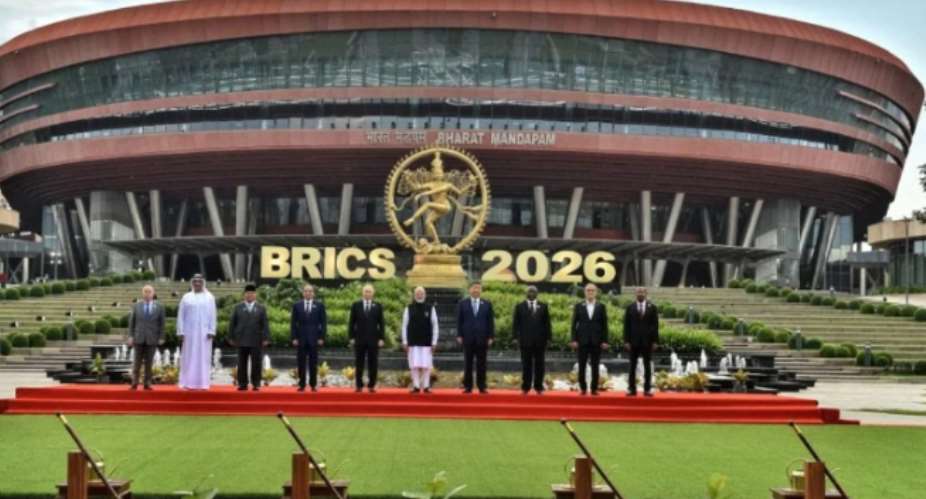
As leaders from the BRICS bloc gathered in New Delhi for the group's 18th summit on September 12 and 13, 2026, President Vladimir Putin used the occasion for something arguably more valuable to Moscow than the summit's joint declaration: a dense schedule of one-on-one meetings designed to deepen Russia's bilateral ties with fellow member states, even as Western sanctions continue to squeeze its economy.
A Working Trip With a Packed Agenda
The Kremlin described Putin's three-day visit coinciding with BRICS' 20th anniversary as a working trip built around far more than attendance at the summit itself. On September 11, the day before the main leaders' sessions, Putin addressed the plenary of the BRICS Business Forum, the platform that traditionally precedes the summit and brings together business representatives from member economies.
He then held a full bilateral meeting with Indian Prime Minister Narendra Modi, before the two leaders jointly toured an India-Russia industrial exhibition and the INNOPROM fair, which showcased Russian technology across aviation, space, nuclear science, AI, mining, and banking.
Strengthening the "Special" Relationship With India
The centrepiece of Russia's summit diplomacy was its relationship with host nation India. Indian officials said Modi and Putin agreed to further strengthen what both sides describe as their "special" bilateral relationship, with talks spanning energy, defence, trade, and strategic cooperation.
The two countries have set a target of raising bilateral trade to $100 billion by 2030, up from nearly $70 billion in 2024–25 a goal made more attainable by India's sharply increased purchases of Russian crude oil, which climbed to a record 51% share of India's crude imports in July 2026 amid disruptions to Middle Eastern supply.
Defence cooperation featured prominently in the discussions, with reports indicating talks touched on fighter aircraft, missile systems, and broader military technology transfer, including discussion of a potential Su-57 fighter jet deal and an upgraded BrahMos missile package though no final agreement on either had been announced as of the summit's opening.
In a more symbolic gesture, Modi presented Putin with a Russian translation of the Thirukkural, a classical Tamil text on virtue and governance, underscoring the cultural dimension Moscow and New Delhi have both leaned on to reinforce a relationship that predates BRICS itself.
Positioning Russia as a Bridge, Not a Bloc
Putin used his public remarks at the summit to frame BRICS and, by extension, Russia's role within it not as an anti-Western alliance but as an open, non-exclusive grouping. He told the gathering that BRICS "was not against anyone" and that Moscow remained open to working with the whole world, even as he criticized Western economic restrictions imposed on Russia.
That framing serves a clear strategic purpose: it allows Russia to deepen ties with BRICS partners several of which, including India, continue to balance relationships with both Moscow and Washington without forcing those countries into an explicit anti-Western posture that could complicate their own diplomatic and trade relationships.
That balancing act was visible throughout the summit. This year's 11-member BRICS gathering includes countries with sharply different positions on the Middle East conflict, such as Iran and the UAE, complicating any effort to agree on strong common language in a joint declaration.
Analysts say India, as host, has had to carefully manage these competing interests which in turn gives Russia additional space to pursue its bilateral goals with individual members quietly, even where a unified bloc-wide statement proves elusive.
Beyond India: A Wider Network of Engagement
Putin's presence in New Delhi also placed him alongside Iranian President Masoud Pezeshkian, Chinese President Xi Jinping on his first visit to India in nearly seven years Egyptian President Abdel Fattah el-Sisi, Ethiopian Prime Minister Abiy Ahmed, Indonesian President Prabowo Subianto, and South African President Cyril Ramaphosa.
For Russia, a summit of this scale offers a rare, efficient venue to advance several bilateral relationships simultaneously, from energy cooperation with India to continued alignment with Iran and China on shared grievances over Western sanctions and economic pressure all without the diplomatic cost of arranging separate state visits to each capital.
Why This Matters for Russia's Broader Strategy
For a country facing sustained Western sanctions over its war in Ukraine, platforms like BRICS have become an increasingly important vehicle for sustaining trade relationships, defence cooperation, and diplomatic legitimacy outside the US-led international order.
Deepening ties with India in particular a country that has so far declined to join Western sanctions against Russia and has become one of the largest buyers of discounted Russian oil gives Moscow both an economic lifeline and a powerful diplomatic counterweight to its isolation from Europe and North America.
The New Delhi summit, in that sense, illustrates a broader pattern in Russia's foreign policy: using multilateral gatherings less as venues for collective bloc action and more as efficient staging grounds for a series of parallel, mutually reinforcing bilateral relationships each one chipping away, in its own way, at the isolation Western sanctions have sought to impose.
Mustapha Bature Sallama
Medical/Science communicator, Private Investigator, Criminal Investigation and Intelligence Analysis,United States Institute of Peace (USIP), [email protected] +233555275880
Sources
Al Jazeera, "Putin, Pezeshkian in India for BRICS summit clouded by Iran and Ukraine war," September 11, 2026
Al Jazeera, "BRICS meets in India: What's on the agenda, why it matters," September 12, 2026
The Express Tribune, "Modi, Putin agree to strengthen India-Russia partnership on eve of BRICS summit"
The Tribune (India), "BRICS Summit 2026: Modi-Putin talks conclude"
Indian Defence News, "Putin's Packed India Visit To Boost BRICS And Bilateral Ties"
International News and Views, "BRICS Summit 2026: Putin Arrives in India, Defence Talks in Focus"
NPR, "BRICS leaders meet in India as wars and US tensions test the bloc," September 12, 2026

 NDC gov't ‘scored own goals’ with new SHS placement policy — Dr. Bempah Tandoh
 Five-year presidency will give governments more time to deliver — Kofi Bentil
 Improved invigilation is exposing true performance of Ghanaian students — Mahama...
 There's no policy to introduce Arabic, Chinese in all public schools — Mahama
 Anthropic boss calls for AI slowdown, Altman and Musk agree
 Saudi Arabia closes East-West pipeline as Houthis tighten grip on Red Sea
 Uganda buries 'youngest' king amid succession row
 'If we were wrong, we must first apologise to NPP' – Mustapha Gbande on National...
 Han SHS to get boarding status as Mahama inspects GETFund projects in Upper West
 Late herbal doctor’s wife granted GH¢100,000 bail amid poisoning, arson claims


