




The Twin Towers had long been part of New York's visual identity, appearing in films, music videos and on album covers.
Their destruction on 11 September 2001 transformed that image and gave new meaning to songs written before the attacks, while inspiring musicians across genres to respond in their own way.
French journalist Jean-Marie Pottier, author of Ground Zero: Une histoire musicale du 11-Septembre (Ground Zero: A Musical History of 9/11), spoke to RFI about how the attacks shaped American music and musicians, and how the New York skyline became part of that musical memory.
RFI: What did the Twin Towers represent for American musicians before the 9/11 attacks?
Jean-Marie Pottier: Before 9/11, the Twin Towers were an integral part of the New York skyline, just like the Empire State Building or the Statue of Liberty. They were iconic landmarks, and depicting them was commonplace. Even before they were completed, the Twin Towers already served as a backdrop for a musical. In the film Godspell – which was quite well-known at the time and was even screened at the Cannes Film Festival – actors sing and dance on top of one of the two towers.
The Twin Towers were inaugurated in 1973, and around that time, film composer Lalo Schifrin – best known for the Mission: Impossible theme – released an album titled Towering Toccata. The cover features the two towers, with Schifrin depicted behind them on a gigantic scale. There was also the cover of Supertramp's album Breakfast in America, which shows the New York skyline, with the towers clearly visible.
This New York landmark, frequently referenced by artists – particularly in music videos – is portrayed in two contrasting ways. On one hand, the towers can be glorified, offering breathtaking views that symbolise the American Dream; on the other, they are often depicted in a much darker way, representing the flip side of that dream. As early as the 1980s and '90s, album covers featured the towers in flames – grim, nocturnal visions. They were being portrayed as potential targets long before 9/11.
How Dolly Parton became much more than country music's 'backwoods Barbie'
RFI: In the days following 9/11, there were a number of charity concerts with rock and pop superstars. What did this say about the country at the time?
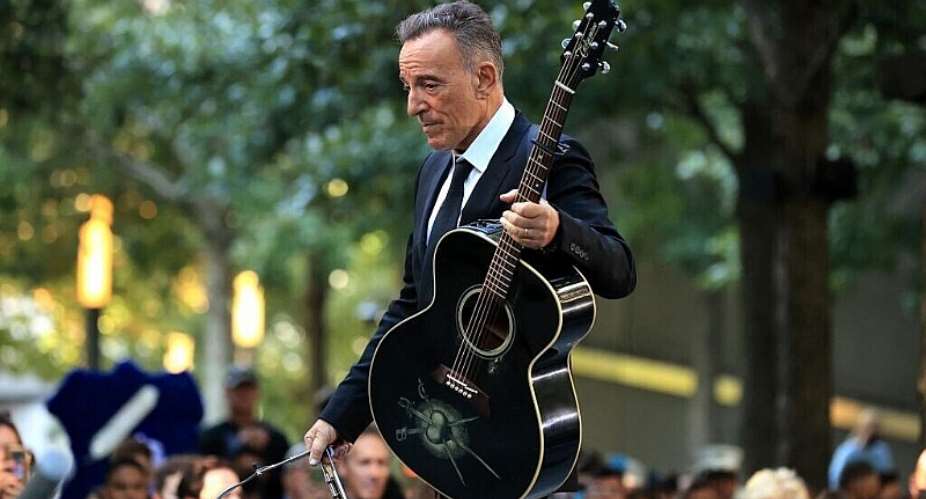
JMP: What is particularly interesting is how they demonstrate how a historical event can alter the meaning attributed to a song. For instance, at the America: A Tribute to Heroes concert, Bruce Springsteen performed My City of Ruins – a song originally written about the decline of his hometown, Asbury Park, New Jersey. Suddenly, that "city of ruins" was no longer Asbury Park, but New York. Similarly, the concerts featured Enrique Iglesias and Mariah Carey, each performing a song titled Hero. Although both songs predated the attacks, they were suddenly imbued with a new emotional resonance.
These charity concerts also reflect a strong surge of patriotism among pop musicians, who perform songs such as The Star-Spangled Banner, God Bless America, or America the Beautiful. These anthems do not always command universal agreement and are sometimes viewed as overly aggressive or jingoistic. At other, smaller-scale charity concerts, you could hear Woody Guthrie's This Land Is Your Land – a popular protest song among the American left.
RFI: When we think of 9/11, Bruce Springsteen inevitably comes to mind, but so do Jay-Z and the New York rappers Beastie Boys. How did different artists position themselves in the wake of the attacks?
JMP: There was a wide range of tones and attitudes among artists in the immediate aftermath of 9/11. Bruce Springsteen acted almost as a "public service" artist. Hailing from New Jersey, he viewed New York as a city that was inherently significant. He explained that, in the days following the 9/11 attacks, fans reached out to him, saying: "You need to sing on our behalf."
He was also struck by the fact that, in the weeks following the attacks, The New York Times published brief biographies of a vast number of the victims – bearing in mind that there were nearly 3,000 deaths. Many of them were fans of his music. This inspired the 2002 album The Rising, which was conceived to reflect a collective experience. In the songs Springsteen steps into the shoes of a wide range of characters: a firefighter in one of the towers, a 9/11 widow, a suicide bomber preparing an attack, and so on.
For Jay-Z, on the other hand, life went on. His album The Blueprint was released on 11 September 2001. About 10 days later, during a concert, he dropped a freestyle line: "My album came crashing down the same day as the Twin Towers." At the time, that sort of comment was considered to be in very poor taste. Then a year later, on his next record, he had a track where he said: "Rumour has it The Blueprint classic / Couldn't even be stopped by Bin Laden." He added: "I was stronger than the attacks. My work survived it." He was showing a boastful, arrogant side, but he was trying to assert himself in the face of the event.
The Beastie Boys were closer to the style of Springsteen. music acts as a balm after a tragic experience. The track An Open Letter to NYC is truly a love letter to New York City; they sing, "I hope you're doing well; you meant so much to us." And on the cover of the album To the 5 Boroughs, released in 2004, they depicted the New York skyline with the Twin Towers still standing – as if to show that the towers survived in their memories and their music.
'Black Lives Matter', and songs are showing it's a fact
RFI: What was the New York music scene like in general at the time of the attacks and how did 9/11 affect it?
JMP: The attacks coincided with the emergence of a new scene dubbed the "return of rock" – following a decade when guitar-based rock was thought to have lost some of its influence. It was not solely an American phenomenon, yet New York was a pivotal hub for the rock scene. There were bands like The Strokes, as well as Interpol and the Yeah Yeah Yeahs. The 9/11 attacks provided a tragic backdrop to the rise of these groups.
They had started making music earlier, but they fitted into the context of late-1990s New York – a city undergoing a cleanup yet still affordable for broke artists. The year 2001 marked the end of Rudy Giuliani's mandate as mayor, during which he had notably sought to make the city safer. The emergence of new music scenes was part of this broader transformation of New York, and 9/11 was a pivotal moment.
RFI: In the years that followed, rock acts like Sonic Youth and contemporary composers such as Steve Reich created works relating to 9/11. How do you explain the vast differences in genres around the same event?
JMP: For me, it's quite simple. It comes down to the fact that the event was so colossal that no one could escape it. It [was] the largest attack on American soil since Pearl Harbor in 1941 and the United States' entry into World War II. To use a cliché, 9/11 was the event that truly defined an entire generation.
Of course, each genre reinterprets the event through its own lens. Hip-hop features many protest songs, particularly regarding the plight of African Americans. Country music tends to strike a more patriotic tone overall. However, there is also an American alternative country tradition that focuses more on outlaws or outsiders and has produced songs that are more critical of [former president] George W. Bush's policies.
Then there is the realm of art music, with composers like Steve Reich and John Adams. They, too, reinterpreted the event – which had generated such striking sounds and images – by incorporating archival audio into their own works. Once again, everyone viewed the event through their own particular lens.
This article is based on an interview in French by RFI's Bastien Brun.


 WASSCE: School officials helped students cheat for years, but we now see the tru...
 Probe alleged military killing of lecturer in Bawku – Kusaug Youth demands
 ‘If we all pay GH¢1,000 each, we should be able to construct National Cathedral’...
 Mahama inspects proposed site for Upper West Regional Airport
 Mahama reiterates government's commitment to end double-track SHS system
 Police interdict officer over death of 23-year-old Ivan Baidoo on Tema Motorway
 NDC gov't ‘scored own goals’ with new SHS placement policy — Dr. Bempah Tandoh
 Five-year presidency will give governments more time to deliver — Kofi Bentil
 Improved invigilation is exposing true performance of Ghanaian students — Mahama...
 There's no policy to introduce Arabic, Chinese in all public schools — Mahama


