




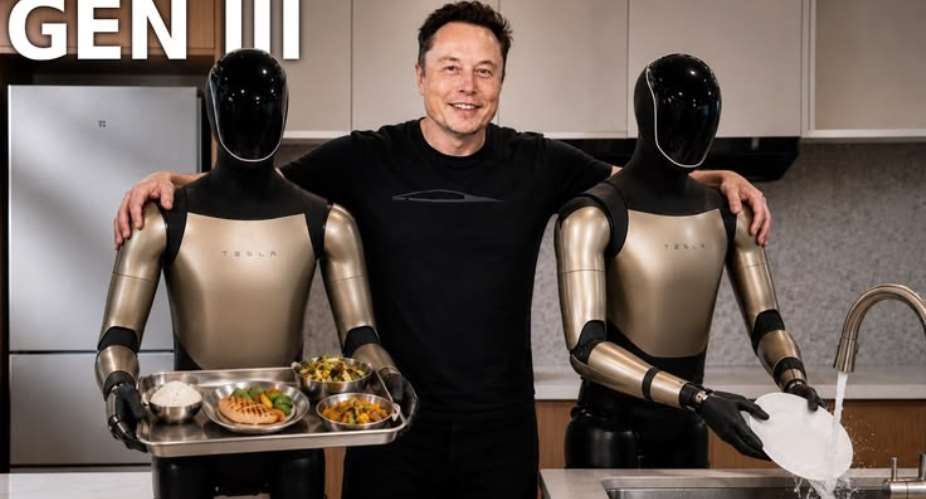
Imagine a helper who never sleeps. He does not complain. He does not ask for a salary raise at the end of the month. He does not go home to rest on Sunday. He just works — cooking, cleaning, lifting, carrying — for what Elon Musk says could one day cost about the same as a small bag of pure water an hour.
That helper is not a person. He is a machine. His name is Optimus, also called the Tesla Bot. And his newest body, called Gen 3, is already being built in America right now, on the same Fremont, California factory floor that used to build Tesla cars.
This is not science fiction anymore. It is happening in 2026, while you are reading this.
What Is Actually True, And What Is Still A Dream
Let us be honest and clear, because too many videos and blog posts online are stretching the truth to get clicks.
Tesla began mass production of Optimus at its Fremont factory in January 2026, on lines that used to make Model S and Model X cars. In February 2026, Musk showed off the new Gen 3 hands and simply wrote online, "This bot got hands." By March, Tesla was calling Gen 3 the most advanced robot body it had ever built, with full production planned for that summer.
Here is what we actually know about the machine itself:
- **Size and weight:** About 173 centimetres tall (5 feet 8 inches) and 57 kilograms — roughly the size of an average adult.
- **Hands:** Each hand now has 22 degrees of freedom, more than double the 11 it had before. That means the fingers can bend and twist in many more directions, closer to how a human hand moves.
- **How the hands work:** Tesla did something clever. Instead of putting small motors inside the fingers, they moved all 25 motors per arm into the forearm, and used thin cables — like tendons in a human arm — to pull the fingers. This is called a tendon-driven design. It keeps the hand light and quick, the same way your own fingers move because muscles in your forearm pull tendons, not because your fingers themselves are full of muscle.
- **Battery:** About 2.3 kilowatt-hours, similar to earlier versions, but Tesla says smarter software should stretch the working time by around 40 percent, giving roughly 5 to 8 hours of use before recharging.
- **The brain:** A new chip called AI5, built by Tesla itself, said to handle about five times more information at once than the chip before it. This lets the robot process camera images, touch sensors, and body position all at the same time, so its movements look smoother and more natural.
- **The voice:** Tesla has connected the robot to Grok, the artificial intelligence chatbot built by Musk's other company, xAI. This means you may soon be able to simply talk to the robot in plain language — "please wash this plate" — instead of typing commands or pressing buttons.
Reuters reporting says more than a thousand of these robots are already quietly working inside Tesla's own supply chain, mostly sorting parts and carrying trays between shelves — real work, but still simple work, not yet full housekeeping.
The Famous "$1 An Hour" Number — Where It Really Comes From
Now here is the part that made headlines everywhere: the "$1 an hour" or "$2 an hour" figure.
This number does **not** mean you can rent a robot today for one dollar. It is a future estimate — a calculation of what it might cost to run and pay off a robot per hour of work, if, and only if, Tesla manages to build these robots by the millions and bring the price down to around $20,000 to $30,000 each, a target Musk has repeated since 2023 and again at Davos in January 2026.
That price target is not the real price yet. As of the middle of 2026, people who study Tesla's factory costs closely believe each Optimus Gen 3 unit still costs somewhere between $50,000 and $150,000 to actually build. Nobody can walk into a shop and buy one today. There are no pre-orders. There is no waitlist. Tesla has openly warned that any website offering to "pre-order" or "invest in" Optimus is a scam, and sadly, criminals have already used fake Elon Musk videos to trick people out of money using Optimus hype.
Tesla itself has said public sales might begin around the end of 2027, but many independent analysts think 2028 or 2029 is more realistic, based on how long Tesla's other big promises — like fully self-driving cars — have taken to actually arrive.
So the true story is this: the dream of a $1-an-hour robot house helper is a real, serious engineering goal, backed by real money and real factories. But it is still a future fact, not a present one.
Can It Really Cook And Clean Already?
Tesla engineers claim the new hands, with their 50 actuators and 22 degrees of freedom, could eventually allow more than 3,000 different types of hand movement — enough, in theory, to fold clothes, chop vegetables, or wipe a table.
But we must be careful here. In Tesla's own July 2026 earnings report, the company admitted its first Gen 3 units are still in a "learning phase" inside the factory — meaning the robots are mostly collecting data and being trained, not yet doing full productive work on their own. The "3,000 tasks" figure is design intent — what the hardware is built to eventually do — not something already proven on camera in a real kitchen.
This pattern is not new for Tesla. Every Optimus reveal has followed the same cycle: big excitement, then doubt from experts, then slow, real progress that arrives later than promised. It happened with Tesla's self-driving cars too — the "robotaxi" service is now running in parts of Texas, but it has also faced over a dozen reported crashes under safety review. Excitement and caution must travel together.
Let Us Hear The Other Side Too
It would be lazy of me to only praise this robot without asking hard questions, because a good writer always looks at both sides of the coin.
First, many people doubt Tesla will hit its price and timeline targets. Big promises delayed by years have become almost a tradition for this company.
Second, even if the robot becomes cheap one day, what happens to the millions of people around the world who cook, clean, and carry for a living? A house help in Accra, a kitchen worker in Lagos, a cleaner in London — their jobs exist because humans need help with these tasks. If a machine can eventually do it for almost nothing, real people could lose real income. Musk himself talks about a future of "universal high income" to soften this blow, but no government anywhere has built such a system yet.
Third, safety matters greatly. A robot with strong motorised hands working close to children or elderly people in a home must be extremely well tested before it is trusted. One wrong grip could cause real harm. Trust must be earned slowly, through years of proof, not rushed because a company wants good headlines.
These are not small worries. They deserve serious answers before robots move from factory floors into our kitchens and living rooms.
What This Means For Us, Here In Ghana
Some readers may think, "This is an American story, it does not concern us." I disagree, and I will tell you why.
Ghana has always valued hard work with the hands — our market women, our kayayei carrying loads on their heads, our house helps, our fitters and mechanics at Suame Magazine. These are honest, dignified jobs that feed families. If cheap robots eventually spread across the world, the question is not whether Ghana will be affected — it is when, and how ready we will be.
But here is the hopeful part. I am a student of engineering myself, studying both software and mechanical engineering at Accra Technical University. I see young Ghanaians building small robots, coding apps, and fixing machines with their own hands, using little more than determination and YouTube tutorials. If the world is moving toward robots and artificial intelligence like Grok, Ghana must not just watch from the sidelines as a customer. We must train our young people to build, repair, and even design these machines ourselves. A nation that only buys robots stays poor. A nation that learns to build them grows rich.
This is the true lesson from Tesla's factory floor: the future belongs not to those who fear the robot, but to those who understand it.
Author's Note
I wrote this piece because I believe knowledge should never be locked away in expensive Silicon Valley reports that ordinary readers cannot access. A grandmother in Kumasi and a curious child in Takoradi deserve to understand what a "Tesla Bot" is, in plain language, just as much as any investor on Wall Street. Technology should never feel like a secret club. My promise to you, my reader, is always this: I will search for the truth, separate the hype from the facts, and bring it home to you in words that welcome everyone — young and old, student and elder, believer and skeptic alike. Robots are coming, whether we are ready or not. Let us at least meet the future with open eyes, and please, never send money to any website claiming to sell you a Tesla robot today — that robot does not exist for sale yet, and the "seller" is a thief.
About the Author
Chief Tutu Baffour Asare Brownsy Williams is an author, filmmaker, opinion columnist, and digital content creator based in Accra, Ghana. He is the founder of Brownsy Silva Company, a multi-disciplinary creative platform spanning novels, films, engineering commentary, and opinion journalism. His columns reach a growing readership across Ghana and the diaspora communities of the UK, USA, Canada, and Germany, covering topics ranging from science and technology to culture, psychology, and African development. He is currently a student of engineering at Accra Technical University, where his studies in software and mechanical engineering shape his passion for writing about the machines that are reshaping our world.


 'If we were wrong, we must first apologise to NPP' – Mustapha Gbande on National...
 Han SHS to get boarding status as Mahama inspects GETFund projects in Upper West
 Late herbal doctor’s wife granted GH¢100,000 bail amid poisoning, arson claims
 NDC has failed to deliver on Agenda 1-3-3 for 24-hour economy – Sam Pyne
 Wa-Bolgatanga trunk road to be asphalted – Mahama
 Gbewaa College of Education lecturer dies after alleged military assault in Pusi...
 Ghana won’t back down on mining value addition – Ambassador Kojo Bonsu
 How Dr Jesse Amuah, wife was murdered over GH¢1,500 payment dispute
 Mahama announces 20% salary incentive for health workers in deprived areas
 Ghana must move from plastic policies to implementation – EPA CEO


