




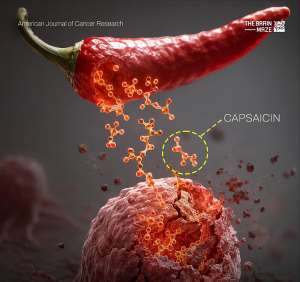
Capsaicin, the natural compound responsible for the fiery heat of chili peppers, may have an unexpected second act: triggering self-destructive processes inside melanoma cancer cells. That's according to research published in the American Journal of Cancer Research, part of a growing body of laboratory studies exploring capsaicin's potential anti-cancer properties.
What the Study Found
The research, led by scientists including Anowarul Islam and Pin Ju Chueh, examined how capsaicin affects A375 melanoma cells a commonly used human skin cancer cell line in the laboratory. The team found that capsaicin binds directly to a protein called tNOX (also known as ENOX2), a tumour-associated enzyme found on the surface of cancer cells that helps drive their growth and survival but is largely absent from normal, healthy cells.
By targeting tNOX, capsaicin was found to suppress a related protein called SIRT1, setting off a chain of molecular events inside the melanoma cells. This disruption pushed the cells toward autophagy a process in which cells effectively break down and consume their own internal components.
While autophagy can sometimes help cells survive stress, the researchers found that in this case it tipped over into a destructive, cytotoxic form of autophagy that killed the melanoma cells, driven in part by a build-up of reactive oxygen species (ROS), unstable molecules that can damage cellular structures when they accumulate.
Part of a Broader Pattern
Melanoma is a comparatively rare but particularly dangerous form of skin cancer, and one of the leading causes of cancer-related death worldwide relative to its incidence, in part because treatment options remain limited once it spreads. That makes findings like these of particular interest to researchers hunting for new therapeutic angles.
This melanoma study is not an isolated finding. Capsaicin has now been studied in laboratory and animal models across a wide range of cancer types, including oral, nasopharyngeal, lung, prostate, colon, liver, and glioma cancers, with researchers documenting effects on cell death pathways including apoptosis (programmed cell death) and autophagy.
In one notable example, a study from the American Institute for Cancer Research found that capsaicin slowed tumour growth in mice implanted with human lung cancer cells and triggered self-destruction in the cancer cells themselves, while leaving healthy lung cells unharmed.
An Important Caveat: This Is Not a Treatment (Yet)
Despite the encouraging findings, the melanoma research like most capsaicin cancer studies to date was conducted on cancer cells grown in a laboratory dish, not in humans, and not even in animal models in this particular study.
Cell-based laboratory findings frequently do not translate directly into effective treatments once tested in living organisms, let alone in human clinical trials, due to factors like drug absorption, metabolism, dosage tolerability, and the vastly more complex environment of an actual tumour inside the body.
Researchers in this field have consistently emphasized that substantially more work including animal studies and eventually controlled human trials would be needed before capsaicin, or a capsaicin-derived compound, could be considered an actual cancer treatment.
It's also worth noting that eating spicy food is not the same as receiving a concentrated, targeted dose of capsaicin under laboratory conditions, so these findings should not be read as dietary advice or a reason to self-treat any cancer diagnosis.
Why It Matters Anyway
Even with those caveats, studies like this one add to scientific understanding of tNOX and similar tumour-specific proteins as potential drug targets proteins that, because they appear on cancer cells but not healthy ones, could theoretically be exploited to kill tumours while sparing normal tissue, a longstanding goal in cancer drug development.
Capsaicin's ability to bind and disrupt tNOX makes it a useful research tool for probing this pathway further, even independent of whether capsaicin itself ever becomes a clinical drug.
This article is for general informational purposes and does not constitute medical advice. Anyone with questions about cancer prevention, treatment, or diagnosis should consult a qualified healthcare professional.
Mustapha Bature Sallama
Medical/Science communicator, Private Investigator, Criminal Investigation and Intelligence Analysis,United States Institute of Peace (USIP), [email protected] +233555275880
Sources
Islam, A., Hsieh, P.-F., Liu, P.-F., Chou, J.-C., Liao, J.-W., Hsieh, M.-K., & Chueh, P.J. (2021). "Capsaicin exerts therapeutic effects by targeting tNOX-SIRT1 axis and augmenting ROS-dependent autophagy in melanoma cancer cells." American Journal of Cancer Research, 11(9), 4199–4219.
Frontiers in Oncology, "Capsaicin: A Two-Decade Systematic Review of Global Research Output and Recent Advances Against Human Cancer," 2022
American Institute for Cancer Research, "Compound in Chili Pepper Slows Lung Cancer Tumor Growth in Animal Study"
Wiley Online Library / Phytotherapy
Research, "Capsaicin: A chili pepper bioactive phytocompound with a potential role in suppressing cancer development and progression," 2024


 'If we were wrong, we must first apologise to NPP' – Mustapha Gbande on National...
 Han SHS to get boarding status as Mahama inspects GETFund projects in Upper West
 Late herbal doctor’s wife granted GH¢100,000 bail amid poisoning, arson claims
 NDC has failed to deliver on Agenda 1-3-3 for 24-hour economy – Sam Pyne
 Wa-Bolgatanga trunk road to be asphalted – Mahama
 Gbewaa College of Education lecturer dies after alleged military assault in Pusi...
 Ghana won’t back down on mining value addition – Ambassador Kojo Bonsu
 How Dr Jesse Amuah, wife was murdered over GH¢1,500 payment dispute
 Mahama announces 20% salary incentive for health workers in deprived areas
 Ghana must move from plastic policies to implementation – EPA CEO


