




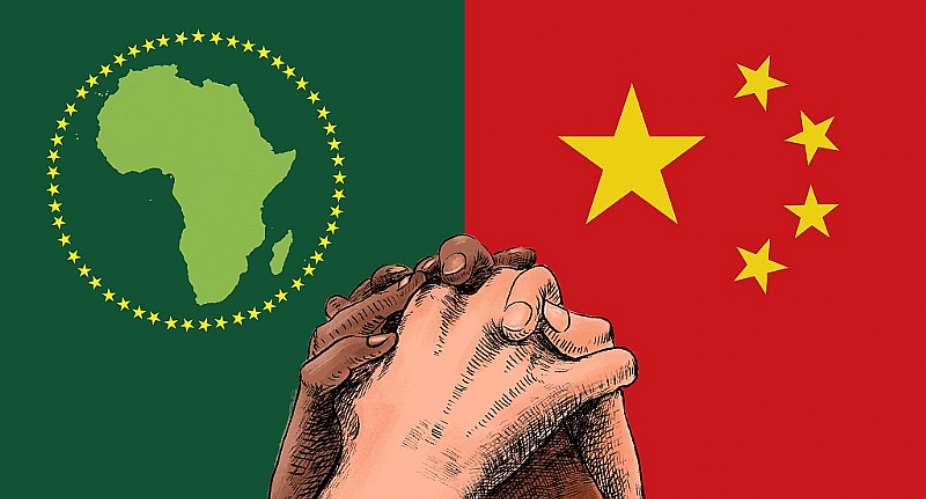
While researching an article I wrote for a Chinese journal, I discovered something almost wonderfully symbolic in the story of the Chinese admiral Zheng He, his giraffe, and China’s current interactions with Africa.
More than six hundred years ago, long before European imperialism had perfected the art of dressing their colonial conquest in the halo of altruism and the language of civilization, a gigantic Chinese fleet sailed across the Indian Ocean and reached the eastern coast of Africa.
Between 1405 and 1433, Zheng He, the celebrated admiral of the Ming Dynasty, commanded seven extraordinary maritime expeditions that took Chinese ships as far as Arabia and the East African coast. Among the African states with which the Chinese established contact was Malindi, in present-day Kenya.
On one of his voyages, Admiral He brought a giraffe back to the Chinese imperial court in 1414. It was quite a spectacle as the Chinese had never seen such a magnificent creature. They associated the giraffe with the mythical qilin, an auspicious animal believed to herald good fortune and wise government.
The giraffe's arrival became a sensation at the Ming court and was commemorated in Chinese art.
Africa had gifted China a giraffe.
There is something almost poetic about the contrast with the ancient Sino-African encounter and what happened when Europe eventually came to Africa in earnest.
The Europeans did not take a giraffe home. They took Africans.
While China came to Africa several times and conducted honorable trade, Europe came with malicious intent to steal, plunder, ravage, conquer, and colonize.
Europeans took gold and ivory, rubber and timber, cocoa and cotton, palm oil and land. They took kingdoms and political sovereignty. They took the freedom of millions of human beings and, in one of the most monstrous crimes in human history, transported Africans across the Atlantic as chattel commodities to be bought and sold at auctions, and built astonishing fortunes upon the most obscene traffic in human flesh - the wealth they so shamelessly flaunt in the world today.
The contrast is clear. While Zheng He and the Chinese were no saints, they were honorable. Admiral Zheng He’s voyages served Ming imperial diplomacy, commerce, and power, and China, like every serious civilization, pursued its interests. But the historical contrast is nevertheless instructive. Encounters between Ming China and African societies in the Indian Ocean did not result in the conquest, partition, and colonization of the African continent.
Unfortunately for humanity, European contact eventually did.
And this is where the story of the giraffe becomes more than an amusing historical anecdote. It offers an intriguing doorway into how different civilizations have approached Africa and, more importantly, how Africa itself should approach the world.
A saying often ascribed to Chinese wisdom goes: “Give a man a fish, and you feed him for a day; teach a man to fish, and you feed him for a lifetime.”
While we might debate the origin of the proverb, it nevertheless fits well with the Chinese concept of: 授人以鱼,不如授人以渔 - Shòu rén yǐ yú, bù rú shòu rén yǐ yú
Literally: “Give a person a fish; it is not as good as teaching a person to fish.”
Its underlying philosophy is simple and profound: temporary assistance may relieve immediate hunger, but acquiring skills and productive capacity gives a person the means to provide for himself.
That distinction matters enormously to Africa.
For decades, the dominant Western approach to Africa has been to distribute fish in an offensive paternalistic manner.
Admiral He’s giraffe story therefore becomes more than an exotic anecdote. It becomes a question. What do civilizations do when they encounter one another? Do they exchange, learn, and negotiate? Or do they arrive with the sword concealed beneath the missionary robe and call theft civilization?
This question remains both urgent and pungent because the West, unfortunately, has never entirely abandoned the old mentality. Rather than jettisoning the colonial mindset, it merely refined its vocabulary. The gunboat has become the sanction. The colonial administrator has become the IMF and World Bank consultant. The concessionary company has become the multinational corporation.
While the language of Euro-colonialism has changed, the voracious appetite for other people’s resources has not.
The mentality of “Why pay for it when you can kill for it?” has been the hidden arithmetic of too much Western power. The West speaks endlessly of democracy, human rights and a rules-based order, but as Fanon told us: “When I search for the Man in the technique and the style of Europe, I see only a succession of negations of man, and the avalanche of murders.”
The Western set rules have too often been elastic enough to accommodate slavery, colonialism, coups, occupation, economic strangulation and the destruction of inconvenient societies. A people can be bombed into rubble, provided the bombs are dropped by the right people and accompanied by the right press release.
But, as we have consistently maintained on this blog, Africa must not respond to Western arrogance and unbridled imperialism by becoming permanently dependent upon any other power.
International politics is not a romance novel, as International Relations 101 informed us. China does not engage Africa because it has suddenly become African. Beijing has markets to develop, resources to secure, diplomatic relationships to cultivate, and strategic interests to advance. Chinese companies seek profit. Chinese foreign policy serves China. All good and jolly because that is what serious states do.
The proper question is not whether China loves Africa. The proper question is whether African governments are intelligent and disciplined enough to make Chinese interests serve African interests in a win-win situation.
For decades, the dominant Western approach to Africa has been to distribute fish. Aid, grants, emergency relief, debt initiatives, consultants, conferences, workshops, and solemn development programs have multiplied. The West has created an entire international industry to explain Africa’s poverty to Africans.
Despite endless declamations by its plantation supervisors masquerading as presidents, Africa still grows cocoa and imports chocolate, produces crude oil and imports refined fuel, grows cotton and imports clothing, and exports minerals while importing the finished technologies made from them.
Africa has become extraordinarily good at supplying the world’s factories while remaining extraordinarily bad at building factories of its own.
That is the scandal we have always condemned on these pages.
As pointed out supra, the exact origin of the famous saying about teaching a man to fish, often attributed to China, is of little importance because its wisdom is universal: temporary assistance may relieve hunger, but it’s only productive capacity that creates independence.
The central issue is not whether someone offers Africa a fish. The issue is whether Africa will remain forever at the water’s edge, waiting for the fisherman.
China’s own development offers Africa an instructive lesson. China did not merely learn to fish. It learned how to build the rod, manufacture the boat, construct the engine, operate the harbor and dominate the market. It welcomed capital and technology, studied the industrialized world, borrowed what was useful and adapted it to its own national purpose.
Unlike Africa, China did not confuse participation in the global economy with surrender to it.
This is not hostility. It is elementary nationalism.
This is where Ubuntu enters the argument. Ubuntu says, in essence, that a person becomes a person through other people. Human life is relational. No society is an island and no civilization possesses a monopoly on wisdom.
The Russians' existential struggle with their European cousins emphasizes the point: your security cannot be permanently purchased at the cost of my insecurity. Your abundance cannot rest indefinitely on my deprivation.
China’s call for a community with a shared future for humanity points in a similar direction, at least as a principle. Humanity occupies one planet, shares one atmosphere, and is bound together by trade, disease, technology, war, and climate.
The African Ubuntu insight is not sentimental decoration; it is a political philosophy. Our prosperity as humanity is bound together. African Ubuntu gels well with Chinese President Xi Jinping’s vision of a Shared Future for Humanity.
The future cannot remain a private estate owned by a handful of powerful nations, however arrogant and loud-mouthed.
We do not condemn the West for the fun of it. We would wish that Westerners learn how to behave like normal human beings, without their hubristic arrogance engendered by ignorance. We advocate that the West turn its swords into plowshares - not only literally, but economically and intellectually.
Westerners must abandon the arrogance that treats African lives as expendable and African resources as Western entitlement. They must learn that partnership is not charity and they should stop confusing equality with a concession.
But the biggest onus is on Africa, which must also look in the mirror. While colonialism explains much, it cannot become our eternal alibi. We must learn that no foreign power can manufacture African self-confidence. We must know that China cannot industrialize Africa for Africans - that is not the duty of China. Europe cannot make Africa sovereign - why should it? America cannot build the institutions that African leaders have repeatedly weakened - it’s not in the interest of the US to undertake such a burden.
Africa must learn to negotiate with knowledge, enforce contracts, build competent institutions, and think beyond the next election. The continent must become a producer, not merely a consumer market; a partner, not a permanent ward.
The African Continental Free Trade Area offers the continent an historic opportunity to confront the world on an even keel. A continent of more than a billion people should no longer approach the world as a collection of beggarly, weak, fragmented markets.
The giraffe traveled from Africa to China six hundred years ago as an object of wonder. Perhaps Africa’s next gift to the world should be something more consequential: not raw wealth extracted from African soil, but the evidence of African industrial, scientific, and technological capability.
There is enough in the world for human need, as Gandhi reminded us, but not for human greed. Humanity can coexist, but only when the powerful learn restraint, when wealth is not confused with superiority, and when the strong stop treating the weak as material for their comfort.
Africa does not need another master, whether he speaks English, French, Mandarin, or any other language. Africans need to build up their confidence to confront the world without surrendering to it.
And we must do it in a world where, at last, humanity understands that no one is truly free while another is permanently made poor.
©️ Ọ̀dọ̀fin Fẹ́mi Akọ́mọláfẹ́ (1st Dan, Ọ̀dọ̀fin I of Kasoa)
(Farmer, Writer, Published Author, Essayist, Satirist, Social Commentator, Geopolitical Analyst.)


 Han SHS to get boarding status as Mahama inspects GETFund projects in Upper West
 Late herbal doctor’s wife granted GH¢100,000 bail amid poisoning, arson claims
 NDC has failed to deliver on Agenda 1-3-3 for 24-hour economy – Sam Pyne
 Wa-Bolgatanga trunk road to be asphalted – Mahama
 Gbewaa College of Education lecturer dies after alleged military assault in Pusi...
 Ghana won’t back down on mining value addition – Ambassador Kojo Bonsu
 How Dr Jesse Amuah, wife was murdered over GH¢1,500 payment dispute
 Mahama announces 20% salary incentive for health workers in deprived areas
 Ghana must move from plastic policies to implementation – EPA CEO
 EPA pushes coordinated action to tackle Ghana’s plastic pollution crisis at nati...


