




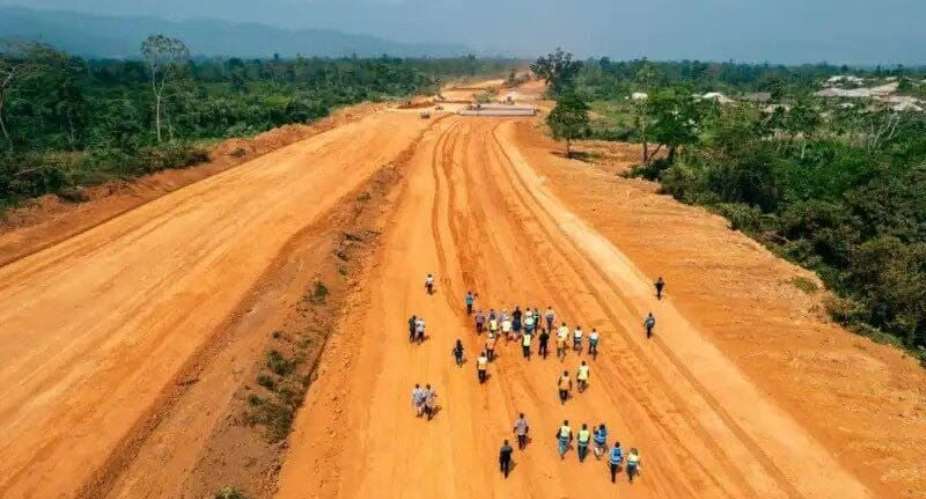
The debate over the future of the Accra-Kumasi road corridor raises an important question about Ghana's development priorities: should government preserve every available dollar for a major future infrastructure project when the existing road urgently requires attention?
The Minority Caucus in Parliament has called on government to reallocate $300 million from the $1.7 billion reportedly ring-fenced for the proposed Accra-Kumasi Expressway to undertake critical repairs on the existing Accra-Kumasi Highway.
Government's position that funds earmarked for the new expressway should be protected is understandable. Major infrastructure projects require financial discipline, and repeatedly diverting earmarked resources can delay or even derail strategic investments.
But there is another side to the argument that cannot be ignored.
The existing Accra-Kumasi Highway is one of Ghana's most important transport corridors. It connects the national capital with Kumasi and serves communities, businesses and travellers across southern and central Ghana. It is also an important artery for the movement of agricultural produce, manufactured goods, passengers and commercial traffic.
When such a strategic road deteriorates, the consequences go far beyond inconvenience.
Poor road conditions increase travel times, vehicle maintenance costs and fuel consumption. They disrupt supply chains, increase transportation costs for businesses and ultimately contribute to higher prices for consumers. More seriously, dangerous sections of a heavily travelled highway can expose motorists, passengers and communities to avoidable risks.
This is why the current debate should not be reduced to a political contest between government and opposition.
It should be treated as a question of infrastructure management and national priorities.
Ghana certainly needs modern expressways. As the population grows and economic activity expands, the country cannot continue relying indefinitely on roads designed for traffic volumes of an earlier era. A modern Accra-Kumasi Expressway could improve mobility, reduce travel times, strengthen domestic trade and support Ghana's ambition to become a regional transport and logistics hub.
That long-term vision deserves support.
But building tomorrow's expressway should not require neglecting today's highway.
Thousands of people depend on the existing road every day. Traders cannot postpone transporting their goods until a new expressway is completed. Farmers cannot wait years before moving produce to markets. Commercial drivers, businesses, students, families and emergency services must continue using the current route.
The real policy question therefore should not simply be whether $300 million should be taken from the expressway fund.
Government should urgently establish what level of investment is required to restore the most dangerous and deteriorated sections of the existing highway while protecting the financial viability of the proposed expressway.
If the required repairs can be financed from alternative sources without touching the ring-fenced fund, that option should be pursued. If alternative financing cannot be secured quickly and portions of the existing highway present serious safety or economic risks, then a carefully structured temporary reallocation deserves objective consideration.
What Ghana cannot afford is paralysis while the debate continues.
There should also be transparency. Government should clearly communicate the condition assessment of the existing highway, the estimated cost and timetable for rehabilitation, the financing arrangements for the proposed expressway and the implications of any diversion of earmarked funds.
Infrastructure planning should never force citizens to choose between maintaining what already exists and building what the country needs for the future. Responsible development requires both.
Indeed, Ghana's broader infrastructure challenge is partly a maintenance challenge. We often focus national attention on commissioning new projects while allowing existing public assets to deteriorate. Preventive maintenance may attract fewer headlines than constructing a new highway, but it protects public investment and can save enormous reconstruction costs later.
The Accra-Kumasi corridor is too important to Ghana's economy to become another victim of this pattern.
The proposed expressway represents an investment in Ghana's future. The existing highway represents the reality Ghanaians must travel on today.
We should protect the future project, but we must also protect the lives, businesses and communities depending on the current road.
Development is not only about building something new. It is also about maintaining what we already have and ensuring that today's infrastructure remains safe and functional while tomorrow's infrastructure is being built.


 'If we were wrong, we must first apologise to NPP' – Mustapha Gbande on National...
 Han SHS to get boarding status as Mahama inspects GETFund projects in Upper West
 Late herbal doctor’s wife granted GH¢100,000 bail amid poisoning, arson claims
 NDC has failed to deliver on Agenda 1-3-3 for 24-hour economy – Sam Pyne
 Wa-Bolgatanga trunk road to be asphalted – Mahama
 Gbewaa College of Education lecturer dies after alleged military assault in Pusi...
 Ghana won’t back down on mining value addition – Ambassador Kojo Bonsu
 How Dr Jesse Amuah, wife was murdered over GH¢1,500 payment dispute
 Mahama announces 20% salary incentive for health workers in deprived areas
 Ghana must move from plastic policies to implementation – EPA CEO


