




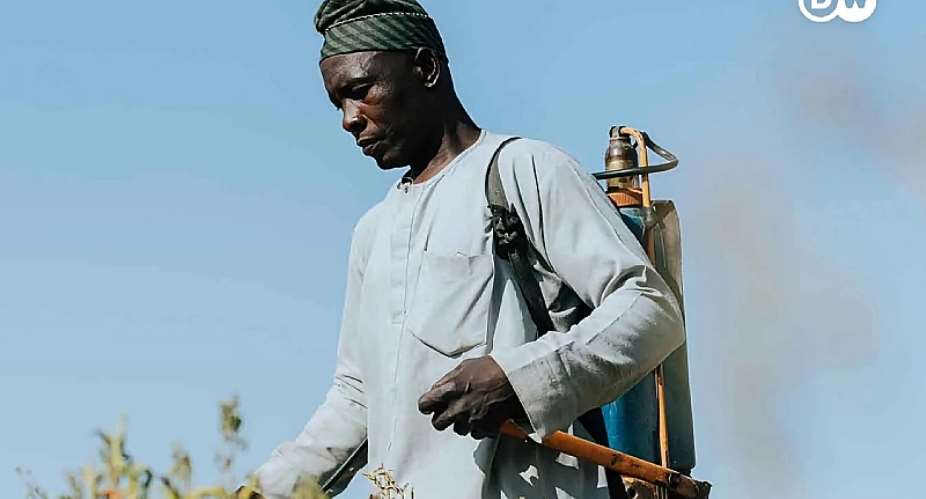
Nigeria has been ranked second in West Africa for acute pesticide poisoning among farmers and farm workers, trailing only Burkina Faso, according to a new regional study a finding that arrives alongside separate research showing pesticide residues persisting in some of the region's most commonly eaten foods.
The Numbers
The study, published in the journal Frontiers in Public Health and commissioned by the Pesticide Action Network (PAN), found that Burkina Faso recorded the highest national incidence of unintentional acute pesticide poisoning (UAPP) in the region at 83.8 percent, followed by Nigeria at 69.0 percent.
The Gambia followed at 51.5 percent, Ghana at 39.0 percent, Senegal at 30.5 percent, and Côte d'Ivoire at 20.0 percent.Averaged across the six countries studied, the research estimated that 48.9 percent of farmers and farm workers in West Africa experience unintentional acute pesticide poisoning annually.
The regional figures sit within a larger global picture. The study estimated that between 402 million and 433 million farmers and farm workers worldwide suffer cases of unintentional acute pesticide poisoning each year, with the heaviest burden concentrated in Southern Asia, followed by Southeast Asia and East Africa.
Globally, unintended pesticide poisoning is estimated to cause around 11,000 deaths annually, with nearly 60 percent of those fatalities occurring in a single country, India.
How Farmers Are Exposed
Acute poisoning among farmers and farm workers typically occurs through inhalation, ingestion, or skin contact with pesticides during mixing, spraying, or handling treated crops routes of exposure made more dangerous where protective equipment, training, and safe storage practices are limited. Nigerian data illustrates the scale of what farmers are being exposed to: over 65 percent of the active ingredients in pesticides used in the country are classified as highly hazardous, many of them already banned or severely restricted in the European Union, the United States, and parts of Asia.
According to the Nigerian Stored Products Research Institute, Nigeria uses roughly 23,400 metric tons of pesticides annually, with more than 80 percent of the products distributed to smallholder farmers already banned in the EU and US.
The consequences have already turned fatal. In 2020, more than 270 people died in Benue State after pesticide contamination of a community river a stark illustration of how hazardous agrochemical use can extend beyond individual exposure into wider environmental and public health emergencies.
Residue on the Plate
Poisoning risk does not end with the farmer. A separate, earlier regional Total Diet Study implemented by the UN Food and Agriculture Organization together with national food safety authorities in Benin, Cameroon, Mali, and Nigeria, in collaboration with the World Health Organization and the Centre Pasteur of Cameroon tested 3,696 commonly consumed foodstuffs, pooled into 308 composite samples, for up to 470 pesticide residues.
Researchers detected 39 different pesticides across 294 total occurrences, with organophosphates and pyrethroids accounting for the large majority of findings; six substances alone including chlorpyrifos and cypermethrin made up more than three-quarters of all detections. At least one pesticide was found in 45.8 percent of all samples tested.
Some of the highest concentrations turned up in unexpected places: two composite samples of smoked fish from Mali contained chlorpyrifos at levels reaching over 18,000 micrograms per kilogram, alongside multiple other pesticides a finding Malian officials later said underscored the need to raise awareness among smoked fish producers specifically.
The Trade and Economic Fallout
Pesticide residue exceeding international limits is not just a health issue it is also an economic one. Nigeria has lost an estimated $362.5 million annually due to the European Union's ban on its bean exports over excessive pesticide residue, a restriction in place since 2015, with other products including sesame seeds, palm oil, and dried fish also facing repeated rejections in export markets.
Bean samples from Nigeria have been found containing dichlorvos at up to 0.3 milligrams per kilogram thirty times the European legal limit of 0.01 milligrams.
What Governments Could Do
Civil society groups working on the issue in Nigeria have converged on a fairly consistent set of recommendations. The Alliance for Action on Pesticides in Nigeria (AAPN) has called on the National Assembly to enact a dedicated pesticide and agroecological control bill, built around full disclosure, transparency, public participation, and strong regulatory oversight.
The group has also urged lawmakers, agricultural ministries, and philanthropic organisations to actively promote safer alternatives including bio-pesticides, organic fertilisers, and agroecological practices and to integrate those alternatives directly into constituency projects, farm input support schemes, extension services, and government budget lines, rather than continuing to distribute hazardous chemicals through those same channels.
Legal advocates within the coalition have specifically flagged the practice of distributing highly hazardous pesticides through constituency projects and government-backed input schemes as a point of particular concern, noting that many recipient farmers and communities remain unaware of the long-term health risks involved.
Broader civil society calls have pushed further still, urging an immediate review and stricter enforcement of national pesticide regulations to curb the continued importation, sale, and use of highly hazardous pesticides altogether, aligned with international hazard classification systems used by the World Health Organization.
An Unresolved Tension
Underlying all of this is a tension regulators across the region have yet to fully resolve: pesticides remain central to protecting crop yields and food security for small holder farmers who form the backbone of West African agriculture, yet the same chemicals that protect harvests are simultaneously poisoning the people who apply them and, in measurable quantities, ending up on the plates of consumers who never handled a sprayer at all.
Whether governments respond with stronger import controls, expanded farmer training and protective equipment access, or a genuine push toward safer alternatives is likely to shape both public health outcomes and agricultural export competitiveness across the region for years to come.
Mustapha Bature Sallama
Medical/ Science Communicator,
Private Investigator, Criminal Investigation and Intelligence Analysis,
International Conflict Management and Peacebuilding. ( USIP)
[email protected]
+233555275880
Sources
Nigeria ranks 2nd in acute pesticide poisoning in West Africa Study, Vanguard News, September 2026.
Nigeria Enter Second For Pesticide Poisoning For West Africa As New Study Raise Concern For Farmers, Obaland Magazine, September 2026.
Nearly half of world's farmers hit by pesticide poisoning, study finds, The Eastleigh Voice, September 2026.
Almost half of the world's farmers are poisoned by pesticides every year, PAN International, September 2026.
Stakeholders Urge Action to Ban Toxic Farm Pesticides, Voice of Nigeria, 2026.
Sub-Saharan Africa total diet study in Benin, Cameroon, Mali and Nigeria: Pesticides occurrence in foods, ScienceDirect/Food Chemistry: X.
Large scale FAO Total Diet Study successfully assesses chemical residue contamination in food in Benin, Cameroon, Mali and Nigeria, Codex Alimentarius/FAO.
65% of agro pesticides in Nigerian market are hazardous, report says, BusinessDay NG.
Nigeria loses $363m annually to EU beans import ban, coalition says, Shipping Position, May 2026.
Coalition seeks end to usage of hazardous pesticides to enhance human, food safety, Peoples Gazette, July 2026.


 Ghana announces visa-free travel to Maldives, Zambia and Antigua and Barbuda
 Mahama swears in three new Supreme Court justices, urges judicial independence
 'Aren’t you over dramatising after you advised Akufo-Addo to give us ugly financ...
 Hopeson Adorye urges security agencies to investigate Obiri Boahen’s warning to ...
 'Administer justice without fear or favour, affection or ill will' — Mahama tell...
 Tema Port congestion alone cannot justify GHS12 cement price increment – GPHA
 UTAG-KNUST threatens legal action over Pro-VC and Dean appointments
 NPP is recycling failed politicians in its upcoming national executive elections...
 30,000 job creation projection for Accra-Kumasi Expressway is even conservative ...
 'You can't use profits to finance the creature comforts of management and boards...


