




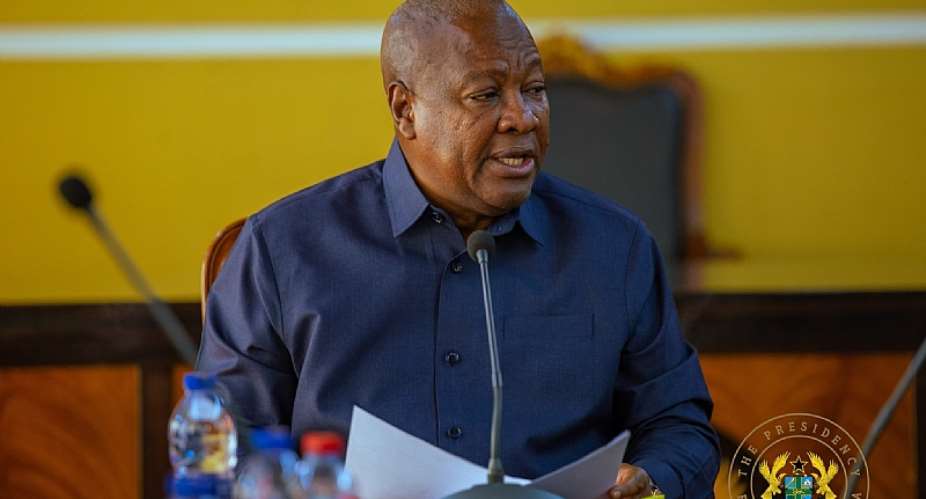
President John Dramani Mahama has said the proposed Independent Public Emoluments Commission (IPEC), which is expected to replace the Fair Wages and Salaries Commission (FWSC), will link the salaries and other compensation of chief executives and board members of state-owned enterprises (SOEs) to the performance of their institutions.
President Mahama said the proposed commission would introduce greater consistency, transparency and fairness into public sector remuneration, including compensation arrangements within SOEs.
He made the remarks on Thursday at the 2026 Governing Boards and CEOs’ Conference organised by the State Interests and Governance Authority (SIGA) in Accra.
According to the President, IPEC would provide “an opportunity to establish a more coherent, transparent, equitable and sustainable” system for determining remuneration across the public sector.
He stressed that executive compensation “cannot be determined in isolation from institutional performance” and should take into account an institution’s financial position, productivity, achievement of agreed targets, quality of services and the value it creates for the state.
The President said board chairpersons, chief executives, managing directors and management teams of SOEs and other specified entities would be expected to cooperate fully with SIGA and the FWSC during the transition to the proposed commission.
He said the officials would also be required to provide timely and accurate information on compensation, conditions of service and financial performance while complying with approved remuneration arrangements.
“No state-owned enterprise must maintain a compensation arrangement outside the established framework merely because of its corporate status or revenue-generating capacity,” he said.
President Mahama further cautioned that institutional autonomy should not be used to justify disparities in remuneration or compensation practices that lack transparency and are unrelated to performance.
He said institutional autonomy could not become “a licence for unjustified disparities, opaque compensation practices or remuneration that bears no relationship to performance.”
SOEs Record GH¢19.8bn Profit
The President’s remarks came as SIGA presented its 2025 State Ownership Report, which showed a significant turnaround in the financial performance of SOEs.
According to the report, SOEs moved from a net loss of GH¢2.26 billion in 2024 to a net profit of GH¢19.8 billion in 2025.
President Mahama welcomed the improvement but cautioned that the gains must translate into sustained operational efficiency and stronger institutional performance.
“You must not use profits that rightly belong to the Ghanaian people to finance the creature comforts of management and boards,” he told participants.
He said the proposed remuneration reforms were also intended to ensure that more profits were channelled to the state as dividends rather than being absorbed through management and board benefits.
FWSC Pilots Performance Indicators
Chief Executive Officer of the Fair Wages and Salaries Commission, Dr George Smith-Graham, disclosed that his outfit, in collaboration with the Public Services Commission, had piloted performance indicators in 15 institutions on the President’s instructions last year.
He, however, expressed concern about the level of cooperation from some chief executives, saying it “is not coming from the very top”.
Dr Smith-Graham said a security engagement involving all chief executives and led by Dr Abdul-Baasit Bamba would be held on September 25 as part of the transition process.
Mahama Cautions SOE Boards
President Mahama also called for greater discipline and clarity in the roles of boards and management of state-owned enterprises.
He cautioned board chairpersons against taking up offices within their respective entities and reporting to work every day as though they were occupying full-time executive positions.
According to him, boards should concentrate on oversight and strategic direction rather than taking responsibility for routine operational decisions, while chief executives must respect legitimate board oversight.
He said a board that interfered in day-to-day operations weakened accountability, while a chief executive who resisted legitimate oversight from the board could equally undermine the effectiveness of the institution.

 Road crashes kill about eight Ghanaians every day – Transport Minister declares ...
 Sustained performance is your real test, not one-year turnaround – Mahama to SOE...
 15,000 public health workers earn average of GH¢600 monthly— HSWU
 BECE/WASSCE results: We need honest national conversation – Afenyo-Markin
 Independent Public Emoluments Commission to tie SOE executives’ pay to performan...
 State-owned enterprises must prove value created for Ghanaians – Mahama
 Gov’t to introduce strict household waste separation regime – Mahama Ayariga
 Algeria cuts diplomatic ties with United Arab Emirates over 'provocative and hos...
 Colombia court orders President de la Espriella to hide social media videos of h...
 Account for GH¢49.7m South Africa evacuation expenditure – Minority tells Ablakw...


