




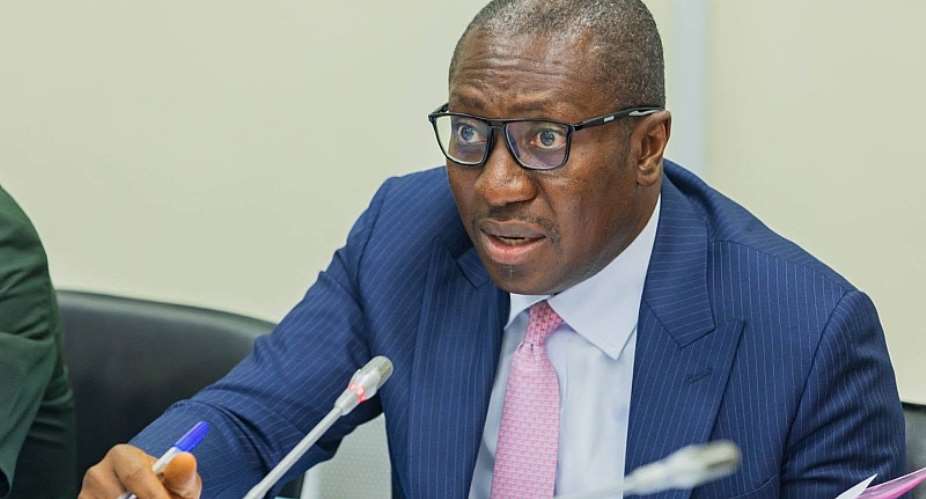
Minority Leader in Parliament, Osahen Alexander Afenyo-Markin, has called for an urgent and honest national conversation on Ghana’s education system, following concerns over the latest West African Examinations Council (WAEC) results and persistent challenges with the placement of Junior High School (JHS) graduates.
Mr Afenyo-Markin said the latest examination results should concern every Ghanaian, arguing that the performance of candidates exposed deeper weaknesses within the education system and could have serious consequences for thousands of young people.
He said 183,233 young people completed secondary education without obtaining a credit in Core Mathematics, while the credit pass rate in English Language dropped to 62.40%, its lowest level in 4 years.
According to the Minority Leader, the performance in both subjects was also below the levels recorded in 2024, making the situation one that required immediate national attention.
He said the challenges went beyond the West African Senior School Certificate Examination (WASSCE), citing difficulties surrounding the placement of Basic Education Certificate Examination (BECE) candidates into Senior High Schools (SHSs).
Mr Afenyo-Markin said 54,985 BECE candidates were initially denied automatic placement, while there were also reports of some children being wrongly placed in special schools and others arriving at their assigned schools only to discover that no space was available.
He questioned the apparent mismatch between the number of candidates seeking placement and the vacancies government says are available.
According to him, government figures indicate that there are 859,828 vacancies for 623,072 candidates, while 85 private schools participating in the Free Senior High School (Free SHS) programme also have available capacity.
He stressed, however, that the existence of a self-placement portal did not amount to providing students with actual school places.
“A self-placement portal is not a school place; every child needs an actual seat in a functioning classroom,” he said.
Mr Afenyo-Markin consequently warned that more than 200,000 young Ghanaians could potentially be left behind at different stages of the secondary education system if the challenges were not urgently addressed.
He urged the government to move beyond reacting to problems after they had attracted public attention and instead tackle the underlying weaknesses within the education system.
The Minority Leader called on the government to publish the final placement outcomes and disclose the rules and pass marks used in the placement process to promote transparency and restore public confidence.
He also advocated adequate funding for teaching and remedial programmes to support students who performed poorly in the examinations.
In addition, he called for clear pathways into technical and vocational education and training (TVET), apprenticeships and skills development for young people who failed to obtain the required WASSCE credits.
Mr Afenyo-Markin said the scale of the challenges required government to treat education as a major national crisis requiring immediate intervention and sustainable solutions.
He called for a broad national discussion on educational funding, teaching quality, contact hours, teacher motivation, learning materials, infrastructure and supervision.
According to him, the discussion must transcend partisan politics because weaknesses in the education system would ultimately affect an entire generation.
“This must rise above partisan excuses because the future of an entire generation is at stake,” he said.
Mr Afenyo-Markin also defended the record of the New Patriotic Party (NPP) in expanding access to education, citing the introduction of Free SHS, Free TVET, apprenticeship and skills-development opportunities.
He said those interventions were intended to ensure that poverty or examination results did not permanently deny any Ghanaian child the opportunity to build a future.
He maintained that the immediate priority should be finding practical solutions for the 2 groups of affected young people.
“The 54,985 BECE candidates need real school places; the 183,233 WASSCE graduates need a second chance,” he said.
The Minority Leader said the situation was placing significant pressure on parents, students and teachers and urged President John Dramani Mahama and his administration to act promptly.
He stressed that the national response should address not only the immediate placement difficulties and examination results but also the broader quality and effectiveness of Ghana’s education system.
“When our children's education is in crisis, Ghana's future is in danger. The time to act is now,” he said.

 Road crashes kill about eight Ghanaians every day – Transport Minister declares ...
 Sustained performance is your real test, not one-year turnaround – Mahama to SOE...
 15,000 public health workers earn average of GH¢600 monthly— HSWU
 BECE/WASSCE results: We need honest national conversation – Afenyo-Markin
 Independent Public Emoluments Commission to tie SOE executives’ pay to performan...
 State-owned enterprises must prove value created for Ghanaians – Mahama
 Gov’t to introduce strict household waste separation regime – Mahama Ayariga
 Algeria cuts diplomatic ties with United Arab Emirates over 'provocative and hos...
 Colombia court orders President de la Espriella to hide social media videos of h...
 Account for GH¢49.7m South Africa evacuation expenditure – Minority tells Ablakw...


